Abacus.AI Review: The Ultimate All-in-One AI Super Assistant

Overview & Purpose
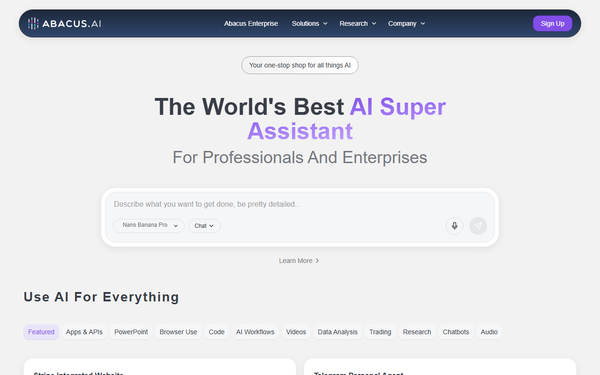
Abacus.AI is an all-in-one AI platform positioned as the world's first Super Assistant for professionals and enterprises. It seamlessly combines generative AI capabilities through ChatLLM (access to top LLMs and media generators), autonomous Deep Agent for task automation and no-code app building, Abacus AI Desktop for productivity, and a full enterprise-grade MLOps platform for traditional machine learning tasks. Primary use cases span predictive modeling, demand forecasting, anomaly detection, fraud detection, sentiment analysis, personalized recommendations, custom AI chatbots, data analysis, report generation, workflow automation, video/image creation, and rapid application development. It enables users to embed cutting-edge AI into professional workflows or enterprise applications without managing multiple tools or infrastructure.
The target audience includes developers, data scientists, marketers, business analysts, and enterprise teams across industries such as finance, e-commerce, healthcare, and SaaS. It appeals to professionals seeking productivity boosts and organizations needing scalable, customizable AI solutions that integrate with existing systems like Slack, Google Drive, or Confluence.
Key Features & Capabilities
Core functionality revolves around three pillars: (1) ChatLLM for conversational access to frontier models (including GPT-5.x variants, Claude Sonnet/Opus, Gemini, Grok, Llama, and image/video generators like Kling, Veo, Flux); (2) Deep Agent, a multi-skilled autonomous agent that thinks, acts, researches, builds apps/websites, automates workflows, analyzes data, and generates reports or media; and (3) the Enterprise Platform with end-to-end MLOps, including dataset management, AutoML for predictive modeling, time-series forecasting, anomaly detection, personalization engines, and API deployment via Python SDK and REST APIs.
Standout features that differentiate it from competitors include unrestricted access to dozens of premium LLMs plus generative media tools in a single $10–20/user/month subscription (far cheaper than separate ChatGPT Plus + Claude + Midjourney accounts), no-code Deep Agent for turning prompts into production apps or automated workflows (with one-click deployment and integrations), Company Knowledge for private data grounding, and seamless blending of generative agents with traditional ML pipelines. Enterprise readiness features security, compliance, custom fine-tuning, and scalable hosting.
Limitations include an opaque credit-based usage system (500–1,000 credits per complex Deep Agent task; no clear per-model rates upfront), restricted Deep Agent tasks on the Basic tier, occasional agent looping or hallucinations that waste credits, and less emphasis on raw GPU control for ultra-specialized research workloads compared to dedicated platforms like RunPod or Vertex AI.

User Experience
The platform offers a low learning curve for basic ChatLLM conversations and document analysis, making it accessible for non-technical professionals. However, leveraging Deep Agent for complex automations or the full MLOps suite involves a moderate-to-steep learning curve, especially for non-developers navigating tool connections or workflow breakdowns. The interface is modern and web-based (with desktop app options) but has been described by some users as a "labyrinth" or overwhelming due to the breadth of features and scattered sections.
Documentation is comprehensive and high-quality, with dedicated how-to guides, prompting tips, SDK references, and troubleshooting at abacus.ai/help. Support resources include email ([email protected]), in-app billing/help, and community YouTube tutorials; however, response times are frequently cited as slow in user reviews.
Performance & Reliability
ChatLLM responses and basic tasks are fast and efficient, with generous token limits (often described as 10x more than competitors). Deep Agent completes typical tasks (app building, research reports, data analysis) in 5–25 minutes with real-time web access and tool integrations. The underlying MLOps handles enterprise-scale training and inference reliably for predictive use cases.
Common complaints include Deep Agent getting stuck in repetitive loops (wasting credits without useful output), sudden credit exhaustion mid-task, occasional hallucinations in research or code generation, and account lockouts on heavy usage. Reliability is strong for standard workloads but less consistent for mission-critical, unsupervised agent runs. No major outages reported as of March 2026 research, though users advise monitoring long tasks.

Pricing & Value
Abacus.AI offers a transparent yet credit-augmented model:
- Basic tier: $10 per user per month (20k credits included, 3 limited-complexity Deep Agent tasks).
- Pro tier: $20 per user per month (additional credits, unrestricted Deep Agent access).
- Enterprise: Starts at $5,000/month with custom scaling, dedicated support, and advanced features. App/database hosting and heavy data transfer use additional credits beyond generous free tiers (up to 25k credits/month). First-month discounts are common.
Value is exceptional compared to alternatives (e.g., separate subscriptions for ChatGPT, Claude, Midjourney, and an MLOps tool like SageMaker), delivering frontier models, agents, and production ML deployment at a fraction of the cost. The proposition shines for teams needing breadth rather than hyper-specialization, though unpredictable credit burn can erode value for very heavy or experimental users.
Practical Tutorial
A common enterprise task is building a predictive model (e.g., demand forecasting or churn prediction) using the platform's AutoML capabilities. This leverages the original strengths of Abacus.AI and integrates seamlessly with ChatLLM/Deep Agent outputs.
Step-by-step walkthrough (based on official Python SDK and Enterprise Platform flows; full details in docs):
- Sign up at abacus.ai/app/signup and verify your account (free trial credits available).
- Navigate to the dashboard and create a new Project → Select "Predictive Modeling" (or "Forecasting" for time-series).
- Upload your dataset (CSV/Excel; e.g., historical sales data with features like date, product, region, promotions). The platform auto-detects schema and handles cleaning/feature engineering suggestions.
- Choose your target column (e.g., "demand_next_week") and use case. Abacus.AI automatically selects algorithms, runs hyperparameter tuning, and compares models (no manual coding required).
- Review model metrics (accuracy, feature importance) in the UI. Optionally refine via ChatLLM prompt: "Improve this forecasting model with external weather data."
- Deploy the model as an API endpoint or integrate into Deep Agent workflows (e.g., "Use this model to generate weekly reports in Slack").
- Monitor predictions in production and scale via the Python SDK if needed:
from abacusai import AbacusAI client = AbacusAI(api_key='your_key') client.predict('your_model_id', data={'features': [...]}) - Test and iterate: Export results or embed the API into your app.
For visual no-code alternatives, use Deep Agent by prompting: "Build a demand forecasting dashboard from this CSV and deploy it." Official tutorials and videos are available at abacus.ai/help and the platform's YouTube playlist for deeper customization.
Final Verdict
Overall rating: 8.5/10 (excellent value and breadth, docked for credit opacity and occasional agent instability).
Professionals, developers, and enterprises should use this tool for its unmatched all-in-one affordability, rapid automation, and production-ready ML integration that accelerates decision-making and application development. Avoid it if you require perfectly predictable costs, zero-tolerance for agent hiccups, or a dead-simple interface for absolute beginners.
One-sentence recommendation: Abacus.AI delivers tremendous power and productivity at an unbeatable price—ideal for any team ready to replace multiple AI subscriptions with a true Super Assistant.