Abridge Review: The Best Enterprise AI Scribe for Epic Users

Overview & Purpose

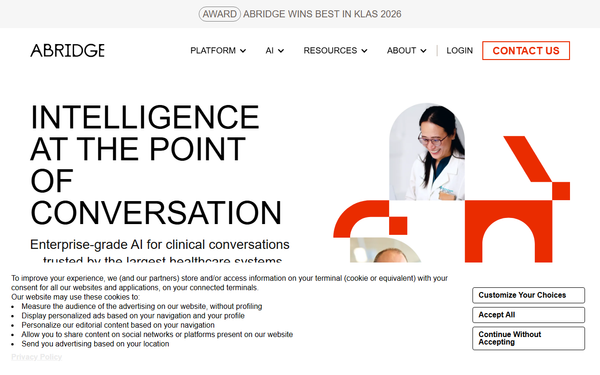
Abridge is an enterprise-grade generative AI platform that captures patient-clinician conversations in real time and automatically transforms them into structured, clinically accurate, billable, and auditable notes. Its primary use cases include ambient clinical documentation for physicians and nurses, revenue-cycle optimization (such as real-time prior authorization and billing-code alignment), and generating patient-friendly visit summaries. The tool reduces administrative burden by integrating directly into major electronic health record (EHR) systems—most notably Epic—without requiring clinicians to leave their existing workflows.
Target audience is large healthcare systems, clinicians across multiple specialties and care settings (outpatient, inpatient, emergency), nurses, and revenue-cycle teams. It is not designed for individual developers, marketers, designers, or small independent practices; deployment occurs at the organizational level through enterprise contracts. As of March 2026, Abridge is trusted by major institutions including Mayo Clinic, Kaiser Permanente, Johns Hopkins Medicine, Duke Health, and others. It also offers patient-facing features via Patient Visit Summaries (PVS) written at an 8th-grade reading level and a companion consumer-oriented experience to help patients review and understand their care plans.
Key Features & Capabilities
Core functionality centers on ambient listening: clinicians record conversations via the Abridge for Clinicians mobile app or web interface, after which the AI generates a full SOAP-style note draft. The standout differentiator is the proprietary Contextual Reasoning Engine, which pulls in prior patient data, health-system guidelines, clinician preferences, and real-time context to produce notes that are not only accurate but also predictive (e.g., suggesting orders) and compliant. Additional capabilities include Linked Evidence (click any note sentence to jump to the exact audio/transcript source), multilingual support, multi-specialty adaptability, real-time prior-authorization processing, and automatic billing-code alignment.
Patient-side features include auto-generated PVS that can be copied into the EHR or shared directly, helping patients stay informed without extra clinician effort. The platform supports nursing documentation and scales across thousands of users.
Compared with competitors such as Nuance DAX Copilot or Suki, Abridge stands out for its deep Epic-native integration (Haiku to Hyperdrive) and auditability via Linked Evidence, plus recent wins as #1 in KLAS Ambient AI categories for 2025 and 2026. Limitations include its enterprise-only model (no self-serve signup or free tier), heavier reliance on Epic than on other EHRs (Athenahealth integration is newer), and the requirement for organizational IT deployment, which can take weeks to months. It does not yet replace human oversight entirely—clinicians must review and edit drafts, especially in highly specialized or behavioral-health contexts.

User Experience
Ease of use is high once deployed: recording is as simple as tapping a button in the mobile app or web editor, with natural conversation flow and no need to dictate commands. The learning curve is minimal for clinicians already using Epic; most report seamless adoption within days. The interface is clean and intuitive—notes appear in a familiar web editor with side-by-side transcript syncing and clickable evidence links; the Patient Visit Summary tab is clearly separated for quick patient communication.
Documentation is excellent via the official support portal, which includes step-by-step articles and best-practice guides. Enterprise customers receive dedicated implementation support, training, and ongoing account management. Overall interface quality earns praise for fitting existing workflows without friction.

Performance & Reliability
Note generation is fast—drafts appear seconds after recording ends—and processing scales reliably across large health systems. Accuracy is among the highest in the category thanks to the Contextual Reasoning Engine and clinician-in-the-loop validation; Linked Evidence virtually eliminates “black-box” concerns. Real-world outcomes include 78 % reduction in cognitive load, 86 % less after-hours documentation, and 53 % improvement in professional fulfillment.
Known issues are minor and improving: some clinicians note occasional need for editing in complex medical-decision-making sections or specialized fields (e.g., behavioral health), rare omissions of spoken details if audio quality is poor, and early integration hiccups with certain Epic smartphrases (largely resolved by 2025–2026 Epic updates). Hallucinations are infrequent and stylistic rather than clinical. Reliability is bolstered by HIPAA compliance, 256-bit encryption, U.S.-based data centers, and enterprise governance tools. User feedback on platforms such as Reddit and industry reports consistently ranks Abridge ahead of peers for note quality in Epic environments.
Pricing & Value
Abridge does not publish public pricing and operates exclusively on custom enterprise contracts negotiated with health systems. Industry estimates place costs at approximately $200–$250 per clinician per month (roughly $2,500 per year), with full implementations potentially higher depending on scale, integration depth, and add-ons. There is no free tier, trial for individuals, or per-minute billing—pricing is subscription-based at the organizational level.
Value proposition is strong for large systems: ROI comes from measurable reductions in clinician burnout, after-hours work, and documentation time (often 2+ hours per day saved), plus improved revenue capture through better billing compliance and real-time prior authorizations. Compared with alternatives, Abridge’s deeper contextual accuracy and Epic integration often justify the premium over lighter or cheaper scribes (e.g., Suki at ~$59–$299/mo or Nuance DAX). Smaller practices or solo clinicians will find the cost and deployment model prohibitive.
Practical Tutorial
Abridge provides official documentation and video demos; the following is a real-world walkthrough for the most common task—recording a patient encounter and generating/sending a note plus Patient Visit Summary—based on the current support guide (as of March 2026).
Step 1: Prepare and Record (Mobile or Web)
Download the free Abridge for Clinicians app (iOS) or go to notes.abridge.com on a laptop. Obtain patient consent (required). Select the patient from your worklist or tap “+” and label the recording with first/last name. Tap the red record button and conduct the visit naturally. When finished, tap “Create Note” (mobile) or pause then “Create Note” (web).
Example: In a primary-care visit for a patient with hypertension and new knee pain, simply speak as usual—no special commands needed. The AI captures history, exam, assessment, and plan.
Step 2: Review and Edit in the Web Editor
Return to notes.abridge.com. Click the visit in the sidebar; the AI-generated note appears instantly. Edit like a standard document. Use Linked Evidence: highlight any sentence to instantly see the synced transcript and audio segment. Open the “Patient Summary (PVS)” tab to review the plain-language version (8th-grade level) and make minor edits.
Step 3: Finalize and Share
Click “Send Note” to push the clinical note directly into Epic (or copy/paste if manually added). Copy the Patient Visit Summary and share via patient portal, print, or EHR note. Patients receive clear after-visit instructions without extra clinician work.
For visual guidance, see the official support article or CEO demo videos on YouTube. Full documentation is available at support.abridge.com.
Final Verdict
Overall rating: 4.7/5. Large health systems and Epic-using organizations with 50+ clinicians should use Abridge because it delivers proven burnout reduction, superior contextual accuracy, seamless integration, and measurable ROI at enterprise scale. Small practices, solo physicians, or those on non-Epic EHRs should avoid it due to the lack of self-serve access, higher relative cost, and longer deployment timeline.
Abridge is the gold-standard ambient AI scribe for forward-thinking health systems ready to invest in clinician well-being and documentation excellence at scale.