AgentDock Review: Build and Deploy Production-Ready AI Agents
Overview & Purpose

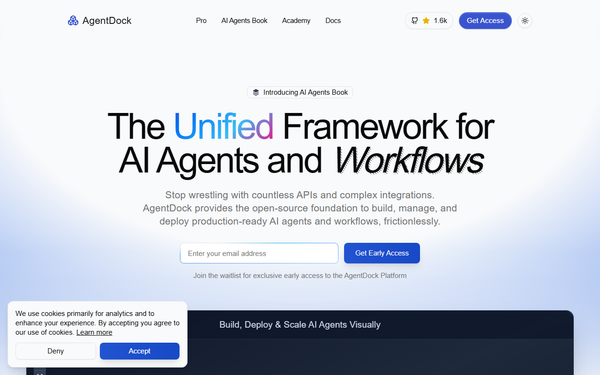
AgentDock is an open-source framework (AgentDock Core) paired with a forthcoming cloud platform (AgentDock Pro) that enables businesses and developers to build, manage, and deploy production-ready AI agents and automated workflows. It unifies access to multiple AI model providers, eliminates the need to manage disparate APIs, billing cycles, and rate limits, and provides both code-first extensibility and visual tools for orchestration. Primary use cases include automating repetitive business processes such as resume screening, compliance monitoring, customer support routing, marketing content generation, lead research, and data analysis across departments like HR, finance, legal, and sales.
The platform targets a broad audience: developers and engineers who value framework-agnostic, self-hostable open-source tools; non-technical users and teams via Pro’s natural-language and visual interfaces; and enterprises seeking scalable, cost-controlled AI automation without vendor lock-in. As of March 6, 2026, the Core is fully available via GitHub, while Pro remains in early-access waitlist mode with unified infrastructure features.
Key Features & Capabilities
Core functionality revolves around a modular node-based architecture where every capability (LLM calls, tools, orchestration logic) is a reusable node. Users can create agents via natural language descriptions (in Pro) or JSON templates and code (in Core), connect them into complex workflows with event triggers, conditional logic, persistent memory, and knowledge integration, and deploy with configurable determinism for reliability.
Standout differentiators include:
- Framework- and provider-agnostic design supporting OpenAI, Claude, Gemini, Grok, and others with automatic failover in Pro.
- Unified billing and infrastructure that dramatically reduces API management overhead and costs.
- Open-source Core (MIT license) for full customization and self-hosting, plus a reference Next.js client.
- Enterprise-grade features in Pro such as persistent memory, SLAs, and over 1,000 app integrations referenced in early reviews.
Limitations include the current waitlist for Pro’s full visual builder and cloud features, sparse public documentation on advanced enterprise integrations or security beyond an initial audit, and a reliance on users configuring their own LLM API keys in the open-source version. No native mobile apps or extensive pre-built agent marketplace exist yet, and some reviewers note that certain Pro elements still feel “less polished” due to the platform’s relative newness.
User Experience
The interface earns high marks for accessibility. The open-source client offers a clean web-based chat and agent management dashboard that non-technical users can navigate after minimal setup. Natural-language agent creation in Pro promises “describe what you want” simplicity, while the visual node-based builder handles complex logic without deep coding. Early testers describe it as “impressive” and “user-friendly” for rapid prototyping.
The learning curve is moderate: developers familiar with Node.js and JSON can be productive quickly via templates, but mastering conditional orchestration and custom nodes takes time. Documentation is solid at the introductory and GitHub levels but still evolving, with referenced “Getting Started” guides and an AI Agents Book. Community support exists via Discord, X (@agentdock), and GitHub issues; Pro will add enterprise SLAs. Overall, the experience feels modern and frictionless once installed, though the Pro waitlist delays full no-code access.
Performance & Reliability
AgentDock Core is built for production with session management, evaluation frameworks (rule-based, LLM judges, NLP), and stateful Redis-backed storage, delivering reliable multi-step reasoning and tool calling. Pro promises automatic failover and predictable scaling. Early reviews highlight significant productivity gains—e.g., reducing manual task time and operational bottlenecks—with agents handling real-world workloads like lead enrichment or report generation efficiently.
No widespread performance complaints or outages appear in public forums or GitHub issues as of March 2026. Common industry AI-agent challenges (hallucinations, tool failures) are mitigated by configurable determinism and evaluation tools, but users must still tune prompts and monitor costs. Reliability is strong for self-hosted setups; cloud Pro SLAs are forthcoming.
Pricing & Value
AgentDock Core is completely free and open-source (MIT). AgentDock Pro pricing is not yet public—users join the waitlist at agentdock.ai for early access and potential free credits at launch. The platform emphasizes “transparent, predictable pricing” and cost savings through consolidated API access and unified billing, with enterprise options expected to include custom SLAs.
Value is compelling compared to fragmented alternatives (e.g., raw LangChain setups or proprietary platforms): free self-hosting eliminates lock-in, while Pro’s infrastructure layer reduces engineering overhead and unpredictable LLM bills. Organizations avoiding vendor dependency and seeking hybrid open/cloud flexibility will find strong ROI; those needing immediate detailed pricing or fully mature SaaS may wait for broader release.
Practical Tutorial
A complete, official tutorial is available for the open-source Core and Client. Below is a step-by-step walkthrough for a common task—building a simple weather + web-search AI agent—based directly on the documented process (tested via self-hosting as of March 2026). Full guide: https://hub.agentdock.ai/docs/getting-started and GitHub repo.
-
Prerequisites
Install Node.js ≥ 20.11.0, pnpm ≥ 9.15.0, and Docker (recommended for Redis state). -
Clone and Install
git clone https://github.com/AgentDock/AgentDock.git cd AgentDock corepack enable pnpm install -
Start Stateful Services (Recommended)
docker compose up -d -
Configure Environment
cp .env.example .env.localAdd your LLM keys (e.g.,
OPENAI_API_KEY=sk-...) and set Redis storage:KV_STORE_PROVIDER=redis REDIS_URL="redis://localhost:6380" -
Create Your Agent Template
Create directoryagents/weather-search-agent/and filetemplate.json:{ "version": "1.0", "agentId": "weather-search-agent", "name": "Weather & Research Assistant", "description": "Answers weather questions and performs web searches", "personality": [ "You are a helpful assistant that provides concise answers.", "Use the weather tool for current conditions and forecasts.", "Use the search tool for any other information." ], "nodes": ["llm.openai", "weather", "search"], "nodeConfigurations": { "llm.openai": { "model": "gpt-4o-mini", "temperature": 0.7 }, "weather": { "maxResults": 5 }, "search": { "maxResults": 8 } }, "chatSettings": { "historyPolicy": "lastN", "historyLength": 50, "initialMessages": ["Hello! Ask me about weather or any topic."] } } -
Run and Test
pnpm devOpen http://localhost:3000/chat?agentId=weather-search-agent
Test prompts: “What’s the weather in New York?” or “Search for latest AI news.” -
Deploy for Production
pnpm build && pnpm startDeploy the built Next.js app to any Node host with Redis.
This creates a fully functional, stateful agent in under 10 minutes. For Pro’s visual builder (once accessed), the process simplifies further to natural-language description + drag-and-drop nodes.
Final Verdict
8/10 – A highly promising hybrid open-source/cloud platform that delivers on flexibility and simplicity for AI agent development.
Developers, startups, and enterprises wanting customizable, cost-efficient, production-ready agents without lock-in should adopt it immediately via the free Core (and join the Pro waitlist). Teams needing a fully polished, immediately available no-code SaaS with transparent upfront pricing or extensive pre-built templates should wait for broader Pro release or explore more mature alternatives.
Highly recommended for any team serious about building scalable AI workflows today.