AI Bingo Review: Test Your Skills at Spotting AI Art Models
Overview & Purpose
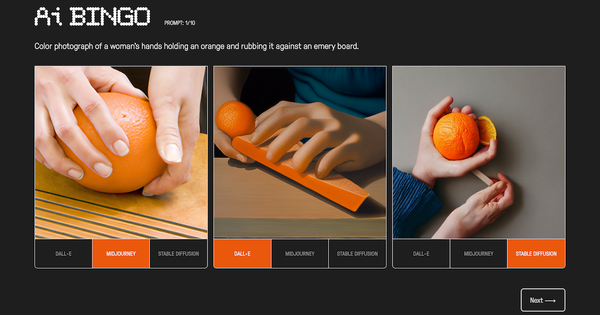
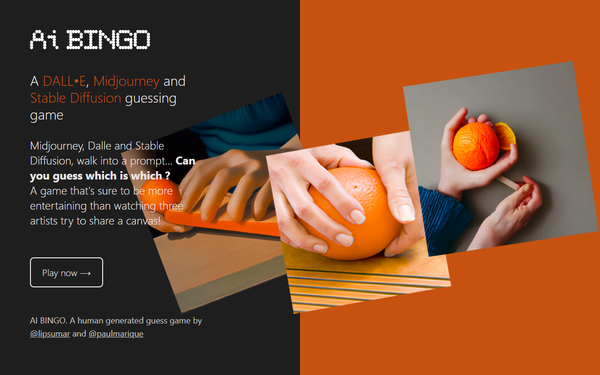
AI Bingo is a free, browser-based guessing game that challenges players to distinguish between images generated by three leading AI art models—Midjourney, DALL•E, and Stable Diffusion—using identical text prompts. The core premise is simple yet engaging: Midjourney, DALL•E, and Stable Diffusion “walk into a prompt,” and players must guess “which is which” by identifying the originating model for each image. It positions itself as “a game that’s sure to be more entertaining than watching three artists try to share a canvas,” turning passive observation of AI art into an active, competitive visual Turing test.
Primary use cases include casual entertainment, educational exploration of AI stylistic differences (e.g., Midjourney’s artistic flair, DALL•E’s crisp photorealism, or Stable Diffusion’s occasional artifacts), and friendly competition with friends or online. As of research conducted on April 11, 2026, the tool remains a lightweight, no-signup web experience hosted at https://ai-bingo.lipsumar.io/, created by @lipsumar and @paulmarique.
Target audience encompasses AI art enthusiasts, digital designers, marketers experimenting with generative tools, developers curious about model behaviors, and anyone interested in the evolving aesthetics of AI-generated imagery. It appeals particularly to hobbyists who already use these models and want to sharpen their ability to recognize their unique “fingerprints.”
Key Features & Capabilities
Core functionality revolves around multiple rounds where players are presented with a shared prompt and three corresponding images (one from each model). The task is to correctly match or identify which image belongs to Midjourney, DALL•E, or Stable Diffusion. Real-time scoring tracks accuracy, often providing per-model performance breakdowns (e.g., “7/10 DALL•E”).
Standout features include:
- Educational style recognition: Forces direct comparison of subtle differences in composition, lighting, detail, and artifacts across models.
- Bingo-inspired structure: Many descriptions reference a 3x3 grid format or progressive rounds that mimic bingo for added engagement and replayability.
- No barriers to entry: Instant play in any modern browser, mobile-friendly, zero registration or downloads.
- Competitive and social elements: Shareable scores for playing with friends or in communities like Reddit’s r/midjourney.
Differentiators from competitors (such as passive AI art galleries or style-comparison tools) lie in its gamified, active testing format—turning knowledge of AI quirks into a fun challenge rather than static viewing. Unlike broader AI directories or generators, it focuses purely on discernment and learning.
Limitations include restriction to only these three models (no Flux, Leonardo, or others), potential repetition once styles become familiar, and reliance on the models’ current versions (styles evolve rapidly with updates like DALL•E 3 or Midjourney V7). No advanced customization, leaderboards, or multiplayer modes are prominently featured. Some directory listings mention features like adaptive difficulty or language support, but these appear to be generic extrapolations not confirmed on the core site.
User Experience
The interface is intentionally minimalist and intuitive, with a low learning curve—most players can jump in and understand the rules within seconds via the prominent “Play now” call-to-action. Navigation centers on the game grid or round-based prompts and images, with simple click-to-select or drag-to-match mechanics for assigning models. Real-time feedback on correct/incorrect guesses keeps momentum high.
Interface quality feels clean and modern, optimized for quick loading even on modest connections, with clear visuals that let the AI images take center stage. Mobile compatibility is strong, allowing play on phones or tablets without friction. No complex menus or overwhelming options clutter the experience.
Documentation and support resources are minimal by design—this is a straightforward game rather than a professional tool. The creator’s social handles (@lipsumar) provide informal community touchpoints, and early Reddit discussions from the game’s launch offer player tips. No formal user manual or video tutorials appear on the site, but the self-explanatory gameplay reduces the need for them.
Performance & Reliability
As a lightweight web application, AI Bingo loads and runs efficiently in standard browsers, with prompt-image sets generating or displaying near-instantly. Gameplay feels responsive, and scoring updates occur seamlessly without lag reported in user discussions.
Known issues are rare; searches across Reddit, directories, and social mentions (as of April 2026) reveal no widespread complaints about downtime, bugs, or broken image loading. Occasional player frustration stems from the inherent difficulty—AI models have grown more similar over time, making distinctions challenging rather than site-specific problems. Internet connectivity is required, as expected for a dynamic image-heavy experience. Overall reliability is high for a niche entertainment tool, with consistent uptime inferred from ongoing directory listings and community references.
Pricing & Value
AI Bingo is completely free with no tiers, ads, or paywalls. There are no enterprise options, subscriptions, or in-app purchases—play is unlimited and unrestricted.
Value proposition is excellent for its niche: zero cost delivers immediate educational entertainment and insight into AI art ecosystems that might otherwise require separate subscriptions to Midjourney, DALL•E (via ChatGPT), or Stable Diffusion instances. Compared to alternatives like static comparison galleries or paid AI courses, it provides hands-on practice at no expense. The only “cost” is time invested in learning model quirks, which pays dividends for frequent AI image users.
Practical Tutorial
No official video tutorials or in-depth guides are hosted on the site, but gameplay is straightforward. Here is a step-by-step walkthrough for a common task—completing a full game session and reviewing your results (based on consistent descriptions across sources as of April 2026):
- Visit https://ai-bingo.lipsumar.io/ in any browser and click the prominent “Play now ⟶” button to launch the game instantly (no account needed).
- The game begins with an introductory round or 3x3 grid. A text prompt appears (e.g., “a futuristic cyberpunk city at dusk”), followed by three AI-generated images displayed side-by-side or in positions to match.
- For each image (or across the grid), select or assign the model you believe created it: click/tap the label for Midjourney, DALL•E, or Stable Diffusion. Some versions allow dragging images to model slots for matching.
- Submit your guesses for the round. Immediate feedback highlights correct matches in green and reveals the true origins, often with a running score (e.g., accuracy percentage per model).
- Continue through multiple rounds (typically 9–10 for a full “bingo” session). Prompts vary in complexity to test different stylistic strengths.
- At the end, review your overall score, per-model accuracy (e.g., “8/10 Midjourney”), and any insights into why certain models were harder to identify. Share your results via screenshot or link for social bragging rights.
- Restart for a new session—fresh prompts and images ensure replayability.
This process typically takes 5–10 minutes per full game. For community examples, search Reddit for user-shared scores from similar sessions (e.g., early posts noting Midjourney’s distinctive style).
Final Verdict
Overall rating: 4.5/5 – A delightfully simple yet addictive gem that punches above its weight in entertainment and educational value.
Who should use this tool: AI art enthusiasts, digital designers, marketers, and curious creatives who want a quick, free way to train their eye on model-specific aesthetics while having fun—especially those already experimenting with Midjourney, DALL•E, or Stable Diffusion.
Who should avoid this tool: Users seeking deep technical analysis, multi-model support beyond these three, competitive leaderboards, or offline play; it’s too lightweight and entertainment-focused for professional training or enterprise needs.
One-sentence recommendation: If you love AI art and want to test (and improve) your ability to spot the differences between Midjourney, DALL•E, and Stable Diffusion in under 10 minutes, dive into AI Bingo—it’s free, fast, and surprisingly insightful.