Discover 2,150+ Free AI Tools with Ai Library Review
Overview & Purpose
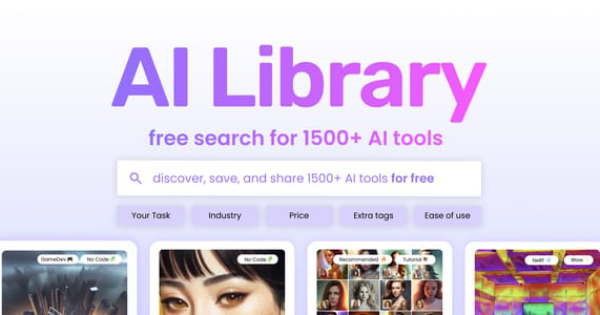
AI Library at https://library.phygital.plus/ is a free, comprehensive catalog and discovery platform that aggregates over 2,150 AI tools, neural networks, Google Colab notebooks (colabs), educational materials, and related resources. Launched in March 2023 as part of the Phygital+ ecosystem, its primary purpose is to serve as a centralized, up-to-date database for generative AI developments, with a strong emphasis on creative applications such as graphics, design, art, 3D modeling, video, and game development.
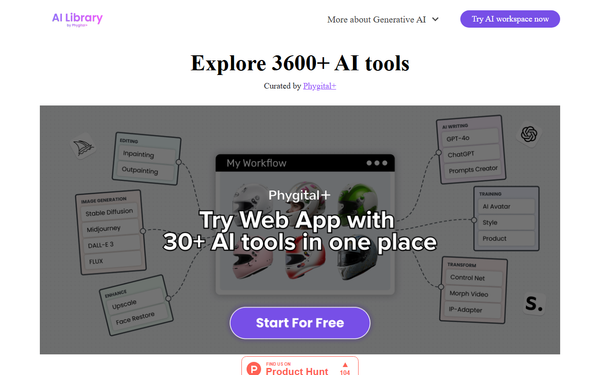
Users explore tools through semantic search (which understands contextual meaning rather than relying solely on keywords) and customizable filters, making it easy to discover solutions without scattered web searches. Primary use cases include finding ready-to-run Colabs for experimenting with models like Stable Diffusion, locating prompting guides, identifying image/video generators, or sourcing educational content on training custom AI avatars. The target audience spans developers, designers, artists, game developers, marketers, content creators, and AI enthusiasts who work with visual or generative content. It complements the paid Phygital+ workspace (phygital.plus), which integrates 30+ AI tools into a unified node-based environment, while the Library itself remains fully free and focused purely on discovery.
Research conducted as of April 13, 2026.
Key Features & Capabilities
Core functionality revolves around semantic search and advanced filters to browse the extensive collection of neural networks, standalone tools, executable Colabs, and educational resources. Standout features include daily updates to keep pace with the rapidly evolving AI landscape, a dedicated "What's New" section, tool submission form for community contributions, and categorized educational materials covering prompting, model training, and workflows. The platform's inclusion of Google Colabs sets it apart from many directories by providing direct links to runnable notebooks for hands-on experimentation with open-source models.
Differentiation comes from its creator-centric focus (graphics, CG, and art) and semantic search, which delivers more intuitive results than keyword-only competitors like Futurepedia or There's An AI For That. It also maintains a clean separation between discovery (Library) and execution (Phygital+ workspace), avoiding bloat. Limitations include the lack of built-in execution or unified credits—users must navigate to external sites or Colabs, which may require accounts, API keys, or GPU resources. Some links to rapidly changing tools can occasionally become outdated despite curation efforts, and there are no native user ratings or in-depth comparisons within the catalog itself.
User Experience
The platform offers a low learning curve, making it accessible even for beginners in AI. Navigation feels intuitive for a modern directory: a prominent search bar powered by semantic understanding, sidebar filters (by type, cost, category, or format like "Colab"), and clean result cards with descriptions, links, and tags. Interface quality is professional and minimalist, optimized for quick browsing without distractions.
Documentation is solid, with an FAQ explaining the Library's connection to Phygital+, plus linked tutorials and use cases (many hosted on docs.phygital.plus). Support is available via email ([email protected]) or the contact form. Community feedback highlights it as a time-saving "discovery hub" that eliminates the need to jump between sites.
Performance & Reliability
As a lightweight catalog, search and page loading are fast and efficient, with semantic results delivering relevant tools even for vague or natural-language queries. Reliability is high thanks to regular updates and community submissions, though it depends on external tool maintainers for long-term link accuracy. No widespread outages or performance complaints appear in reviews or forums as of April 2026. Common user notes (from Product Hunt and Reddit discussions) praise its value in tracking new releases, with minimal gripes limited to occasional broken external links—typical for any AI directory.
Pricing & Value
AI Library is completely free with no tiers, paywalls, or required accounts for core browsing and discovery. There are no premium upsells within the Library itself; paid options exist only in the separate Phygital+ workspace for integrated tool usage.
The value proposition is excellent for budget-conscious users: it provides a vast, searchable repository that rivals paid directories while remaining open and community-driven. Compared to alternatives like Futurepedia (which offers similar listings but often behind premium features), AI Library stands out for its Colab focus, semantic search, and creator-specific curation—all at zero cost. It delivers high ROI for anyone who frequently experiments with new AI creative tools.
Practical Tutorial
A common task is discovering and accessing a Colab for experimenting with a specific model, such as Stable Diffusion image-to-image generation. Here is a step-by-step walkthrough (based on the platform's documented capabilities and use cases):
-
Visit https://library.phygital.plus/ and use the main semantic search bar. Type a natural-language query like "Stable Diffusion image to image Colab free" or "custom AI avatar training notebook."
-
Review instant semantic results. The platform surfaces contextually relevant tools, Colabs, and educational guides even if exact keywords aren't present.
-
Apply filters on the left sidebar: select "Colab" under type/format, "Free" under pricing, and relevant categories like "Image Generation" or "Stable Diffusion." You can further refine by date added or tags like "open-source."
-
Click on a promising result card to view details, including a short description, direct Colab link, author notes, and related educational materials (e.g., prompting tips or training guides).
-
Open the linked Google Colab notebook (you'll need a free Google account and may require a runtime with GPU). Follow any embedded instructions—many include sample prompts or one-click setup.
-
For deeper learning, navigate to the Education or Tutorials section (linked from the main nav) or explore use-case pages like "Concept from sketch" or "Train on style" for real-world examples.
Official video overview: https://www.youtube.com/watch?v=LO7cnffZc9A. Additional Phygital+-linked tutorials for workflows discovered via the Library are available at docs.phygital.plus/tutorials.
Final Verdict
Overall rating: 4.7/5. AI Library excels as a free, specialized discovery tool for creative AI, earning strong praise as an efficient single hub that saves hours of research.
Creators, designers, game developers, and AI experimenters should use it to stay current on tools and Colabs without cost or hassle. Avoid it if you need seamless, integrated execution of multiple tools in one workspace (opt for Phygital+ paid plans instead) or prefer heavily reviewed/rated general AI directories.
Highly recommended for anyone building a creative AI toolkit—one of the best free resources for staying ahead in generative content creation.