Aimlapi Com Review: One API for 400+ AI Models and Easy Integration

Overview & Purpose

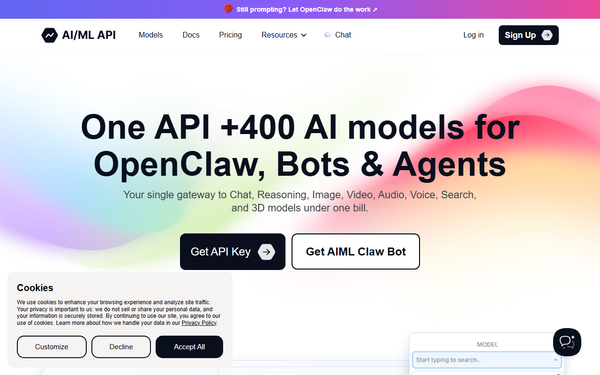
AI/ML API (aimlapi.com) is a unified API gateway providing access to over 400 AI models spanning chat, reasoning, image generation, video, audio, voice, search, embeddings, and 3D capabilities from providers including OpenAI, Google, Anthropic, xAI, Alibaba, and others. It serves as a single endpoint for developers to integrate diverse AI functionalities into applications, with full OpenAI SDK compatibility—allowing a switch from services like OpenAI by simply changing the base URL to https://api.aimlapi.com/v1.
Primary use cases include rapid prototyping and MVP development, production-scale AI agents or bots, autonomous assistants, and high-volume workloads where model experimentation or switching is needed without managing multiple vendor accounts. The platform targets primarily developers, startups, indie hackers, and enterprises building AI-powered products, offering a serverless infrastructure for low-overhead integration. As of research conducted on March 13, 2026, it positions itself as a cost-efficient, scalable alternative for teams seeking broad model access under one bill and one API key.
Key Features & Capabilities
Core functionality revolves around OpenAI-compatible chat completions (/v1/chat/completions), multimodal support (text-to-image, image-to-text, video generation), streaming, function calling, vision capabilities, and embeddings—all accessible via a single REST endpoint or SDKs. The AI Playground allows sandbox testing of models without code, while the API supports querying the full model list dynamically.
Standout features include true drop-in OpenAI compatibility (no code rewrites beyond base URL and key), crypto payments, 99% claimed uptime with infinite scalability and no rate-limit impact on production tiers, priority support on paid plans, and a vast model catalog (e.g., GPT variants, Claude Opus, Gemini Flash/Pro, Qwen, Sora/Veo proxies, Grok Imagine). This differentiates it from direct providers (limited models) or competitors like OpenRouter by emphasizing one-bill simplicity, serverless deployment, and claimed fastest inference/low latency for rapid iteration.
Limitations include dependency on upstream providers (potential inconsistencies in availability or output quality), a very restrictive free tier (10 requests/hour), reported output-length restrictions on some models (e.g., certain Claude variants), and occasional model unavailability or timeouts per user reports. No native fine-tuning or custom training is offered; enterprise users must contact sales for private models.
User Experience
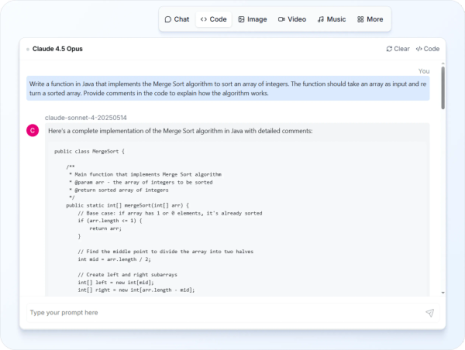
Ease of use is excellent for anyone familiar with OpenAI’s API—migration typically requires one line of code change, with a shallow learning curve even for beginners thanks to comprehensive quickstart guides. The dashboard is straightforward for key management and billing, and the Playground provides instant no-code testing across categories (Chat, Image, Video, etc.).
Interface quality is clean and functional, with well-organized documentation at docs.aimlapi.com featuring searchable model lists, error references, glossary, and integrations. Supported SDKs include Python (OpenAI library or requests), JavaScript (fetch/Node), and cURL examples. Support resources include Discord/community (free tier), priority human help (paid), shared Slack (enterprise), and a help center; however, user feedback highlights inconsistent responsiveness and occasional unhelpful replies. Overall, the experience shines for quick onboarding but can frustrate during troubleshooting.

Performance & Reliability
The platform claims low-latency inference, infinite scalability, and 99% uptime via top-tier serverless infrastructure, making it suitable for real-time applications. Some users report fast responses and predictable behavior under load for basic tasks.
However, known issues include occasional timeouts (e.g., 524 errors on longer generations), model unavailability, partial downtime, and output truncation on high-token models—issues frequently cited in reviews. Reliability receives mixed feedback: effective for prototyping and light production but less dependable for mission-critical or high-volume workloads compared to specialized providers. No widespread major outages reported, but individual experiences vary widely.
Pricing & Value
Pricing follows a simple prepaid credit model with three tiers:
- Free: $0 forever; 10 requests/hour, limited models and Playground—ideal for testing.
- Pay As You Go: $20 minimum prepaid (includes ~40M credits initially); full model access, no usage caps, pay-per-use (model-specific rates), crypto supported, priority support.
- Enterprise: Custom; dedicated servers, unlimited rate limits, private models, training, Slack channel.
Usage is charged per 1M tokens (input/output), per image generation, per megapixel, or per second of video/audio—examples include sub-$1/M token rates for many LLMs and $0.007–$0.195 per image generation. Exact costs vary by model (e.g., cheap alternatives to premium GPT/Claude options). No refunds on prepaid credits.
Value proposition is strong for cost-conscious users needing model variety (often 50-80% savings vs. direct premium APIs) and easy experimentation, especially versus managing multiple vendor subscriptions. Compared to alternatives like OpenRouter or direct OpenAI, it excels in breadth and simplicity but lags in transparency and refund flexibility. Best value for startups and indie developers; enterprises gain from custom scaling.
Practical Tutorial
Official documentation provides an excellent quickstart. Here is a complete, tested walkthrough for a common task: generating a chat response using the popular Python OpenAI SDK (fully compatible—no extra code beyond base URL).
- Sign up at https://aimlapi.com/app/sign-up and verify your account.
- Log in and navigate to https://aimlapi.com/app/keys to generate and copy your API key (shown only once).
- Install the OpenAI Python package:
pip install openai. - Create a script (e.g.,
chat_example.py):
from openai import OpenAI

client = OpenAI(
    base_url="https://api.aimlapi.com/v1",
    api_key="YOUR_AIMLAPI_KEY"  # Replace with your key
)

response = client.chat.completions.create(
    model="google/gemma-3-4b-it",  # Or any model from https://aimlapi.com/models, e.g., "gpt-4o"
    messages=[
        {"role": "user", "content": "Tell me a short joke about AI"}
    ],
    temperature=0.7,
    max_tokens=150
)

print("AI Response:", response.choices[0].message.content)- Run:
python chat_example.py. Switch models by changing themodelstring and test first in the Playground at https://aimlapi.com/app/. - For production, store the key in environment variables and handle errors (see docs for full error codes).
This works identically for image generation (use vision or dedicated endpoints) or other capabilities. Full official tutorial and more examples (cURL, Node.js) are at https://docs.aimlapi.com/quickstart/quickstart.
Final Verdict
Overall rating: 3.5/5. AI/ML API delivers strong value for developers seeking affordable access to 400+ models through one seamless, OpenAI-compatible interface—ideal for prototyping, experimentation, and cost-optimized production at small-to-medium scale. Who should use it: Startups, indie developers, and teams prioritizing model variety, quick migration, and budget savings over absolute reliability. Who should avoid it: Enterprises or users requiring guaranteed uptime, responsive support, refund flexibility, or high-stakes production workloads (consider established aggregators or direct providers instead due to mixed billing/reliability feedback). One-sentence recommendation: Test with the free tier and a small prepaid amount—it’s a powerful shortcut for multi-model AI integration if you verify performance for your specific use case first.