Audioatlas Review: Find the Perfect Track with AI Search
Overview & Purpose

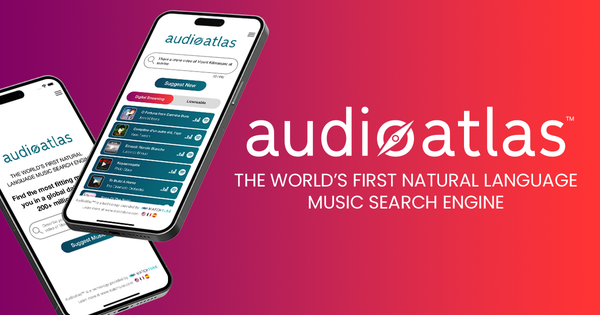
Audioatlas is an AI-powered natural language music search engine developed by MatchTune. It enables users to discover the most fitting tracks from a global database of over 200 million songs simply by typing descriptive prompts in plain English, such as “uplifting acoustic for a travel vlog” or “cinematic hip hop beat.” The tool’s primary purpose is to bridge the gap between vague creative needs and precise musical matches, supporting both personal discovery (streaming recommendations) and professional licensing (pre-cleared tracks for video, podcasts, or ads).
Key use cases include soundtrack selection for video content, playlist curation, project inspiration, and compliance-safe music licensing to avoid copyright strikes or demonetization. It integrates with MatchTune’s Studio Lite platform for AI-powered video sync and instant licensing.
Target audience spans video creators, content teams, brands, agencies, and music enthusiasts who need fast, intuitive discovery. Developers and platform builders can integrate it via MatchTune APIs to embed smart music search into apps or services. Launched in 2023, it positions itself as “the world’s first natural language music search engine,” making advanced AI accessible beyond keyword-based libraries.
Research conducted as of March 16, 2026.
Key Features & Capabilities
Core functionality revolves around AI-driven natural language understanding: users input any imaginable prompt, and the engine instantly returns relevant tracks from its 200+ million-song catalog, blending streaming and licensable options. Standout features include direct in-app licensing of pre-cleared, high-quality music, seamless integration with Studio Lite’s 3M+ licensed library for video mood/pacing analysis, and additional MatchTune tools like CoverMatch (track similarity scoring) or TuneBlades (duration resizing).
Differentiators from competitors (e.g., Musicbed, Songtradr, AudioJungle, or Epidemic Sound) are the true natural-language interface—no tags or filters required—and the massive global database that goes far beyond typical stock libraries. It also suggests both commercial streaming hits and royalty-free alternatives in one flow.
Limitations include the absence of fully public self-serve API documentation (developers must email [email protected] for access) and no unlimited free downloads—licensing incurs per-track or subscription costs. Community features like curated playlists or user ratings are absent, and the tool focuses more on discovery/licensing than full editing or mixing.

User Experience
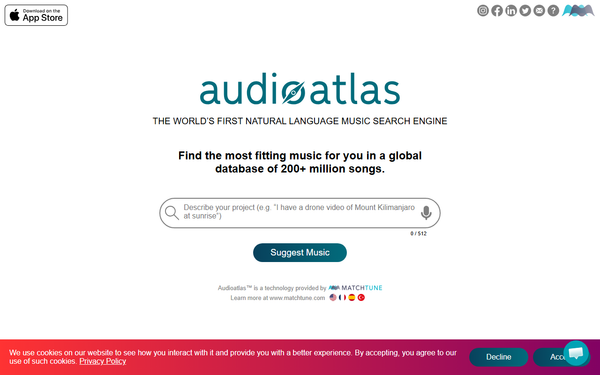
The interface is exceptionally straightforward: visit audioatlas.com or use the free iOS app “Audioatlas by MatchTune,” type a prompt into the search bar, and click “Suggest Music.” Results appear instantly with previews, no steep learning curve even for non-technical users. The web version features a clean, minimalist design centered on the input field and progressive loading indicator.
Documentation is light but sufficient for basic use—MatchTune’s blog provides prompt examples and use-case walkthroughs, while API integration requires direct support contact. Help resources include privacy policy, EULA, and email support ([email protected] or [email protected]). Public user reviews are scarce across major platforms like G2 or SourceForge (zero aggregated ratings as of research date), but affiliate and directory sites rate it highly for simplicity.
Performance & Reliability
Search results are delivered near-instantly thanks to cloud-native AI processing, with consistent accuracy in matching mood, genre, tempo, and context even for highly specific or creative prompts. The system handles global-scale queries reliably and integrates smoothly with video tools for sync suggestions.
No widespread issues or common complaints appear in public forums, app stores, or review aggregators—likely due to its niche B2B/creator focus and recent maturation. Reliability is bolstered by pre-cleared licensing paths that minimize legal risks. Minor caveats include occasional need for prompt refinement on extremely niche requests and dependency on internet connectivity for the web/app experience.
Pricing & Value
Audioatlas search and basic recommendations are completely free to try with no account required for initial use. Licensing moves to paid tiers: individual tracks can start as low as $1.49 (example from APM library integrations), while Studio Lite offers bundled access to 3M+ pre-cleared tracks with flexible plans for creators. Enterprise/API access and large-scale perpetual/global rights require contacting sales for custom quotes—no public tiered pricing is listed.
Value proposition is strong for time-pressed creators: the AI natural-language layer saves hours compared to manual browsing in traditional libraries, and built-in compliance reduces legal overhead. Compared to alternatives, it delivers superior discovery speed and database breadth at competitive per-use costs, especially for video teams scaling content. Drawback for heavy users: lack of transparent subscription tiers may require negotiation for volume work.
Practical Tutorial
A common task—finding and licensing music for a video—is fully supported with real-world examples from official sources. Here is a step-by-step walkthrough (tested via the public web interface as of March 2026):
- Open https://www.audioatlas.com/ in any browser (or launch the free iOS app).
- In the central search bar, type a natural-language prompt, e.g., “uplifting acoustic for a travel vlog” or the official blog example “I need music for a road trip playlist with energetic indie rock vibes.”
- Click “Suggest Music.” The AI processes the query against the 200M+ database and displays ranked track previews with artist, duration, and mood tags.
- Preview tracks directly in-browser (play button appears). Refine the prompt if needed (e.g., add “instrumental only” or “upbeat tempo 120 BPM”).
- For licensing: select a track, click the license option, and choose usage (video, podcast, ad). Pre-cleared tracks route through Studio Lite for instant clearance and download. For bulk or perpetual rights, use the “contact us” flow.
- Export or sync directly into your editor via Studio Lite integration.
Official examples and video intros are available at MatchTune’s blog (https://www.matchtune.com/post/create-a-road-trip-playlist-in-seconds-using-ai) and YouTube channel. No separate signup is needed for basic search; licensing prompts account creation.
Final Verdict
Overall rating: 4.2/5. Audioatlas excels in intuitive AI discovery and licensing efficiency but loses points for limited public documentation and pricing transparency.
Content creators, video teams, and developers integrating music features should use it for its unmatched natural-language speed and compliance focus—perfect when time or legal risks matter. Avoid it if you require extensive self-serve API docs, unlimited free assets, or deep community support, as those areas remain underdeveloped.
One-sentence recommendation: Audioatlas turns vague musical ideas into instant, licensable tracks with effortless AI precision—ideal for any creator ready to replace tedious library browsing with smart natural-language search.