Audiobot Review: The Best AI Voice Generator for Spanish Accents
Overview & Purpose
AudioBot is an AI-powered text-to-speech (TTS) service that instantly converts typed or pasted text into natural-sounding, professional audio files, downloadable in MP3 format. It leverages deep learning for human-like vocal patterns and intonation, supporting over 500 voices across more than 100 languages and accents, with a notable specialization in Spanish and regional accents from 14+ countries (including Mexico, Colombia, Argentina, Spain, and others). Primary use cases include generating voiceovers for videos, social media content, corporate presentations, e-learning courses, podcasts, audiobooks, radio shows, and accessibility tools for visually impaired users. It eliminates the need for expensive human voice actors while enabling quick, high-quality audio production.
The target audience spans content creators (YouTubers, podcasters, marketers), educators developing courses, businesses creating multilingual or Spanish-focused media, developers building voice-enabled apps via API, and writers converting scripts or ebooks to audio. It is particularly valuable for Spanish-speaking markets due to its extensive regional accent support, as well as general users seeking affordable, realistic narration in English, Portuguese, French, Hindi, and other languages.
Key Features & Capabilities
Core functionality revolves around a straightforward TTS pipeline: input text, select a voice (with filters by language, country, and gender), optionally adjust speed, pitch, or tone/style, generate the audio in seconds, preview it, and download as MP3. Users retain full copyright and ownership of the generated audio, with commercial use permitted on paid plans. Additional capabilities include API access for programmatic integration, Zapier connectivity (for workflows with apps like YouTube or Google Sheets), a WordPress plugin, and a Chrome extension for Google Docs narration. Unlimited audio length is available on paid plans, and some tiers support SSML for advanced control.
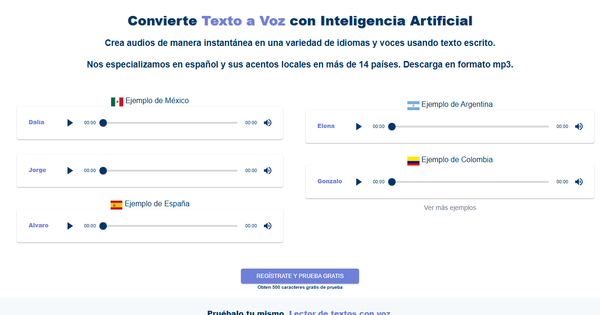
Standout features that differentiate it include its deep focus on realistic Spanish/Latin American accents (e.g., Mexican voices like Dalia or Jorge, Colombian like Gonzalo, Argentine like Elena), which provide culturally nuanced delivery not always matched by broader competitors. The large voice library (500+ options) combined with instant generation and natural prosody makes it efficient for high-volume production. Integrations and full IP ownership further enhance its appeal for professional workflows.
Limitations include a restrictive free trial (only 500 characters), potential character caps per generation in the free tier, and a lack of advanced features like voice cloning or emotion-specific controls in basic plans (though tone adjustments are mentioned). It does not emphasize multilingual SSML extensively in free access, and documentation for the API is not prominently featured on the main site.
User Experience
AudioBot features a clean, minimalist web interface that prioritizes simplicity: a text input box, voice selector (with country/language filters and previews), generate button, and immediate audio player with download option. The learning curve is extremely low—even first-time users can produce audio in under a minute without prior experience or tutorials. The site is available in Spanish and Portuguese, aligning with its core audience.
Interface quality is intuitive and responsive for web-based use, with no reported clutter or performance lags in previews. However, advanced users may find it basic compared to desktop apps with batch processing or advanced editors.
Documentation and support resources are limited publicly; the site focuses on self-service with voice examples and a simple registration flow. API details exist for developers but are not exhaustively documented on the homepage. Support appears to be via email or account dashboard (standard for similar SaaS tools), with no dedicated help center, video library, or live chat prominently advertised. User testimonials highlight ease of use positively.
Performance & Reliability
Generation is fast—typically completing in seconds even for longer texts—thanks to optimized AI models. Voices are consistently praised for realism, natural intonation, and minimal robotic artifacts, outperforming some competitors in head-to-head tests for Spanish and general quality. Paid plans support high-fidelity output suitable for professional use, with no limits on audio length.
As of April 2026 research, no widespread known issues or common complaints appear in reviews on platforms like Capterra, SaaS directories, or general web searches. Aggregated ratings reach approximately 4.7/5 based on hundreds of reviews, with feedback emphasizing reliable voice quality, quick turnaround (e.g., ebook-to-audiobook conversion in minutes), and consistent uptime. Minor potential drawbacks include character-based quotas that could affect heavy users without upgrading, but overall reliability is strong for its category.
Pricing & Value
AudioBot offers a free tier with 500 characters for trial upon signup. Paid options are flexible and character-based: one-time prepaid plans start around $13–$28 (e.g., Basic pack for ~300k characters) with a 30-day money-back guarantee, or monthly subscriptions beginning at approximately $17 (Personal plan for ~200k characters/month), scaling to higher tiers (Professional/Elite) for more volume. Higher plans unlock unlimited length, full voice access, and advanced features. All paid users receive 100% intellectual property ownership.
Value proposition is competitive for Spanish-focused or budget-conscious users, offering premium voice quality and ownership at lower entry points than many rivals (e.g., vs. subscription-heavy tools like Murf.ai or ElevenLabs). One-time options provide excellent long-term savings for occasional users, while integrations add workflow efficiency. It delivers strong ROI for voiceover needs without ongoing high costs, though heavy users may find credit systems less flexible than unlimited plans from premium competitors.
Practical Tutorial
A step-by-step tutorial for creating a voiceover (common task: video narration in Spanish):
- Visit https://audio-bot.com/ and click "Regístrate y prueba gratis" (or the equivalent "Try for free") to sign up for the 500-character trial.
- On the main interface, paste or type your text (e.g., "Hola, bienvenidos a este tutorial sobre inteligencia artificial. Hoy exploraremos cómo las voces AI están revolucionando el contenido digital.").
- Select a voice from the dropdown or voices page (filter by language: Español; country: e.g., México for Dalia (female) or Jorge (male), or Colombia for Gonzalo). Preview sample audio if available.
- Optionally adjust tone, speed, or pitch via available sliders for a more natural delivery.
- Click the generate/convert button—audio processes in seconds.
- Listen to the preview in the built-in player, make tweaks if needed, then download the MP3 file.
- For longer projects, upgrade to a paid plan and repeat or use the API/Zapier for bulk processing.
Real example: Using Colombian Spanish voice "Gonzalo" for a 200-character marketing script produces a professional, engaging narration ready for video editing. Official voice examples are at https://audio-bot.com/voices/all. No in-depth video tutorials are publicly listed, but the process is self-explanatory.
Final Verdict
Overall rating: 4.5/5 – A solid, affordable TTS tool excelling in realism and Spanish regional support, with minor gaps in advanced features and free-tier limits.
Who should use this tool: Content creators, marketers, educators, and developers in Spanish-speaking markets or needing quick, natural voiceovers with full ownership and easy integrations—especially those on a budget or preferring one-time payments.
Who should avoid this tool: Users requiring advanced features like instant voice cloning, unlimited free usage, enterprise-level compliance, or highly customized emotion controls; or those working primarily in languages with less accent variety here.
One-sentence recommendation: AudioBot is a highly recommended, user-friendly AI voice generator for realistic Spanish-accented (and multilingual) audio production at an accessible price point.