AutonomOps AI Review: The Future of Agentic SRE and DevOps
Overview & Purpose
AutonomOps AI, operating under its core platform HealR, is an agentic AI-powered Site Reliability Engineering (SRE) solution that deploys collaborative AI agents and machine learning models to autonomously monitor, detect, investigate, resolve, and optimize mission-critical cloud applications and infrastructure. It correlates metrics, logs, traces, and alerts in real time across multi-cloud and Kubernetes environments, using a Knowledge Graph that learns from historical incidents to enable proactive issue prediction and prevention. Primary use cases include automated incident response and root cause analysis (RCA), alert noise reduction, predictive maintenance, cost optimization, dashboard generation, and compliance monitoring. The tool functions as an intelligent digital co-pilot, shifting SRE teams from reactive firefighting to strategic operations.
The target audience consists primarily of Site Reliability Engineers (SREs), DevOps and platform engineering teams, cloud architects, and observability experts at mid-to-large enterprises managing complex, production-scale cloud ecosystems (AWS, Azure, GCP, Kubernetes). It appeals to organizations experiencing high alert volumes, prolonged MTTR, or growing operational toil, rather than individual developers, marketers, or designers. Research conducted as of March 6, 2026.
Key Features & Capabilities
Core functionality revolves around five specialized AI agents and 20+ ML models working collaboratively. Standout capabilities include the Agentic War Room (autonomous 5-step RCA with evidence collection, real-time investigation, and solution recommendations), Predictive Intelligence (forecasting anomalies up to 12 hours in advance using models like Prophet and ARIMA), Agent Chat (natural-language querying of logs and metrics), Dashboard GPT (instant dashboard creation from plain-English prompts), Blast Radius Analysis (visual dependency graphs showing cascading impacts), Auto-Remediation (500+ playbooks with approval gates and rollback), Correlation Engine (1M events/sec across MELT data), and Knowledge Graph (institutional memory from 1M+ incidents). Additional tools cover SLO management, cost optimization (30% claimed savings), capacity planning, change intelligence, and multi-cloud observability.
Differentiators from competitors (e.g., traditional monitoring like Datadog or New Relic with lighter AI, or AIOps platforms) include true multi-agent collaboration for end-to-end autonomy, intent-based natural-language interfaces that eliminate query languages like PromQL, ensemble ML for near-zero false positives, and proactive prevention rather than reactive alerting. The platform integrates with 25+ sources (Prometheus/Grafana native, plus Datadog/New Relic/PagerDuty in higher tiers) and requires minimal initial configuration for core views.
Limitations include tier-gated access—advanced features like full Predictive Intelligence, unlimited custom agents, and deep integrations are restricted to Unlimited ($399+/mo) or Enterprise plans; some capabilities (e.g., on-prem deployment, full SOC2/HIPAA) are Enterprise-only; and the product remains relatively early-stage (launched features over the past 8–12 months), so integration breadth and long-term maturity may lag established vendors. No built-in synthetic monitoring in base tiers and reliance on existing observability stacks are noted constraints.
User Experience
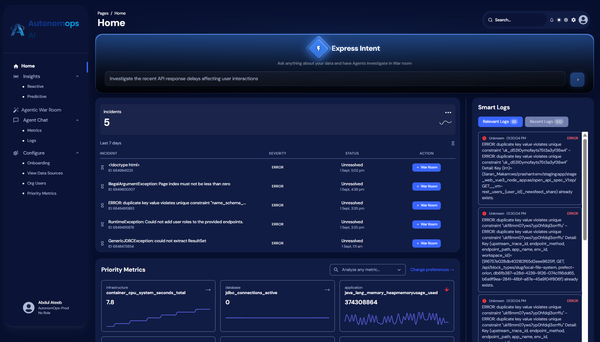
Ease of use is a highlighted strength: natural-language interfaces (Agent Chat, Dashboard GPT, Intent-Based War Room) and zero-setup context-aware homepage minimize the learning curve for SRE professionals already familiar with observability concepts. Users describe incidents or ask questions in plain English, and agents handle correlation and remediation with minimal intervention. The interface features modern conversational chat, interactive timelines, heatmaps, dependency graphs, and auto-generated visualizations—described as intuitive and production-ready.
Documentation includes a growing blog with educational SRE guides, feature deep-dives, and practical resources like “25 High-Signal Prompts for AI SRE.” API documentation and SDKs are available, alongside YouTube demo videos and an interactive War Room demo. Support escalates by tier: community (free), email/chat with 4-hour response (Professional), priority 24/5 (Unlimited), and 24/7 phone with 15-minute SLA plus dedicated CSM (Enterprise). No exhaustive public knowledge base or video academy exists yet, but personalized demo scheduling and white-glove onboarding for Enterprise fill the gap. Overall, the experience feels lightweight for daily use but enterprise-grade in depth.
Performance & Reliability
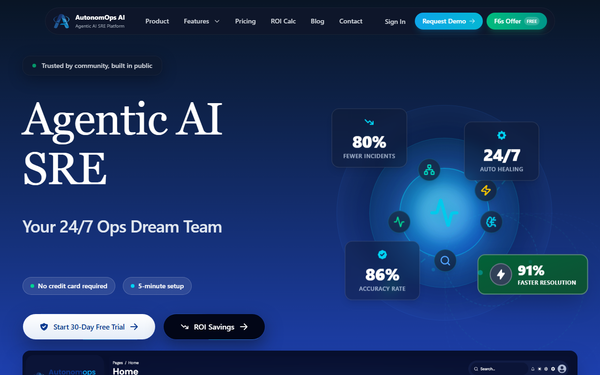
Performance claims are aggressive and data-backed on the site: 80–90% MTTR reduction (hours to ~1 minute), 95% accuracy, 90% alert noise reduction, 1M events/sec correlation, and 30% cost savings through optimization. The Correlation Engine and ensemble ML models deliver real-time processing with reported zero false positives in anomaly detection. Predictive features provide 3–12 hour warnings, and the Knowledge Graph continuously improves from every resolved incident.
No widespread user-reported issues or outages appear in public forums as of March 2026; searches across Reddit, G2, and review sites yield primarily founder commentary and early positive validation from 50+ industry leaders (VMware, Google alumni, etc.). One design partner reported strong results in production testing. Reliability is bolstered by enterprise certifications (SOC2, HIPAA, ISO in higher tiers), encryption, RBAC, and 99.99% uptime SLA for Enterprise. Early-stage adoption means real-world scale testing is still emerging, but available benchmarks and demos show consistent speed and efficiency for complex stacks.
Pricing & Value
AutonomOps AI uses a transparent freemium model with monthly or annual billing (17% annual discount):
- Starter (Free forever): 1 data source, basic Agent Chat (100 queries/mo), 3 Agentic War Room sessions/mo, 7-day retention, community support.
- Professional ($149/mo): 5 data sources, unlimited War Room & Agent Chat, Dashboard GPT, advanced correlation, 30-day retention, email/chat support, 14-day trial.
- Unlimited ($399/mo, most popular): Unlimited integrations & data sources, full Predictive Intelligence, advanced remediation & custom agents, 90-day retention, priority support.
- Enterprise (custom pricing): Everything in Unlimited + on-prem/VPC, full compliance (SOC2/HIPAA/ISO), white-label, unlimited retention, 24/7 support, dedicated CSM, and custom onboarding.
An ROI calculator on the site projects 300%+ ROI within 3 months for typical teams via 45+ hours/week saved and prevented outages (average $2.3M annual savings claimed). Value is strong for growing or large SRE teams facing alert fatigue and high downtime costs—delivering more autonomy at a lower entry price than many legacy AIOps platforms while scaling predictably. Smaller teams may find even the free tier useful for testing, but full value requires Professional+ and existing observability data. Compared to alternatives, it offers superior agentic proactivity at competitive cost, though ROI depends on successful integration and adoption.
Practical Tutorial
Official resources include an interactive War Room demo, YouTube channel demos, and blog articles with practical examples (no single exhaustive video series yet). Here is a step-by-step walkthrough for a common task—performing log and metrics analysis with Agent Chat—based on official feature descriptions and blog guidance (e.g., “Agent Chat for Logs” and “25 High-Signal Prompts”). This mirrors real usage in Professional+ tiers.
- Set up integrations: Log into your HealR dashboard (after signing up at https://autonomops.ai/ and connecting at least one data source like Prometheus, Datadog, or AWS CloudWatch via the integration wizard—takes minutes in Professional tier).
- Access Agent Chat: Navigate to the Agent Chat interface from the sidebar or context-aware homepage.
- Craft your query: Type a natural-language request, e.g., “Analyze error rates in logs for the payment-service over the last 6 hours, correlate with CPU spikes in metrics, and suggest root causes.” Use high-signal prompts from the blog (copy-paste examples like “Show latency trends and blast radius for this incident”).
- Review AI response: The agent instantly returns correlated insights, charts, log excerpts, anomaly highlights, and recommended actions (e.g., “Correlated with deployment at 14:32—rollback suggested”).
- Iterate and act: Follow up conversationally (“Drill into trace ID XYZ” or “Generate dashboard for this”), then trigger Agentic War Room for full autonomous remediation if needed.
- Export or automate: Save results to a custom dashboard via Dashboard GPT or apply auto-remediation playbook.
For full autonomous incident handling, watch the official “HealR AI SRE Demo” on YouTube (https://www.youtube.com/watch?v=830WQZ-Lrhk) or start the interactive War Room demo at https://autonomops.ai/war-room/. Blog post “Agentic War Room: AI-Powered Autonomous Incident Resolution” provides additional prompt examples. Test in the free tier or schedule a live demo for personalized walkthroughs.
Final Verdict
Overall rating: 4.5/5. AutonomOps AI (HealR) excels as an innovative, forward-looking agentic SRE platform that genuinely reduces toil and prevents outages through multi-agent autonomy and predictive intelligence—ideal for SRE and DevOps teams in complex cloud environments who want to reclaim engineering time and achieve measurable ROI. Teams should avoid it if they operate at very small scale, prefer fully mature tools with extensive case studies and third-party reviews, or require immediate deep custom integrations without a demo phase, as the product is still rapidly evolving. One-sentence recommendation: For engineering organizations ready to replace alert fatigue with proactive AI co-pilots, AutonomOps AI delivers transformative autonomous operations worth piloting today.