Bitdive Review: Automated JVM Testing and AI Observability

Overview & Purpose
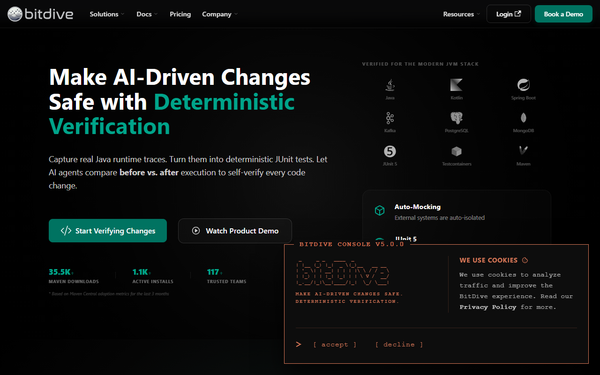
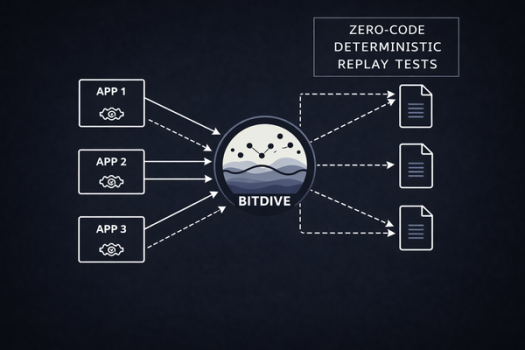
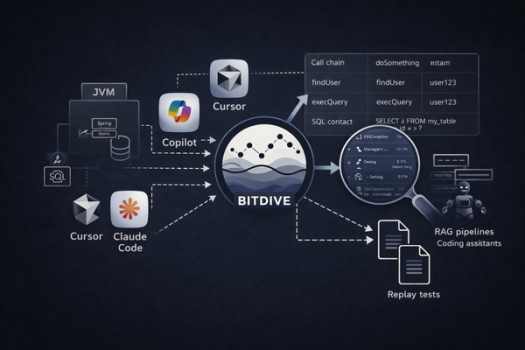
BitDive is a zero-code runtime observability and test automation platform designed exclusively for JVM applications (Java, Kotlin, Spring Boot, Kafka, and supporting databases like PostgreSQL and MongoDB). It instruments applications at the bytecode level to capture complete execution traces—including method calls with parameters and return values, SQL queries with result sets, HTTP requests/responses, and Kafka messages—then automatically converts these real-world executions into deterministic, infrastructure-free JUnit 5 tests with auto-generated mocks for all external dependencies.
By exposing this rich runtime data through its Model Context Protocol (MCP), BitDive enables AI coding assistants (such as Cursor or Claude) to access precise execution context for generating grounded code changes, pinpointing root causes, and verifying fixes via before/after trace comparisons and replay tests. Primary use cases include safe AI-assisted refactoring of legacy systems, rapid creation of regression suites from production or staging traffic, elimination of flaky manual test scripts, accelerated root-cause analysis (reducing MTTR), and reproducible bug reports that replay exactly in any IDE or CI environment.
The target audience is primarily backend developers, engineering teams, SREs, and QA engineers working on JVM-based microservices or monoliths—especially those adopting AI coding tools or struggling with test maintenance and tech debt. It is not aimed at marketers, designers, or non-JVM stacks.
Key Features & Capabilities
Core functionality revolves around lightweight Java agent instrumentation (no code changes required) that delivers method-level visibility across the full call chain, automatic trace-to-JUnit conversion, dependency virtualization for isolated test execution, and semantic-aware trace differencing to detect regressions in logic, payloads, or performance.
Standout differentiators include the Model Context Protocol (MCP) that turns runtime traces into actionable context for AI agents (enabling self-verifying code loops), true zero-code deterministic replay tests that run anywhere Java runs (laptop, CI, no Testcontainers needed on Starter), and infrastructure-free execution that eliminates the fragility of traditional Mockito scripts or external service dependencies. Additional capabilities encompass service maps, heatmaps, JVM performance metrics, and continuous profiling with low overhead (typically 0.5–5% CPU). It integrates natively with Maven, Gradle, JUnit 5, and popular AI IDEs.
Compared with traditional APMs (e.g., Datadog, New Relic), profilers, or mocking libraries (e.g., JMockit), BitDive uniquely bridges observability directly to automated, verifiable testing and AI grounding—replacing guesswork with real execution data.
Limitations include JVM-only support (no Python, .NET, or Node.js), reliance on sufficient real traffic for comprehensive coverage, and data retention caps on lower tiers (14 days on Starter). It does not replace full end-to-end load testing or non-JVM observability platforms.
User Experience
Setup is exceptionally straightforward with a documented 2-minute process: register for the SaaS dashboard, add a Maven/Gradle dependency plus a simple configuration file, and restart the application—after which traces appear automatically. The learning curve is low for any experienced Java developer, as the tool feels like a natural extension of existing JUnit workflows rather than a new framework.
The web interface is clean and visual, featuring interactive call trees, SQL result viewers, payload comparisons, service maps, and one-click test generation. Dashboard navigation is intuitive, with quick filtering by trace ID, method, or time range. MCP integration with AI tools requires only copy-paste of server settings and rules—typically under 5 minutes.
Documentation is solid and developer-focused, with quick-start guides, glossary, comparison pages, and embedded examples at bitdive.io/docs/. Support includes community forums for Starter users, priority response (<24h) on Pro, and dedicated engineers on Enterprise; YouTube demos and blog tutorials supplement the written materials. Overall, the experience emphasizes immediate value with minimal friction.
Performance & Reliability
The agent uses efficient bytecode instrumentation and delivers production-grade performance with minimal overhead, allowing full tracing even in high-throughput services. Tests are fully deterministic and infrastructure-free, running reliably in any standard JVM environment without external dependencies or flakiness.
As of March 2026, no widespread issues, bugs, or performance complaints appear in public forums, review sites, or recent discussions; adoption metrics (35K+ Maven downloads, 1.1K+ active installs) and official case examples (e.g., 99.6% SQL reduction verified via trace diff) indicate strong reliability. Early users report consistent first-run success for test generation and accurate diff-based regression detection. The platform handles complex microservice interactions (including distributed traces) without introducing latency spikes or instability.
Pricing & Value
BitDive offers a clear, developer-friendly tiered structure (all prices in GBP as of March 2026):
- Starter: £0 forever — 1 project, basic trace-to-test creation, IDE MCP integration, 14-day retention, community support. Ideal for individuals or open-source projects (commercial use encouraged to upgrade).
- Pro: £19 per developer per month (monthly or yearly billing; yearly discounts apply) — includes CI/CD automation, Testcontainers support, built-in AI root-cause tools, up to 10 projects, 90-day retention, and priority support. Comes with a 14-day full-featured trial (no card required upfront).
- Enterprise: Custom pricing — adds private cloud/air-gapped deployment, unlimited projects/retention, SSO/RBAC/data masking, SIEM audit exports, dedicated support, and compliance features.
Value is exceptionally high for JVM teams: the time saved on mock maintenance, flaky test debugging, and AI hallucination fixes often pays for itself within weeks. Compared with alternatives (manual testing, heavy APM licensing, or AI-only tools that still require review), BitDive delivers day-one ROI through automated, verifiable coverage without inflating codebase size. Open-source discounts and flexible SaaS/on-prem options further enhance accessibility.
Practical Tutorial
Official quick-start documentation and video demos are available at https://bitdive.io/docs/getting-started/ and https://www.youtube.com/watch?v=Ku2IU3xt_UI. Below is a complete walkthrough for the common task of capturing a real execution trace and generating a deterministic JUnit test (synthesized directly from official guides and examples).
-
Sign up and configure: Register a free account at bitdive.io. In the SaaS dashboard, create a new project, select your framework (e.g., Spring Boot), and copy the provided Maven dependency snippet and
config-profiling-api.ymltemplate. -
Add the agent to your project: Paste the dependency into your
pom.xml(or equivalent Gradle entry). Place the YAML config insrc/main/resources/. No other code changes needed. -
Start your application: Rebuild and launch your JVM service normally (local or staging). The agent auto-connects to BitDive SaaS.
-
Capture a trace: Exercise your application—e.g., send a POST request to an endpoint via Postman or curl. Wait ~30 seconds; the trace appears in the BitDive UI under “Traces” or the Service Map.
-
Review and generate test: Click the trace to open the detailed view (method chain, SQL parameters, HTTP payloads). Select “Create JUnit Test.” BitDive auto-generates a complete, deterministic JUnit 5 class with virtualized mocks for all external calls (DB, APIs, Kafka).
-
Run the test: Copy the generated test into your
src/test/javafolder and execute viamvn test, IntelliJ, or CI pipeline. It replays exactly as captured, with no external services required. -
(Optional) AI verification loop: Configure MCP in Cursor or Claude Desktop (copy server URL and rules from the BitDive dashboard). Prompt the AI with a trace ID, e.g., “Analyze trace-abc123 for root cause of slow response and propose a fix; then replay to verify.” Apply the change, recapture a new trace, and use the built-in diff viewer to confirm semantic and performance improvements (as demonstrated in the N+1 query live demo reducing queries from 243 to 1).
This process typically takes under 10 minutes end-to-end and produces production-grounded tests ready for regression suites.
Final Verdict
Overall rating: 4.5 out of 5.
JVM development teams embracing AI coding assistants or battling flaky tests and legacy debt should use BitDive—it delivers immediate, runtime-grounded verification that traditional tools simply cannot match. Teams working outside the JVM ecosystem, requiring broad multi-language support, or needing extensive third-party user testimonials should avoid it for now, as the platform remains JVM-focused and relatively new.
BitDive transforms real executions into safe, AI-verifiable development workflows—highly recommended for any Java team ready to stop writing mocks.