Blok Review: Predict User Behavior with AI Product Simulations
Overview & Purpose

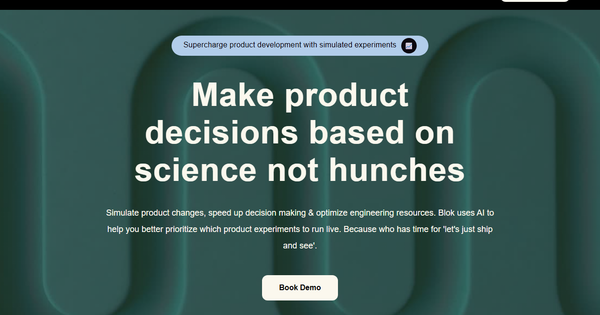
Blok is an AI-powered product simulator that enables teams to predict user responses to potential product changes, prototypes, and experiments before any code is written or real users are exposed. By creating synthetic AI agents (personas) modeled on a company’s actual user analytics data and grounded in behavioral science, Blok simulates how different user segments would interact with variations in UI, flows, messaging, or features. This predictive approach compresses traditional 4–6 week A/B testing cycles into hours, helping teams de-risk decisions, prioritize high-impact ideas, and avoid wasted engineering effort.
Primary use cases include onboarding optimization, conversion rate optimization (landing pages, sign-up flows, CTAs), prototype usability testing, feature adoption prediction, user flow friction analysis, messaging validation, and pricing page structure experiments—anywhere teams would normally rely on gut feel, manual prototypes, or live A/B tests. The tool is especially valuable for iterative product work in high-stakes environments where exposing real users to unproven changes carries risk or compliance concerns.
Target audience is product managers, UX researchers, growth teams, design leads, and marketing teams at SaaS, fintech, healthcare, and ecommerce companies. It appeals particularly to mid-size and larger organizations with existing analytics data (e.g., from Amplitude, Mixpanel, or Segment) that want evidence-based conviction before committing resources.

Key Features & Capabilities
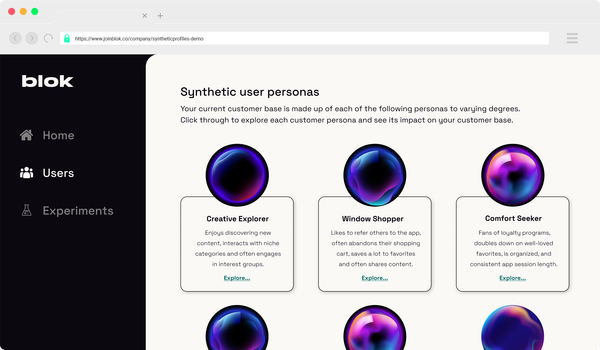
Core functionality revolves around three pillars: building bespoke synthetic user profiles from real product data, running predictive simulations of product experiments against those agents, and using an AI “soundboard” to gather feedback on designs or prototypes without involving actual users. Teams upload event logs, submit Figma files plus experiment hypotheses and success metrics, and receive multi-run simulation outputs including predicted behavioral outcomes, drop-off points, and lift estimates across user clusters (e.g., high-intent users, skeptics, risk-averse types).
Standout features that differentiate Blok from competitors include its use of validated behavioral science frameworks (cognitive biases, decision heuristics, attention patterns) for realistic agent behavior, persona-specific insights rather than aggregate results, and explainable, backtested predictions that improve over time with calibration. Unlike retrospective tools such as Optimizely or traditional usability platforms like Maze/UserTesting, Blok is fully predictive and risk-free—teams can test dozens of variants in parallel before any live exposure. Additional outputs include an overall experiment report, per-persona breakdowns, improvement recommendations, and an interactive chatbot for follow-up questions on results.
Limitations and missing features: Accuracy is described as “directionally accurate” and strong in backtests but not pixel-perfect; it improves with more data and fine-tuning yet cannot fully replace production validation. The tool is still early-stage (emerged from stealth in July 2025), so advanced integrations, mobile/app-specific simulation depth, and self-serve custom agent training are not yet publicly detailed. No native support for voice/chat interfaces or real-time collaborative editing was mentioned.
User Experience
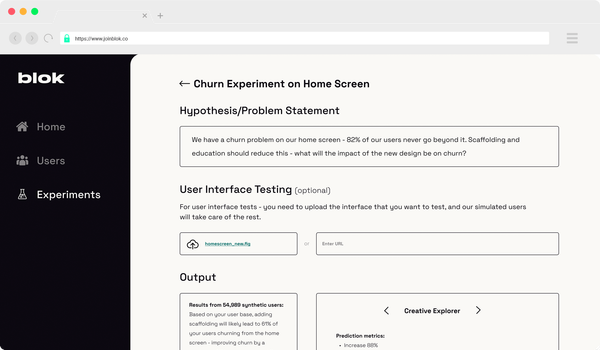
Onboarding begins with a demo call followed by tailored setup for approved teams; once inside the dashboard, the flow is straightforward for anyone familiar with analytics platforms and Figma. Data upload (via integration or CSV) and experiment configuration feel intuitive, with AI handling persona generation automatically. The learning curve is moderate—most value comes from clearly defining hypotheses and metrics, which experienced product teams can master quickly with the team-assisted initial simulation.
Interface quality is modern and report-focused (overall summary, segmented insights, visual friction maps, and a conversational chatbot), though public screenshots are not available. No steep technical barriers exist for core users.
Documentation consists primarily of insight blog posts on the official site rather than exhaustive public guides; support is hands-on during onboarding and likely ongoing via the team. Overall, the experience emphasizes speed and actionable insights over self-serve complexity, making it accessible once access is granted.
Performance & Reliability
Simulations complete in hours rather than weeks, allowing rapid iteration across multiple variants and personas with high efficiency. Backtesting shows strong directional alignment with eventual real-world outcomes, and models continuously improve through calibration. No major performance bottlenecks or downtime complaints appear in public sources—expected for an early-access tool with controlled onboarding.
Known issues or common complaints: None surfaced in reviews or forums as of March 2026; the product’s gated nature limits broad user feedback. Potential edge cases include reduced reliability with sparse or low-quality analytics data, or over-reliance on predictions without follow-up live testing. Reliability is positioned as complementary to (not a replacement for) production A/B results.
Pricing & Value
Pricing is not publicly listed and follows a custom SaaS model negotiated post-demo, with the company actively balancing underlying compute costs. Enterprise options exist for larger teams, and early customers (primarily fintech and healthcare) report high value through engineering time savings and de-risked roadmaps. No free tier is available; access requires approval after booking a demo.
Value proposition stands out against alternatives: traditional A/B testing platforms require traffic and weeks of runtime with user risk, while pure prototype tools lack behavioral depth and segmentation. For teams running frequent experiments, Blok’s ability to compress cycles and prevent failed launches delivers clear ROI—especially when engineering resources are expensive. Early revenue targets suggest mid-single-digit millions annually, indicating confidence in enterprise adoption.
Practical Tutorial
No fully public self-serve tutorial or video series exists yet (the product remains in controlled onboarding), but the official insights blog and demo process provide a clear workflow. Here is a practical, step-by-step walkthrough for a common task—optimizing an onboarding CTA button to maximize activation rates—based directly on documented capabilities (as of March 2026). Full details and updates are available via the official demo booking.
-
Book a demo and onboard – Schedule an intro call at https://calendly.com/d/cv2z-54b-yh3/blok-intro-call. Share your product context; the team approves access and guides initial data integration (Amplitude, Mixpanel, Segment events or CSV upload).
-
Build synthetic profiles – Once inside the dashboard, Blok automatically generates AI agents representing your user base clusters (e.g., new users, power users) using behavioral modeling and science frameworks. Review and refine clusters if needed.
-
Define the experiment – Upload Figma prototypes of your current onboarding flow and variant(s)—for example, “Change CTA button from blue ‘Sign Up’ to green ‘Get Started Free’ with updated copy.” Add hypothesis (“This will increase activation by 15% for new users”) and success metrics (activation rate, time-to-complete, drop-off points).
-
Configure and run the simulation – Select personas to test against, number of simulation runs (multiple for statistical robustness), and any guardrails. Click “Run Simulation”—agents interact with the prototype in a sandbox, logging behaviors like hesitations, misclicks, or completions.
-
Analyze results – Receive an overall report showing predicted lift, comparison charts across variants, and heatmaps of friction. Dive into persona-specific breakdowns (e.g., “Skeptics drop off 22% higher on the new CTA”). Read AI-generated recommendations and query the built-in chatbot (“Why did high-intent users convert better?” or “Compare to current live data”).
-
Iterate and decide – Export insights, test additional variants in minutes, then prioritize the winning design for live A/B or engineering handoff. Backtest against historical data for extra confidence.
This entire process typically takes hours. For more conceptual guidance, see official blog posts such as “How Agentic AI Improves Product Experimentation” on joinblok.co/insights. Real example: Fintech teams have used similar flows to validate pricing-page variants pre-launch without compliance risks.
Final Verdict
Overall rating: 4.3/5. Blok excels at delivering fast, segment-specific, risk-free insights that traditional methods cannot match, earning high marks for innovation and time savings despite its early-stage limitations.
Teams that should use this tool are product, UX, and growth groups at mid-to-large SaaS, fintech, or healthcare companies with solid analytics data who run frequent experiments and want to accelerate iteration while protecting real users. It shines for organizations tired of opinion-driven debates or lengthy A/B cycles.
Teams that should avoid it are small startups without mature analytics, those needing fully self-serve instant access, or companies requiring proven large-scale case studies and 100% predictive precision—Blok is directional and still maturing.
One-sentence recommendation: If you want to test product ideas with virtual users before touching real ones, book a Blok demo today—it’s the closest thing to a wind tunnel for digital product decisions.