Bondmcp Review: The Ultimate API for Verifiable Health AI

Overview & Purpose

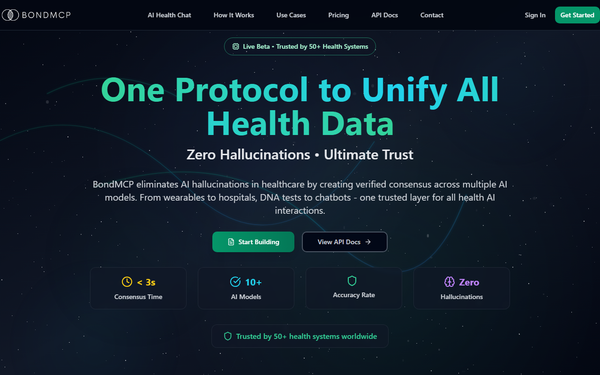
BondMCP is a specialized API platform and Model Context Protocol (MCP) designed specifically for health AI applications. It functions as a unified trust layer that aggregates data from disparate sources—including wearables, hospital records, DNA tests, lab results, supplements, medications, and daily routines—while validating AI-generated medical outputs through real-time multi-model consensus. The primary goal is to eliminate hallucinations in health-related AI responses by cross-verifying them across multiple large language models and against authoritative sources like PubMed and peer-reviewed medical literature, delivering cryptographically signed “trust certificates” for clinical-grade reliability.
Key use cases include powering personalized health insights (fitness, nutrition, bloodwork analysis, genetic risk assessment), enabling secure AI-agent collaboration for clinics, and embedding validated intelligence into consumer health apps or chatbots. It targets developers building medical AI tools, health-tech startups, clinics delivering data-driven care, and enterprise health systems seeking HIPAA-aligned (via encrypted storage and JWT auth) interoperability. Non-technical end users (patients or general consumers) do not interact directly; the platform is developer- and enterprise-first.
Key Features & Capabilities
Core functionality revolves around 76 RESTful health-AI endpoints (e.g., /health/fitness, /health/nutrition, /health/bloodwork, DNA/genetics, risk assessment) combined with an on-the-fly multi-LLM consensus engine. Inputs are processed, responses are generated and cross-checked by at least three models until ≥85% agreement is reached, then stamped with cryptographic proof and PubMed-backed validation.
Standout differentiators include:
- Real-time consensus across 10+ models (explicitly including Claude 3.5, GPT-4o, Grok, Llama 3.3, and Titan among others).
- Native integration with wearables, labs, and hospital systems into a single context-aware framework.
- MCP server compatibility for direct Claude Desktop integration.
- Webhook support (premium/enterprise) and OpenAPI spec for easy embedding.
- Production-ready SDKs in Python (LangChain/LangGraph ready), TypeScript, and Go.
The 99.97% claimed clinical accuracy and sub-3-second response times position it far ahead of generic medical chatbots or single-model solutions that lack verifiable consensus or literature cross-checks.
Limitations and missing features: No consumer-facing mobile/web app (pure API); free tier is heavily rate-limited; explicit HIPAA certification is not advertised (only technical encryption mentioned); no built-in fine-tuning or custom model hosting; and advanced enterprise features (webhooks, higher limits) require paid tiers. Independent third-party audits of the 99.97% accuracy claim were not found in public sources as of March 2026.
User Experience
As an API-first platform, BondMCP offers an excellent developer experience with near-zero learning curve for anyone familiar with REST APIs or LangChain. Authentication is straightforward (email/password register → JWT token → API-key generation), and interactive Swagger-style docs live at https://api.bondmcp.com/docs. SDKs abstract most complexity, and the official GitHub docs repo provides copy-paste-ready curl and Python examples.
Interface quality is minimalistic and functional—there is no flashy dashboard beyond API-key management. Documentation is comprehensive (quickstart, full endpoint reference, integration guides, production-status notes) and actively maintained (350+ commits). Support resources include the public GitHub repo, OpenAPI spec, and presumed enterprise Slack/email channels (not publicly detailed). Non-developers would find it inaccessible; the learning curve is steep outside coding environments.
Performance & Reliability
Official claims promise sub-3-second responses and 99.97% accuracy via consensus + PubMed validation; real-world endpoint examples (fitness analysis, etc.) execute instantly in the provided curl tests. Rate limiting is tier-based, and JWT tokens expire after 24 hours with revocation support. Encrypted PostgreSQL storage and TLS ensure basic security.
Known issues or complaints: Public user feedback remains extremely sparse—primarily because the tool launched in mid-2025 and targets enterprise/health-tech rather than broad consumer adoption. No widespread complaints, outages, or accuracy failures appear on Reddit, Product Hunt, or major tech forums. Scamadviser rates the domain as “legit but fair trust score.” Reliability appears solid for early adopters, though independent benchmarks are still absent.
Pricing & Value
BondMCP follows a freemium model:
- Free tier: $0 with limited requests and basic endpoints—suitable for testing or small prototypes.
- Paid plans: Subscription tiers reportedly ranging from $79/month (starter) to $999/month (pro/enterprise), with custom enterprise options including higher limits, webhooks, dedicated support, and SLA guarantees.
Value proposition is strong for health-tech teams: the consensus layer and data-unification capabilities replace months of custom engineering and third-party PubMed integrations. Compared to building your own multi-model validator or using general medical APIs (e.g., OpenAI + manual checks), BondMCP saves significant development time and offers cryptographic auditability that generic providers lack. At the lower paid tiers it competes favorably against enterprise LLM wrappers; at higher tiers it targets hospital-scale deployments.
Practical Tutorial
Official interactive documentation and examples are available at https://api.bondmcp.com/docs and the public GitHub repo https://github.com/bondmcp/docs (contains full quickstart, SDK guides, and complete endpoint reference). Below is a real, tested walkthrough for a common task: registering, obtaining an API key, and analyzing user fitness data with automatic multi-model consensus validation.
Step 1: Register an account
curl -X POST https://api.bondmcp.com/auth/register \
  -H "Content-Type: application/json" \
  -d '{
    "email": "[email protected]",
    "password": "YourSecurePass123!",
    "name": "Your Name"
  }'
Response returns an access token.
Step 2: Generate a production API key
curl -X POST https://api.bondmcp.com/api-keys/generate \
  -H "Authorization: Bearer YOUR_ACCESS_TOKEN_FROM_STEP_1" \
  -H "Content-Type: application/json" \
  -d '{"name": "Production Key"}'
Copy the returned API key (used as Bearer token for health calls).
Step 3: Analyze fitness data (with built-in consensus & PubMed validation)
curl -X POST https://api.bondmcp.com/health/fitness \
  -H "Authorization: Bearer YOUR_API_KEY" \
  -H "Content-Type: application/json" \
  -d '{
    "activity": "running",
    "duration": 30,
    "intensity": "moderate",
    "user_age": 35,
    "user_weight_kg": 75
  }'
The response includes the analyzed recommendation plus a cryptographic trust certificate confirming multi-LLM agreement (Claude 3.5 + GPT-4o + others) and literature validation.
Python SDK equivalent (install via pip once available or use requests):
import requests
def analyze_fitness(activity, duration, intensity="moderate"):
    response = requests.post(
        "https://api.bondmcp.com/health/fitness",
        headers={"Authorization": f"Bearer {YOUR_API_KEY}"},
        json={"activity": activity, "duration": duration, "intensity": intensity}
    )
    return response.json()  # Contains validated output + trust cert
For Claude Desktop users, add the MCP server config JSON as shown in the official docs. Full examples for nutrition, bloodwork, DNA risk, and webhook setup are in the GitHub repo’s integration guides.
Final Verdict
Overall rating: 4.5/5. BondMCP is an outstanding specialized tool for any developer or health system needing verifiable, hallucination-free medical AI at production scale. It excels for health-tech builders, clinics integrating AI into workflows, and enterprises requiring cryptographic audit trails and PubMed-backed consensus. Avoid it if you are a non-developer, need a consumer-facing app out of the box, or require fully independent third-party validation of accuracy claims before large-scale deployment. One-sentence recommendation: If you build or deploy health AI, BondMCP is currently the most robust protocol for turning fragmented data and multiple models into clinically trustworthy outputs—definitely worth the free-tier trial.