Calton Datx Review: AI-Powered Audience Analytics for DOOH
Overview & Purpose
Calton Datx is an AI-powered audience measurement and analytics platform developed by NYXSYS, a Philippines-based company founded in 2022. It analyzes real-time data from people and vehicle movements using computer vision and machine learning to deliver actionable intelligence for physical environments, with a strong emphasis on digital out-of-home (DOOH) and outdoor advertising. The platform processes video feeds from cameras or sensors to track metrics such as pedestrian counts, dwell time, crowd density, engagement patterns, paths, vehicle traffic, and basic demographics, translating raw data into clear KPIs via a cloud-based, real-time dashboard. Primary use cases include optimizing billboard and digital signage campaigns, measuring ad ROI, understanding store traffic conversion, and supporting data-driven decisions for media planning and accountability in retail, events, and urban spaces.
Target audience primarily includes media owners, advertisers, marketers, and agencies in the OOH/DOOH sector (e.g., clients like New Balance, Dentsu, and UNILAB), as well as retailers and businesses managing physical locations who need to bridge traditional advertising with digital-level precision. It is not aimed at general developers or designers but at business users focused on performance marketing and audience insights.
Key Features & Capabilities
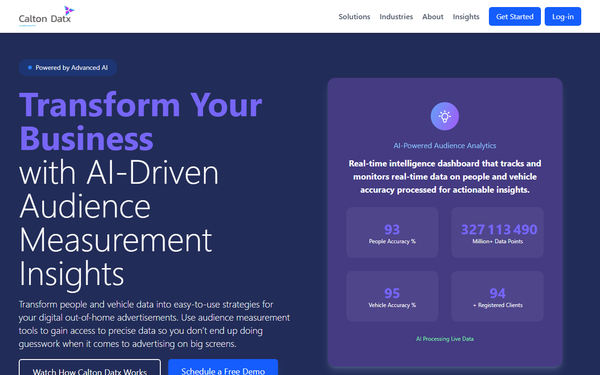
Core functionality revolves around privacy-first computer vision processing (no personally identifiable information stored) that captures live data points on audience behavior and traffic patterns, feeding them into a unified analytics dashboard for instant visualization. Standout features include real-time predictive insights, customizable web and mobile dashboards (plus a dedicated iOS app), high claimed accuracy for people tracking (around 93% in typical setups), vehicle and pedestrian path analysis, congestion monitoring, repeater detection, and direct ROI attribution for ad campaigns. The platform handles millions of data points efficiently and supports both people and vehicle analytics in one system, making it particularly strong for mixed environments like streets with billboards or retail exteriors.
Differentiators from competitors (such as generic foot-traffic counters or basic OOH tools) include its DOOH-specific focus, seamless integration of vehicle and pedestrian data for comprehensive campaign evaluation, cloud scalability without heavy on-premise infrastructure, and actionable KPI translation tailored to advertising ROI rather than just raw counts. Limitations include the necessity of compatible hardware installation (cameras/sensors, potentially including thermal options), lack of publicly detailed integrations with third-party ad platforms, and no mention of advanced AI custom modeling or open APIs for developers. No free self-service analytics layer is available beyond demos.

User Experience
The interface centers on a comprehensive, real-time dashboard described as intuitive and unified, allowing users to monitor all digital signage or location metrics in one view with customizable views for web, mobile, or iOS. Ease of use appears high for marketers familiar with analytics tools, with a moderate learning curve focused on interpreting AI-generated KPIs rather than complex setup (hardware configuration is handled via professional installation). No steep coding or data science knowledge is required.
Documentation and support resources are limited publicly but include a resources hub with case studies, industry reports, and blog posts (e.g., on measuring store traffic). Official support is enterprise-oriented: users book demos via the site, with dedicated onboarding and ongoing assistance from NYXSYS. No extensive knowledge base or video library is publicly indexed, which may slow initial adoption for smaller teams.

Performance & Reliability
Performance is positioned as highly efficient, with real-time processing of live video feeds into insights delivered without noticeable lag on the cloud platform. It excels at handling high-volume data from multiple locations, supporting large-scale DOOH networks with claimed high accuracy and reliability for campaign optimization. No major known issues or widespread user complaints appear in public sources—likely due to its relatively early-stage presence and enterprise focus—though hardware dependency means performance ties directly to camera quality and environmental factors (e.g., lighting or weather for outdoor use). Uptime and scalability are emphasized as cloud-native strengths, with privacy safeguards built in to comply with data regulations.
Pricing & Value
Pricing is not publicly disclosed and follows a custom enterprise model; users must book a demo or inquiry for quotes, with no free tier or transparent tiers listed across official or review sites. Costs likely include subscription fees (per location or campaign volume) plus hardware/setup, typical for computer-vision platforms. Value proposition is strong for mid-to-large OOH advertisers and retailers, where measurable ROI improvements (e.g., case studies cite boosts up to 300%) can justify investment compared to traditional manual counting or less specialized tools. Alternatives like basic sensor systems or competing AI analytics may offer more transparent pricing but lack Calton Datx’s integrated DOOH focus and vehicle/people hybrid tracking. Overall, it delivers high ROI potential for data-driven campaigns but may feel premium-priced for smaller operations without clear upfront costs.
Practical Tutorial
Official public tutorials are limited; the site offers case studies and a resources hub rather than step-by-step videos, with a dedicated blog post titled “How to Measure Store Traffic” available via the resources section. A practical walkthrough for a common task—setting up basic audience analytics for a billboard campaign—can be derived from platform descriptions and onboarding flow:
- Hardware Setup: Install compatible cameras or sensors (video/thermal) facing the target area (billboard or store entrance). NYXSYS provides professional guidance during onboarding to ensure optimal coverage and privacy compliance.
- Account Creation & Demo: Visit https://caltondatx.com/get-started, fill out the inquiry form, and schedule a demo to activate your cloud account.
- Dashboard Configuration: Log into the customizable web/iOS dashboard. Define zones (e.g., “billboard view area” or “pedestrian path”), select metrics (dwell time, crowd density, vehicle impressions), and integrate campaign data (ad schedule or creative IDs).
- Data Collection & Monitoring: Activate real-time tracking. View live feeds of KPIs such as impressions, engagement rate, and repeat visitors on the unified analytics screen. Set alerts for congestion or low dwell time.
- Analysis & Reporting: Generate reports with actionable insights (e.g., “Peak engagement hours: 5–7 PM, 40% uplift from targeted demographics”). Export data or link to ROI calculations for campaign adjustments.
- Optimization: Use predictive insights to refine ad placement or timing, then track improvements in subsequent reports.
For deeper examples, explore official case studies on https://caltondatx.com/resources, such as the retail chain ROI boost or media engagement reports. Full guided onboarding is provided post-purchase.
Final Verdict
Overall rating: 4.2/5 — Strong on innovative real-time AI capabilities and DOOH-specific value, tempered by limited public transparency and resources.
This tool is ideal for OOH media owners, advertisers, and retailers who manage physical campaigns and need precise, actionable audience data to prove and improve ROI in competitive markets. It should be avoided by small businesses, startups, or users seeking self-serve free tools, open documentation, or quick setup without hardware investment, as the enterprise model and installation requirements create barriers.
Calton Datx stands out as a forward-thinking solution for turning real-world foot and vehicle traffic into measurable advertising success—highly recommended for data-focused marketers ready to invest in next-level audience intelligence.