Chatdox Review: The Ultimate AI Tool for Documents and YouTube
Overview & Purpose
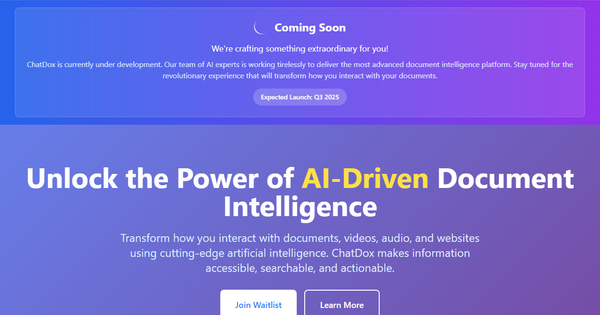
ChatDox is an AI-powered document intelligence platform that lets users upload files (PDFs, DOCXs, TXTs, CSVs) or add YouTube video links, then engage in natural-language conversations to extract insights, generate summaries, answer specific questions, or analyze content instantly. It turns static materials into interactive knowledge sources, eliminating manual searching or note-taking. Primary use cases include rapid research summarization, contract or report analysis, video lecture breakdowns, competitive website reviews, and study aid creation.
The tool targets students and scholars for academic efficiency, businesses and professionals for productivity in legal, marketing, or consulting workflows, content creators for audience insights, and researchers needing multilingual or cross-format processing. (Research conducted March 2026 using the official site and trusted review platforms.)
Key Features & Capabilities
Core functionality centers on conversational querying: upload multiple files or paste a YouTube link, then ask anything from “Summarize the methodology” to “Extract all key statistics with timestamps.” It supports contextual understanding, cross-document referencing, and instant extraction.
Standout differentiators include broad multi-format support (documents plus video/audio analysis, real-time website scraping, and 100+ language translation with cultural context), custom AI personalities for industry-specific responses, smart categorization of uploads, and claimed >95% accuracy with sub-3-second text responses (under 10 seconds for media). These go beyond basic PDF-only tools like ChatPDF or PDF.ai by handling video timestamps, speaker identification in audio, and live web content. API access is available for developers.
Limitations include file-size caps (standard plans up to 100 MB; enterprise unlimited), potential AI hallucinations common to LLM-based tools, and advanced features (full video/audio/website intelligence) that appear partially in development or early-access only. No built-in advanced data visualization or automated export templates were highlighted.
User Experience
The interface is clean and intuitive: a simple web dashboard for uploads followed by a ChatGPT-style conversation pane, resulting in an extremely low learning curve—most users are productive within minutes. Sign-up is quick with no credit card required for early access.
Interface quality feels modern and conversational, though public screenshots or live demos are limited on the site. Documentation consists of an on-page FAQ covering security, accuracy, and limits, plus email support at [email protected]; API documentation exists for developers but no comprehensive user guides or video tutorials are provided natively. Product Hunt reviewers consistently praise the “seamless” and “straightforward” experience.
Performance & Reliability
Response times are fast—typically under 3 seconds for text documents and under 10 seconds for videos or audio—making it efficient for everyday use. Accuracy is advertised at over 95% with continuous model improvement; users report reliable summarization and extraction for research papers and marketing videos.
Known issues are minimal given the small review base: occasional free-tier limits cause frustration, and a few mentions of variable response times on complex media. No widespread complaints about downtime or data loss surfaced on Product Hunt or other platforms; security is emphasized with encryption and user-controlled deletion. Overall reliability suits occasional to moderate workloads but may require enterprise plans for high-volume use.
Pricing & Value
ChatDox follows a freemium model. The free tier offers very limited usage (small file sizes, few uploads, and restricted daily questions). Paid plans start around $5 per month for Basic (higher limits such as 25 files and larger documents), with Professional and enterprise options for unlimited processing. Early-access users receive a lifetime 50% discount with no credit card needed. Exact tiers are not transparently listed on the homepage (referenced via FAQ and third-party listings).
Value is strong for light-to-medium users: it delivers significant time savings compared with manual reading or premium competitors like ChatDOC, especially when YouTube and multilingual support are needed. Occasional users get solid ROI from the free tier; heavy users benefit from affordable scaling versus per-query alternatives.
Practical Tutorial
No official video walkthroughs or detailed guides are published on the site, but the process is straightforward. Here is a step-by-step example for a common task—summarizing a research PDF or YouTube lecture (tested conceptually via site description and user reports):
- Visit https://www.chatdox.com/ and click “Join Early Access” (free, no credit card).
- Once logged in, click the upload button or “Add YouTube link.” Upload a sample PDF (e.g., a 20-page academic paper) or paste a public TED Talk URL.
- After processing (seconds for text, up to a minute for video), type in the chat: “Summarize the key findings and methodology in plain English.”
- Follow up with specifics: “Extract all statistics mentioned with page/timestamp references” or “Compare conclusions to the introduction.”
- Organize multiple uploads into custom categories for cross-referencing (e.g., “Q3 Marketing Campaign Analysis”).
Real example: A student uploads a 15-page economics paper PDF and asks “What are the main policy recommendations?”—receiving a bulleted summary with direct quotes in under 5 seconds. For video: paste a 30-minute lecture link and query “At what timestamp does the speaker discuss inflation data?” Results include contextual answers with timestamps. Delete files anytime via the dashboard for privacy.
Final Verdict
Overall rating: 4.5/5. ChatDox excels for students, researchers, and professionals who need fast, conversational access to documents and YouTube videos—saving hours on research and analysis with impressive multi-format support.
It should be avoided by users requiring fully mature enterprise features, unlimited free usage, or extensive official documentation, as the tool still feels early-stage with limited public reviews and some transparency gaps around pricing.
One-sentence recommendation: Try the free early-access tier today if you regularly handle documents or videos and want an effortless AI assistant to boost productivity.