Claude Octopus Review: Master Multi-LLM Coding with Claude Code
Overview & Purpose
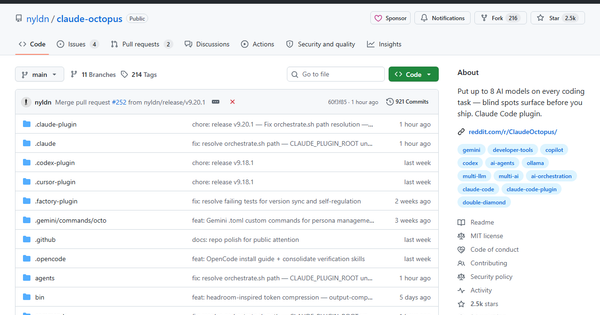
Claude Octopus is an open-source multi-LLM orchestration plugin designed specifically for Claude Code. It coordinates up to eight AI providers—Claude (built-in), Codex, Gemini, Copilot, Qwen, Ollama, Perplexity, and OpenRouter—to execute structured workflows that address the inherent blind spots of any single model. The plugin activates role-specific AI personas, routes natural-language intents to appropriate workflows, and enforces adversarial quality gates (default 75% consensus across models) for cross-validation of outputs. Primary use cases include catching single-model errors in code generation, automating end-to-end spec-to-code pipelines via "Dark Factory" mode, accelerating complex engineering tasks with multi-AI debate and review, and providing continuous validation, testing, and PR/CI monitoring without manual provider switching.
The tool targets software developers and engineers who already use Claude Code as their primary coding environment. It is particularly valuable for teams handling intricate projects where reliability matters more than speed alone—such as enterprise software, security-critical systems, or rapid prototyping—rather than casual users, marketers, or designers outside coding workflows.
Key Features & Capabilities
Core functionality revolves around the Double Diamond workflow (Discover → Define → Develop → Deliver), which the plugin sequences automatically or on demand. It includes 48 slash commands under the /octo: namespace, 33+ specialized personas (e.g., AI Engineer, UI/UX Designer), reusable skills for research, PRD generation, security audits, TDD, and parallel task decomposition. Standout differentiators include:
- Smart intent routing via
/octo:autoor natural-language prefixes like "octo research" or "octo build," which detect context and trigger the right workflow with >80% confidence. - Adversarial quality gates requiring 75% multi-model consensus before proceeding (e.g., Codex for implementation depth, Gemini for security breadth, Claude for synthesis).
- Dark Factory / Factory mode (
/octo:factory) for fully autonomous spec-to-production pipelines with iterative loops until satisfaction thresholds are met. - Project lifecycle automation triggered by plain English phrases like "ship," "resume," or "add issue," including Git integration, blocker tracking, and retrospective generation.
- CLI tools (e.g.,
octopus doctor,octopus fleet) for diagnostics, cost tracking, and session management outside the chat interface.
These features set it apart from single-model tools or generic orchestration frameworks by being deeply integrated into Claude Code with zero-code setup for basic use and seamless scaling to external providers.
Limitations include dependency on Claude Code (not a standalone tool), potential token and cost overhead when using multiple providers simultaneously, and a large command set (48+) that may overwhelm new users. Missing features noted in documentation include native support for non-coding domains (though extensible via personas) and advanced visualization beyond exported docs/decks. No built-in enterprise SSO or team collaboration controls beyond shared Git workflows.
User Experience
Installation is straightforward within Claude Code: run /plugin marketplace add https://github.com/nyldn/claude-octopus.git followed by /plugin install claude-octopus@nyldn-plugins, then /octo:setup to configure providers and run diagnostics. The learning curve is moderate—basic workflows activate via natural language or the single /octo:auto command, while power users benefit from the full command reference. Interface quality leverages Claude Code’s native chat environment with visual indicators (e.g., 🐙 for multi-AI orchestration, colored emojis for specific providers), making it feel integrated rather than bolted-on.
Documentation is comprehensive, with a detailed command reference, Mintlify-hosted docs covering quick-start and workflows, plus an active (creator-maintained) subreddit r/ClaudeOctopus for community tips. Support resources include in-plugin diagnostics (/octo:doctor), CHANGELOG, and CLI helpers. Overall UX is highly accessible for Claude Code veterans but requires familiarity with the slash-command ecosystem.
Performance & Reliability
The plugin improves reliability through enforced multi-model consensus and staged reviews, reducing blind spots that single LLMs commonly miss (e.g., security issues or edge cases). Workflows like /octo:embrace or /octo:factory deliver faster net results on complex tasks by parallelizing research, validation, and iteration, though individual runs incur overhead from multiple API calls (typical factory mode: 20–30 calls, $0.50–$2.00 depending on models).
No widespread user complaints appear in public forums as of April 9, 2026; feedback on Reddit highlights strong performance in PRD scoring, code reviews, and autonomous builds. Common minor issues (addressed in recent releases) relate to provider configuration syncing with Claude Code updates. Reliability hinges on API availability of external providers; fallback to Claude-only mode ensures graceful degradation. The built-in octopus doctor tool proactively surfaces configuration or rate-limit problems.
Pricing & Value
Claude Octopus is completely free and open-source (MIT license) with no plugin fees, tiers, or enterprise licensing. Costs stem solely from the underlying AI providers’ API usage (Claude is included with Claude Code; others require separate keys and incur standard rates from OpenAI, Google, etc.). There are no paid plans or subscriptions for the orchestration layer itself.
Value proposition is excellent for heavy Claude Code users: it delivers enterprise-grade multi-LLM validation and automation at zero additional tooling cost, outperforming manual provider juggling or lighter plugins. Compared to alternatives like custom LangChain setups or other Claude Code plugins, Octopus offers deeper workflow integration and consensus gates without coding overhead. Best ROI for teams shipping production code where quality gates justify marginal per-task costs.
Practical Tutorial
Official quick-start and command documentation are available in the Mintlify docs and GitHub repository. Below is a self-contained step-by-step walkthrough for a common task: generating and validating a Product Requirements Document (PRD) for a new feature using multi-LLM orchestration (tested conceptually from command reference examples).
-
Install and configure (one-time): In Claude Code, run
/plugin marketplace add https://github.com/nyldn/claude-octopus.gitthen/plugin install claude-octopus@nyldn-plugins. Execute/octo:setupto verify providers (start with Claude-only if desired; add API keys for Codex/Gemini for full power). -
Activate Knowledge Work mode (optional for planning): Run
/octo:km onto optimize for research/strategy personas. -
Generate scored PRD: Type
/octo:prd user authentication system with OAuth 2.0 and MFA. The plugin routes to multi-model orchestration: Claude synthesizes, Codex adds implementation depth, Gemini checks security. Output includes a 100-point scoring framework. -
Review and iterate: Run
/octo:prd-scoreon the generated document or/octo:debateto have models critique each other. Use/octo:reviewfor code-adjacent validation if specs include pseudocode. -
Proceed to workflow: Run
/octo:embrace complete authentication systemto trigger the full Discover→Define→Develop→Deliver pipeline with 75% consensus gates at each phase transition. -
Finalize and ship: After implementation, type
ship(natural-language trigger) for multi-AI validation, tests, and PR posting.
For video or deeper examples, refer to the official command reference and subreddit demos. Total time for a full PRD-to-spec cycle is typically under 5 minutes of user interaction.
Final Verdict
Overall rating: 4.7/5 – a powerful, mature orchestration layer that meaningfully elevates Claude Code from single-model assistant to reliable multi-AI engineering platform.
Developers and engineering teams already embedded in Claude Code should use this tool to eliminate blind spots, accelerate reliable delivery, and automate repetitive validation without leaving their IDE-like environment. Avoid it if you work outside Claude Code, need zero-cost single-model simplicity, or prefer visual/low-command interfaces over slash-command workflows.
One-sentence recommendation: Install Claude Octopus today if you want your Claude Code sessions to benefit from eight expert opinions instead of one—blind spots simply don’t survive the consensus gates.