Confident AI Review: The Ultimate LLM Evaluation & Testing Tool
Overview & Purpose
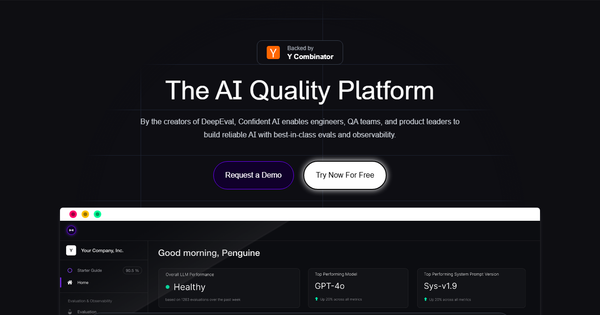
Confident AI is the leading AI quality platform for evaluating, observing, and improving LLM applications from prototyping through production. Built by the creators of DeepEval—the most adopted open-source LLM evaluation framework with over 14,000 GitHub stars—it turns raw LLM traces into curated datasets, datasets into rigorous evaluations, and evaluations into actionable experiments, all without heavy engineering overhead. Primary use cases include pre-deployment regression testing, production monitoring with real-time alerts, multi-turn chatbot simulations, automated dataset curation from live traffic, prompt versioning with git-like branching, A/B testing, and centralized AI risk assessments (red teaming) for regulated industries.
It targets engineering, QA, and product teams at companies of all sizes building LLM-powered applications such as RAG systems, agents, chatbots, and summarization tools. Cross-functional collaboration is a core strength: engineers use code-driven workflows, while product owners and non-technical users leverage no-code interfaces for testing and monitoring. As of research conducted on March 15, 2026, the platform has powered over 8 billion evaluations and serves more than 500 leading AI companies.

Key Features & Capabilities
Core functionality revolves around DeepEval-powered evaluations (40+ research-backed metrics including Answer Relevancy, Faithfulness, Hallucination Detection, G-Eval, Contextual Relevancy, and safety metrics like PII Leakage, Bias, and Misinformation) combined with full-stack observability. Standout capabilities include:
- LLM tracing with spans, threads, and zero-latency async ingestion for debugging tool calls, latency, costs, and metadata.
- Auto-curation of evaluation datasets directly from production traces, with failure categorization.
- Rapid chat simulations (thousands of multi-turn conversations in minutes).
- Git-based prompt versioning synced to codebases, with evaluation-gated merges.
- No-code endpoint testing (Postman-like interface for HTTP/streaming) and online evaluations on live traces.
- A/B regression testing, model/prompt scorecards, human-in-the-loop annotation, and PDF-ready red teaming reports.
- CI/CD integration and real-time performance alerting.
Differentiators from competitors like LangSmith or OpenLayer include its evaluation-first philosophy (evals as a first-class citizen rather than secondary analytics), fully open-source DeepEval metrics (preventing vendor lock-in), generous free tier, cheaper tracing at $1/GB-month, and native support for complex agentic/RAG workflows with both overall and component-level assertions. Integrations span 20+ frameworks including LangChain, LlamaIndex, LangGraph, CrewAI, Vercel AI SDK, and OpenTelemetry.
Limitations include reliance on LLM-as-a-judge approaches (which can introduce variability or bias in edge cases), Python-centric core for advanced custom metrics (though TypeScript tracing and no-code options mitigate this), and free-tier restrictions on test runs and data retention. Self-hosting is enterprise-only, and some advanced automation requires paid tiers.

User Experience
Setup is straightforward: create a free account, install the DeepEval SDK via pip install -U deepeval, and configure the CONFIDENT_API_KEY environment variable—typically under 5 minutes. The interface features clean, modern dashboards with AI-generated summaries, score distributions, and interactive test-case debugging. No-code workflows (available from Starter/Premium tiers) allow non-engineers to run evaluations via simple UI selections, while code users enjoy pytest-style testing.
Documentation is excellent—well-structured with role-specific quickstarts, code examples, and FAQs—making the learning curve gentle for developers familiar with Python or testing frameworks. Advanced features (e.g., custom metrics or component-level agent evals) introduce a moderate curve, as noted in user feedback. Support includes community Discord (2,500+ members), extensive docs, email assistance, and priority/dedicated channels for paid plans. Overall, the platform earns praise for reliability and collaboration, with Gartner reviewers highlighting "truly exceptional" performance despite the advanced-features learning curve.

Performance & Reliability
Evaluations and tracing run efficiently, with local DeepEval execution offering full control and cloud runs enabling seamless team collaboration. Chat simulations scale to thousands in minutes, and async tracing adds zero latency overhead. Billions of evaluations have been processed platform-wide with consistent results, and production monitoring includes real-time alerts for regressions.
No major known issues or widespread complaints appear in public reviews or forums as of March 2026; users on Reddit and comparison analyses commend its handling of complex agent simulations and RAG evaluations over alternatives. Reliability is reinforced by SOC2 Type II, HIPAA compliance (Premium+), 99.9% uptime SLA for enterprise, and enterprise-grade security features like data masking and RBAC.
Pricing & Value
Confident AI offers transparent, usage-based pricing with a generous free tier (no credit card required):
- Free: $0 – unlimited traces (1 GB-month limit), 5 test runs/week, 1-week retention, basic evals/tracing/prompt versioning (limited to 2 users/1 project).
- Starter: From $19.99/user/month – full testing suite, custom metrics, online evals, email support, 1 GB-month included traces (+$1/GB-month extra), 5k online metric runs/month.
- Premium: From $79.99/user/month – no-code workflows, real-time alerts, dataset history, priority support, 15 GB-months included traces, HIPAA/SOC2 add-ons.
- Team/Enterprise: Custom – unlimited projects/users, SSO, dedicated support, on-prem options, AI red teaming, unlimited runs/traces.
Value stands out for evaluation-focused teams: tracing is among the cheapest on the market, the open-source core avoids lock-in, and comprehensive metrics/regression tools accelerate reliable shipping. Compared to LangSmith, it offers a more generous free tier, stronger RAG/agent evaluation depth, and flexible annotation—making it superior for quality-first LLMOps without heavy observability bloat.
Practical Tutorial
A common task is running your first single-turn end-to-end LLM evaluation (pre-deployment regression testing). This walkthrough follows the official quickstart and can be completed in under 15 minutes. Full details and updates are available in the official documentation: https://www.confident-ai.com/docs/llm-evaluation/quickstart.
Step 1: Setup
Create a free account at https://app.confident-ai.com/auth/signup. Retrieve your project API key from the dashboard. Install the SDK:
pip install -U deepevalSet the environment variable:
export CONFIDENT_API_KEY="confident_us_..."(For OpenAI-based LLM-as-a-judge metrics, also export OPENAI_API_KEY.)
Step 2: Create a Dataset (in main.py)
from deepeval.dataset import EvaluationDataset, Golden

goldens = [
    Golden(input="What's the weather like in SF?")
]

dataset = EvaluationDataset(goldens=goldens)
dataset.push(alias="weather-test-dataset")  # Appears instantly on the Confident AI dashboard
Step 3: Define a Metric
from deepeval.metrics import AnswerRelevancyMetric

relevancy = AnswerRelevancyMetric()
Step 4: Run the Evaluation
Replace llm_app with your actual function or endpoint:
from deepeval.dataset import EvaluationDataset
from deepeval.test_case import LLMTestCase
from deepeval import evaluate

dataset = EvaluationDataset()
dataset.pull(alias="weather-test-dataset")

for golden in dataset.goldens:
    test_case = LLMTestCase(
        input=golden.input,
        actual_output=llm_app(golden.input)  # Your LLM call here
    )
    dataset.add_test_case(test_case)

evaluate(test_cases=dataset.test_cases, metrics=[relevancy])
Step 5: View Results
A detailed test-run report appears automatically on the Confident AI dashboard, showing metric scores, distributions, AI-generated summaries, and pass/fail insights. Multiple runs enable instant A/B regression comparisons. For no-code alternatives (non-Python teams), the platform UI allows creating metric collections and datasets directly, then running evaluations with one click—ideal for product teams.
Final Verdict
Overall rating: 4.8/5. Confident AI is ideal for engineering and QA teams building production LLM applications who need open-source flexibility, deep evaluation metrics, collaborative dashboards, and cost-effective observability—especially those using Python or seeking compliance-ready workflows. It excels at preventing regressions and scaling quality without vendor lock-in.
Teams should avoid it if they require purely no-code solutions from day one (though no-code features exist in paid tiers), have extremely heavy non-Python stacks, or prefer APM-style observability over evaluation-first tooling.
Highly recommended: the best open-source-powered platform for shipping reliable LLM apps with confidence in 2026.