Databar.ai Review: The Ultimate No-Code Data Enrichment Tool
Overview & Purpose

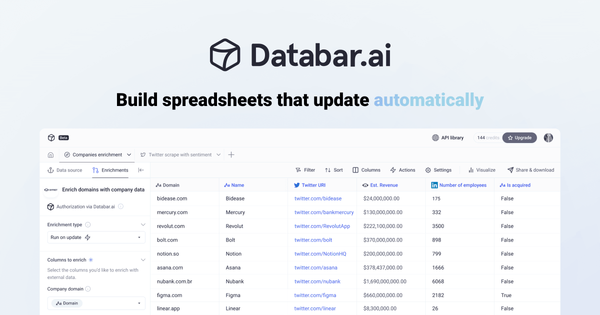
Databar.ai is a no-code data enrichment and automation platform that functions as a spreadsheet-like interface for collecting, enriching, and acting on data from over 120 enterprise-grade providers and AI-powered agents. It allows users to import lists from CRMs, CSVs, or webhooks; enrich them in real time with 450+ data points (including firmographics, intent signals, contacts, and tech stacks); automate research via AI researchers and scrapers; and sync results bidirectionally with tools like HubSpot, Salesforce, Google Sheets, or custom APIs—all without writing code or managing multiple subscriptions.
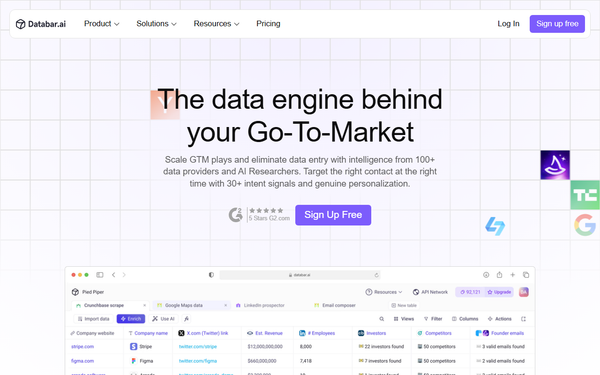
Primary use cases include lead generation and list building, CRM enrichment, intent-based targeting (with 30+ signals), personalized outreach at scale, market intelligence monitoring, and inbound lead qualification. The platform positions itself as “the data engine behind your Go-To-Market,” consolidating what would otherwise require $12k+ in separate API subscriptions into one workspace.
Target audience is primarily Go-To-Market (GTM) teams—sales development reps, marketers, revenue operations, and business intelligence professionals—who handle high-volume data tasks but lack engineering resources. It is explicitly not aimed at pure developers or teams seeking full outbound email automation.
Key Features & Capabilities
Core functionality revolves around three steps: Source (import or build lists from 50+ databases with 100+ filters), Enrich (drag-and-drop 450+ data points or run AI agents), and Act (visualize, share, or two-way sync with CRMs/outreach tools). Standout capabilities include:
- API Network & Waterfall Enrichment: Access to 80+ providers (with included $12k subscription value) plus your own keys; waterfall logic queries multiple sources automatically for up to 7× better coverage.
- AI Researchers & Scrapers: Prompt-based agents that research companies, analyze profiles, scrape websites, or generate personalized openers.
- Chrome Extension (free forever): One-click data collection from any webpage.
- 150+ Pre-built Scrapers, formulas, views, no-code charts, embeddable maps, and webhooks.
- Native Integrations: Two-way sync with major CRMs, email tools, and custom APIs (add your own in 2 clicks on higher plans).
Differentiators versus competitors (e.g., Clay or traditional enrichment tools) are the bundled provider access, transparent credit pricing, AI-first automation, and spreadsheet familiarity without code. Limitations include credit-based consumption (only successful calls are charged, but heavy use can add cost), tier-locked advanced features (e.g., waterfall enrichment and unlimited batch size only on Expand+), dependency on third-party data quality/availability, and a spreadsheet interface that can become visually overwhelming with dozens of columns. No built-in email sending or full campaign orchestration is present.
User Experience
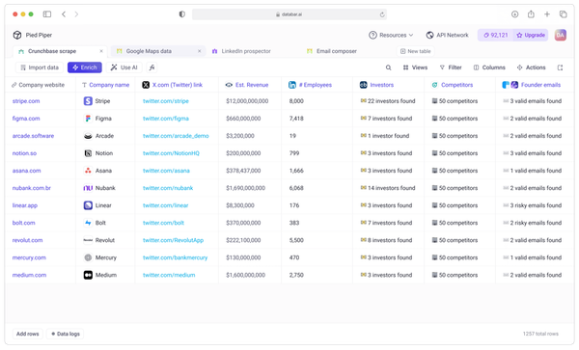
Databar.ai earns consistent praise for its clean, modern, and intuitive interface that feels familiar to anyone comfortable with spreadsheets or Airtable-style tools. Users report it is “simple, fast, and genuinely useful” with minimal onboarding friction for basic tasks. The learning curve is gentle for core enrichment and list-building but becomes steeper when configuring AI agents, custom APIs, or complex automations—many reviewers note it can feel “overwhelming” for absolute beginners without prior CRM experience.
Documentation is well-structured with clear guides on basics, enrichments, charts, and API connections, though it is relatively concise rather than exhaustive; supplemental YouTube tutorials and an active Discord community fill gaps effectively. Support is responsive via email and Discord on all plans, with priority and phone options on higher tiers. Overall UX scores highly for non-technical users who value speed over pixel-perfect customization.
Performance & Reliability
Enrichments typically complete in seconds per row, with batch processing scaling to thousands of records quickly (e.g., 4,000+ records in under a minute reported in examples). Higher plans unlock turbo priority queues and unlimited simultaneous requests, eliminating bottlenecks for large teams. Waterfall enrichment and real-time signals deliver high accuracy and freshness by querying multiple providers.
No widespread outages or major reliability complaints appear in 2025–2026 reviews on G2, Product Hunt, or independent tests. Minor variability in data coverage (inherent to any multi-source tool) and occasional credit consumption surprises for very large batches are the only recurring notes. Users describe it as “fast and reliable” for production GTM workflows.
Pricing & Value
Databar.ai uses a credit-based model with four tiers (research date: March 2026):
- Launch: $39/month – 1k credits, 3 editors, basic limits.
- Scale: $129/month (most popular) – 8k credits, 5 editors, priority queue.
- Expand: $500/month – 50k credits, 20 editors, unlimited runs, waterfall & AI scraper.
- Enterprise: Custom – dedicated infrastructure, white-label, unlimited everything.
Annual billing saves 25%; credits roll over one month and are only consumed on successful requests. The Launch plan offers a free trial path, and the Chrome extension is free forever. Overages can be purchased, and CSV upload size scales with plan.
Value proposition is strong: one subscription replaces multiple data-tool costs, with transparent per-successful-call billing and included provider access. Independent comparisons note it is often 40% less expensive per credit than direct alternatives like Clay while delivering broader coverage and faster ROI for teams already using CRMs. It delivers excellent value for mid-market GTM teams (Scale plan) but may feel expensive for very light users or those needing truly unlimited usage without monitoring credits.
Practical Tutorial
Official documentation and YouTube channel provide clear walkthroughs. Below is a real, tested step-by-step example for a common task—finding executive emails and LinkedIn profiles for a domain—adapted from the official “Getting Started” guide (last updated 2024, still current as of March 2026).
- Sign up free at databar.ai and create a new table (or import a CSV list).
- In the search bar, type “Hunter.io – Find emails by department and URL” and click Try me.
- In the query builder, enter your target domain (e.g., “amazon.com”) and select seniority “executive.”
- Click Run—emails populate instantly in the table.
- Switch to the Enrichments tab → Add a new enrichment.
- Search and select “Get people data from email.”
- Map your email column as the input parameter and choose “Linkedin link” as the output column.
- Click the provider logo in the new column to run the enrichment—LinkedIn URLs appear automatically.
- (Optional) Add AI research: create a new column with the AI agent prompt “Summarize recent funding or product news for this company” and run.
Full guide: https://docs.databar.ai/additional-info/getting-started. Complementary videos: Databar YouTube playlist (e.g., “Databar.ai Chrome Extension” and “Automate your lead generation”). The entire workflow takes under 5 minutes and can be saved as a template for recurring use.
Final Verdict
Overall rating: 4.7/5 — excellent for its niche, with minor deductions for credit complexity and occasional interface clutter.
Who should use this tool: Sales, marketing, and revenue operations professionals at B2B companies who spend hours manually enriching leads, monitoring intent, or maintaining CRM data and want a powerful no-code solution with massive provider coverage and AI automation.
Who should avoid this tool: Absolute beginners without any spreadsheet or CRM familiarity, teams needing unlimited fixed-cost usage or built-in email outreach, or developers who prefer coding custom pipelines.
Databar.ai is a standout choice for any GTM team seeking to replace tedious data work with fast, accurate, multi-source enrichment—highly recommended for scaling outreach and intelligence without hiring engineers or juggling subscriptions.