Daydrm AI Review: The Ultimate AI Partner for Ad Creatives
Overview & Purpose

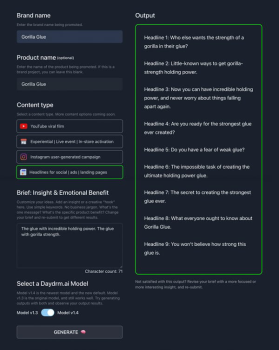
Daydrm.ai is an AI-assisted creativity platform that generates strategic briefs and creative advertising concepts on-demand. It leverages a large language model trained on a custom-built dataset of human-written, award-winning advertising campaigns to produce tailored ideas for creatives, strategists, and production teams. Primary use cases include developing YouTube viral films, experiential and live events or in-store activations, interactive/digital/mobile activations, Instagram user-generated content (UGC) campaigns, and headlines for social media, ads, and landing pages. It also supports multi-format output generation and collaborative iteration.
The tool targets creative professionals such as creative directors, strategists, copywriters, marketers, and agency teams at brands, studios, and corporate communications departments. It serves as a specialized alternative to generic AI tools like ChatGPT, focusing exclusively on advertising creativity rather than broad content generation. As of April 12, 2026, Daydrm.ai positions itself as “human-led, AI-assisted creativity” to accelerate ideation while preserving human oversight.
Key Features & Capabilities
Core functionality revolves around two main generators: a multi-output creative idea generator that produces three concepts simultaneously from a single brief, and an AI creative partner named “Ari” for natural chat-based collaboration and revisions. Users can save outputs to custom folders organized by client, project, campaign, or content type. The platform emphasizes data privacy—inputs and outputs remain private, the model does not train on user data, and users retain ownership of generated ideas.
Standout features include its bespoke training data compiled exclusively from recognized ad campaigns, enabling more relevant and campaign-ready outputs than general-purpose LLMs. The multi-output format and Ari’s pair-like collaboration mimic real creative team workflows, differentiating it from competitors that lack advertising-specific training or iterative chat partners. Additional tools cover strategy briefs alongside creative execution ideas.
Limitations include dependence on high-quality, specific briefs (insight plus emotional benefit language yields best results), outputs often serving as strong starting points rather than fully polished campaigns, and no built-in production or visual asset generation beyond text concepts. It lacks advanced image/video integration or full-funnel campaign management found in broader marketing suites. Some users note it performs best as a brainstorm accelerator rather than a replacement for human creativity.
User Experience
Daydrm.ai features a clean, intentionally simple interface that was user-tested with real strategists and creatives. Navigation is straightforward: users access the multi-output generator or Ari chat directly from the homepage with no steep learning curve for experienced ad professionals. The chat interface with Ari feels conversational and collaborative, similar to working with a human partner.
Ease of use is a strength, with free credits available immediately upon visiting the site (no credit card required). Saving and organizing ideas into folders adds practical workflow value. Documentation is concise via an FAQ section covering ownership, privacy, and best practices for briefs. Support includes help resources within paid plans; video demos on the site demonstrate the generators and Ari in action. Minor feedback from reviews indicates newer users may need a moment to master optimal brief-writing, but overall the platform earns high marks for intuitive design.
Performance & Reliability
Generation is fast—typically delivering results in seconds—making it efficient for rapid ideation sessions. Testimonials and early reviews highlight reliable, high-quality starting concepts that align well with brand tone and campaign objectives when briefs are detailed. The tool has no reported major downtime or consistency issues as of April 2026.
Common user feedback praises outputs as “pretty good starting points” or “jumping-off points for first thoughts,” with some noting occasional generic elements typical of AI tools. G2 reviews (4.6/5 from a small set of users) mention strong performance for social and branding ideas but emphasize the need for human refinement. No widespread complaints about reliability or speed appear in available sources; privacy controls function as advertised with no model learning from user inputs.
Pricing & Value
Daydrm.ai offers flexible, accessible pricing with a low barrier to entry. New users receive free credits for testing all generators without a credit card. Paid options include:
- Day Rate: $5 for 24-hour unlimited access to all generators (one-time purchase, ideal for short projects).
- Monthly: $9 per month for unlimited access (self-managed, cancel anytime).
- Annual: $86 per year (20% savings over monthly).
Enterprise or agency-specific plans with dedicated databases and custom domains (e.g., bbdo.daydrm.ai) are available via direct inquiry but not detailed on the standard pricing page.
Value is strong for frequent users or agencies: at under $10/month it undercuts many general AI writing tools while delivering advertising-specialized outputs. Compared to alternatives like generic LLMs or broader platforms (Canva, Anyword), Daydrm.ai provides higher relevance for ad creatives at a competitive price. The day-rate option suits freelancers or one-off needs. Reviews describe it as cost-effective for ideation acceleration, though some note it may feel expensive for very light or infrequent use.
Practical Tutorial
A step-by-step walkthrough for generating a YouTube viral film concept (based on official site flow and FAQ guidance; video demos available on daydrm.ai):
- Visit https://www.daydrm.ai/ and use free credits (no sign-up required initially) or create a free account for full folder features.
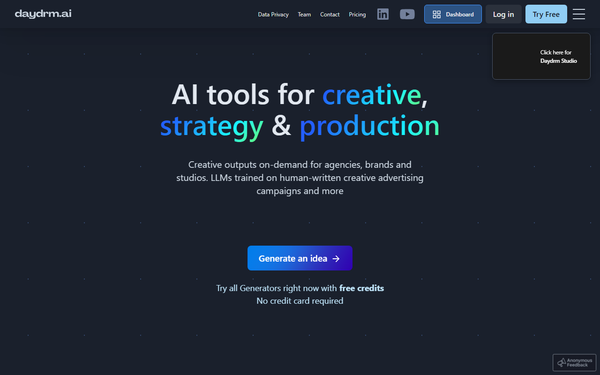
- Click “Generate an idea” to open the multi-output generator or navigate directly to the creative generator.
- Craft a detailed brief including brand context, insight, and emotional benefit (example: “Brand: Eco-friendly running shoes. Insight: Urban runners feel disconnected from nature during city jogs. Emotional benefit: A sense of freedom and reconnection that energizes their entire day.”).
- Select desired formats (e.g., YouTube viral film) and click generate. The system will produce three concepts simultaneously.
- Review outputs. For refinement, open the Ari AI creative partner chat, paste a specific idea, and collaborate conversationally (“Make this more humorous” or “Add a twist ending”).
- Save promising concepts to a custom folder (organize by client/project or content type like “YouTube Viral”).
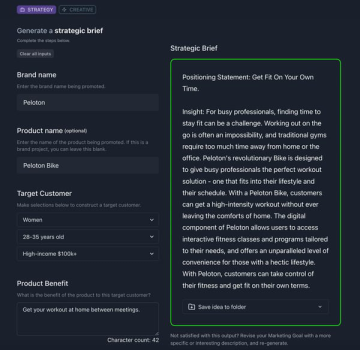
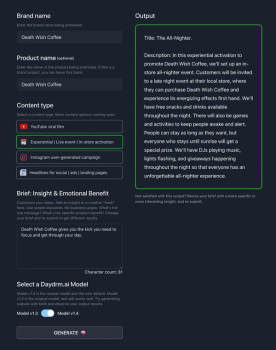
- Export or iterate as needed. For best results, experiment with brief specificity—site examples include Peloton strategy briefs and Death Wish Coffee creative concepts.
Official video walkthroughs are embedded on the homepage under “Watch the creative idea generator in action” and “Watch how to generate ideas with an AI creative partner.”
Final Verdict
Overall rating: 4.5/5. Daydrm.ai excels as a specialized, privacy-focused ideation partner for advertising professionals who need fast, campaign-relevant concepts without the noise of general AI tools. It shines for agencies, in-house creative teams, and strategists seeking to accelerate brainstorming while maintaining human creative control.
Who should use this tool: Creative directors, copywriters, and marketing teams at agencies or brands that value advertising-specific training data and collaborative AI workflows—especially those handling frequent campaign development.
Who should avoid this tool: Absolute beginners unfamiliar with advertising briefs, teams needing full visual production assets, or users on extremely tight budgets who only require occasional generic copy.
One-sentence recommendation: If you’re a creative professional tired of generic AI outputs and want a dedicated advertising ideation partner that feels like working with a talented junior creative, Daydrm.ai is worth the modest investment.