DeepSeek-V3 Review: The Best High-Performance Open-Source AI
Overview & Purpose
DeepSeek-V3 is a powerful open-weight large language model developed by DeepSeek AI, featuring a Mixture-of-Experts (MoE) architecture with 671 billion total parameters but only 37 billion activated per token. It excels at complex reasoning, coding, mathematics, and general language tasks, making it suitable for applications ranging from software development assistance and mathematical problem-solving to research analysis and educational tools. Primary use cases include code generation and debugging, advanced math computations, logical reasoning chains, and high-volume inference workloads where cost and efficiency matter.
Its target audience spans software developers and engineers (especially those building AI-powered coding tools), researchers in AI and data science, educators and students tackling STEM subjects, and businesses seeking affordable, deployable AI for internal tools or commercial products. Both individual users and enterprises benefit from its open-source nature, which democratizes access to frontier-level capabilities without vendor lock-in.
This review is based on research conducted as of March 2026, drawing from official sources, benchmarks, and user feedback across platforms.
Key Features & Capabilities
At its core, DeepSeek-V3 delivers high-performance text generation and reasoning through an efficient MoE design that routes tokens to specialized experts, dramatically reducing computational overhead compared to dense models of similar scale. Standout innovations include Multi-Head Latent Attention (MLA) for compressed key-value caching and improved long-context handling, Multi-Token Prediction (MTP) for faster inference via speculative decoding, and FP8 mixed-precision training that lowers resource demands during both training and deployment. It supports a 128K-token context window (with some reports noting effective extension to 163K in practice) and has been pre-trained on approximately 14.8 trillion tokens, yielding strong multilingual performance with particular strength in English and Chinese.
These features differentiate it from competitors like Llama 3.1 or Qwen2.5 by achieving comparable or superior results in technical domains while using far fewer active parameters and offering fully open weights under a permissive license for commercial use. It rivals closed models such as GPT-4o and Claude-3.5-Sonnet on benchmarks like MATH, HumanEval, and MMLU-Pro, often at a fraction of the inference cost.
Limitations include its text-only nature (no native vision or multimodal capabilities, unlike models with integrated image understanding), higher hardware requirements for full-precision local runs (though quantization and frameworks like vLLM or SGLang mitigate this), and occasional tendencies toward repetitive outputs or reduced performance on highly nuanced "trick" attention tests due to optimizations in its architecture. It also lacks some enterprise-grade features found in proprietary platforms, such as built-in advanced tool-calling ecosystems or extensive safety guardrails out of the box.
User Experience
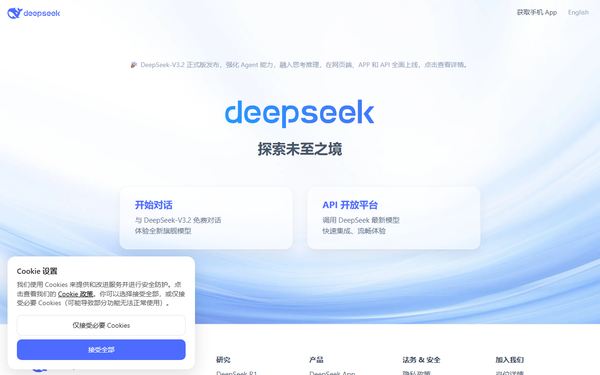
DeepSeek-V3 offers multiple access points with a low learning curve for most users. The web chat interface at chat.deepseek.com provides instant, free access with a clean, ChatGPT-like layout—simple prompt input, conversation history, and basic formatting options—making it approachable for beginners. For developers, the API is fully OpenAI-compatible, allowing seamless integration with existing codebases via the official SDK or libraries like LangChain. Local deployment via Hugging Face Transformers, Ollama, or llama.cpp requires more setup but follows standard LLM workflows.
Documentation is comprehensive and developer-friendly: the GitHub repository includes detailed inference guides, model cards, and example scripts, while the official API docs provide clear endpoint references, rate-limit explanations, and code samples. Community support thrives on platforms like Reddit and Discord, supplemented by the company's responsive updates. Overall, the experience feels polished and efficient, with minimal friction for technical users, though non-technical users may prefer more guided consumer interfaces from competitors.
Performance & Reliability
Inference speed is a highlight thanks to the MoE architecture and MLA optimizations, delivering high tokens-per-second rates even on modest hardware clusters—often outperforming denser models in throughput while maintaining low latency for 128K contexts. Benchmarks consistently place it at or near the top among open-source models, with competitive results against frontier closed models in coding (e.g., 82.6% on HumanEval), math, and reasoning tasks.
Reliability is strong for production use, with few widespread outages reported on the API platform. Common user complaints include occasional repetitiveness in long generations, sensitivity to prompt phrasing in edge-case reasoning (stemming from post-training optimizations), and longer response times when running locally without heavy quantization. Some users note privacy-related hesitations due to the company's Chinese origin and terms of service, though no major security breaches have been documented. Overall, it proves highly dependable for technical workloads when deployed appropriately.
Pricing & Value
DeepSeek-V3 follows a highly accessible cost structure. The web chat is completely free for personal use with generous limits. The API offers one of the industry's lowest rates: approximately $0.27 per million input tokens (cache miss), dropping to $0.07 on cache hits, and $1.10 per million output tokens—making it 10-30x cheaper than GPT-4o or Claude equivalents for comparable performance. Open-source weights enable unlimited local or self-hosted deployment at zero marginal cost beyond hardware.
Value is exceptional: users gain near-frontier capabilities at open-source prices, with full commercial rights and no usage restrictions beyond standard licensing. Compared to alternatives, it delivers superior price-to-performance for coding and math workloads, though enterprises needing multimodal support or ultra-polished safety features may find proprietary options worth the premium.
Practical Tutorial
A common task—generating and explaining Python code for a specific algorithm—is straightforward via the official API (OpenAI-compatible) or web chat. Here is a step-by-step walkthrough using the Python SDK for a real example: implementing a function to compute the nth Fibonacci number with memoization, including unit tests.
- Sign up for a free API key at platform.deepseek.com (top-up optional for heavy use; free tier available for testing).
- Install the OpenAI-compatible client:
pip install openai. - Create a script (e.g.,
deepseek_fib.py):
from openai import OpenAI

client = OpenAI(
    api_key="YOUR_DEEPSEEK_API_KEY",
    base_url="https://api.deepseek.com"
)

response = client.chat.completions.create(
    model="deepseek-chat",  # Uses DeepSeek-V3
    messages=[
        {"role": "system", "content": "You are a helpful coding assistant."},
        {"role": "user", "content": "Write a Python function to compute the nth Fibonacci number using memoization. Include unit tests with pytest and explain the time complexity."}
    ],
    temperature=0.7,
    max_tokens=1024
)

print(response.choices[0].message.content)- Run the script:
python deepseek_fib.py. The model typically returns clean, well-commented code like:
def fibonacci(n: int) -> int:
    memo = {0: 0, 1: 1}
    def fib(k):
        if k in memo:
            return memo[k]
        memo[k] = fib(k-1) + fib(k-2)
        return memo[k]
    return fib(n)

# Unit tests (save as test_fib.py and run with pytest)
import pytest
def test_fib():
    assert fibonacci(0) == 0
    assert fibonacci(5) == 5
assert fibonacci(10) == 55- Time complexity explanation appears automatically in the response (O(n) time and space).
For local use without API costs, download from Hugging Face (deepseek-ai/DeepSeek-V3) and run with transformers or Ollama (ollama run deepseek-v3). Official tutorials are available in the GitHub repository and API documentation.
Final Verdict
DeepSeek-V3 earns a 9.2/10 rating for its groundbreaking efficiency and accessibility.
Developers, researchers, educators, and cost-conscious organizations should use it for its unmatched performance-to-price ratio in coding, math, and reasoning tasks combined with full open-source freedom.
Avoid it if you require native multimodal capabilities, operate under strict data-sovereignty regulations preferring Western providers, or need a consumer-focused interface with heavy moderation.
One-sentence recommendation: If you're seeking frontier-level AI performance without the premium price tag or proprietary restrictions, DeepSeek-V3 is the smartest open-source choice available today.