Devv AI Review: Build and Deploy Full-Stack AI Apps Fast
Overview & Purpose
Devv AI is a versatile AI-powered platform that enables users to build, iterate on, and deploy full-stack AI web applications using natural language prompts. Originally launched in 2023 as a developer-centric search engine that combined large language models with real-time data from sources like Stack Overflow, GitHub, and DevDocs for accurate coding answers, it has since evolved into a comprehensive AI coding agent and app builder. As of March 2026, its primary purpose is to accelerate product development by handling everything from code generation to backend integrations, allowing rapid prototyping and shipping of production-ready AI apps without requiring extensive manual coding or piecing together disparate services.
Primary use cases include creating AI-powered tools (such as task managers with intelligent prioritization, invoice generators, or image-processing apps), streamlining developer workflows through contextual assistance, and enabling non-technical creators to turn ideas into live web products. The target audience spans professional developers seeking productivity boosts, indie builders and small teams focused on MVPs, and even non-technical creators or marketers who want to prototype AI features quickly. While it retains elements of its original search capabilities (now accessible via "Devv Search" in paid plans), the platform's focus has shifted toward end-to-end app creation for faster "generate and ship" results.
Key Features & Capabilities
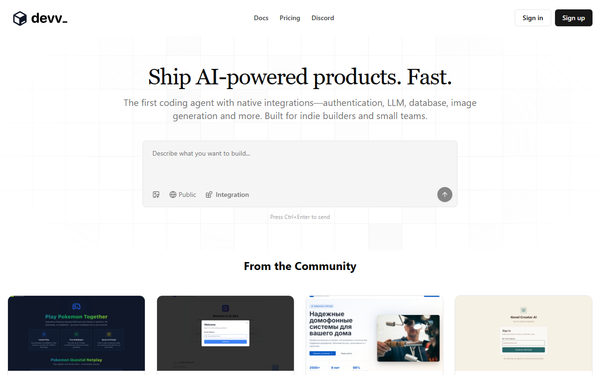
Core functionality revolves around a natural language interface where users describe an app or feature, and the AI Coding Agent generates, refines, and deploys the full-stack application—including frontend, backend logic, database setup, and AI integrations. Standout features that differentiate it from competitors include native backend integrations (authentication, database storage, LLM providers like OpenRouter, image generation via services such as ElevenLabs, and more), seamless preview and iteration via follow-up chat prompts, one-click deployment with custom domains on paid plans, and the ability to export full source code. The platform also incorporates "Devv Search" for powered AI model access, building on its roots in contextual developer assistance, and supports unlimited projects with private visibility in higher tiers.
These elements set Devv apart from pure IDE extensions (like Cursor or GitHub Copilot) or general chat tools by offering an all-in-one hosted environment—no need for separate Supabase, Vercel, or OpenAI accounts for basic stacks. GitHub sync for repository integration remains in development (previously available in beta for contextual repo queries). Limitations include a credit-based usage system where complex agent actions consume variable credits (potentially interrupting workflows mid-project), reliance on internet connectivity, and some features marked "coming soon" such as full team collaboration workspaces. No offline mode or advanced mobile support is available, and complex custom logic may still require manual tweaks after generation.
User Experience
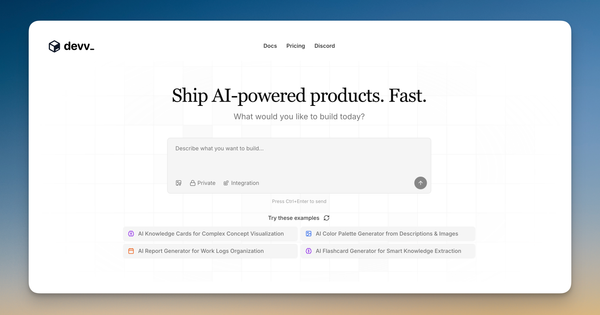
Devv AI boasts an intuitive, low learning curve thanks to its prompt-first interface—users simply describe their project in plain English, and the agent handles the rest, making it accessible even for those without coding experience. The web-based dashboard features clean chat-style interactions for creation and editing, live previews, and an admin panel for managing deployments, resulting in a polished and modern interface quality that feels responsive and focused on speed.
Documentation is solid, with an official docs site (docs.devv.ai) offering a quick intro video, step-by-step getting-started guides, integration overviews, and an FAQ that explicitly addresses non-technical users. Community support via Discord and priority email for paid users supplement this, though some early feedback noted occasional navigation quirks during the pivot. Overall, the experience prioritizes simplicity and iteration, with minimal setup required beyond signing up.
Performance & Reliability
The platform delivers strong speed and efficiency for its core promise: generating functional apps in minutes and handling iterations quickly via the Coding Agent. Early user feedback from its search-engine era praised accurate, context-aware responses, and this carries over to the builder with rapid prototyping that outperforms manual development for simple-to-medium AI projects.
Known issues are relatively minor and typical of AI tools—credit exhaustion can halt progress, occasional network errors or AI misinterpretations require follow-up prompts, and a few users have reported app state glitches (e.g., temporary loss of progress). No widespread outages or critical reliability complaints appear in recent sources, but the credit system and "coming soon" elements can introduce friction for heavy or unpredictable usage. Performance remains reliable for indie-scale projects, with built-in cloud deployment ensuring quick live previews.
Pricing & Value
Devv offers a transparent, usage-based structure with a free tier for exploration (limited credits), a Pro plan at $25 per month (or less with 20% yearly discount), and a Team plan at $49 per seat per month (with pooled credits and waitlist access). Pro unlocks 2,500 monthly credits, unlimited/private projects, custom domains, badge removal, source code export, priority support, and access to powerful AI models including Devv Search; add-on credit packs are available for topping up. The Team plan adds collaboration tools (coming soon) and centralized billing.
The value proposition shines for indie builders and small teams: at this price point, it undercuts the cost of hiring developers or managing multiple paid services (e.g., separate LLM APIs + hosting) while delivering production-ready output faster than alternatives like Cursor, Replit Agents, or general builders such as v0.dev. Free tier suffices for testing, but Pro delivers strong ROI for ongoing projects by removing limits and enabling exports/deployment. Drawbacks include the potential for credit overruns on complex apps and the need for upgrades for serious use, but overall it provides excellent accessibility compared to enterprise tools.
Practical Tutorial
Official documentation provides excellent guidance, including a step-by-step tutorial and intro video at docs.devv.ai. Here is a practical walkthrough for a common task—building a simple AI-powered task manager app (inspired by real community examples and docs excerpts)—that you can complete in under 15 minutes on the free tier:
-
Sign up and start a project: Visit https://devv.ai, create a free account, and click to start a new project. In the main input box, enter a clear description: "Build a task manager web app with user authentication, a database for storing tasks, and AI prioritization suggestions using an LLM integration. Include a clean dashboard for adding, completing, and viewing tasks."
-
Let the Coding Agent generate: Press submit (or Ctrl+Enter). Devv's AI will automatically generate the full app—frontend UI, backend logic, database schema, and LLM integration for smart features like "prioritize tasks based on deadlines." Watch the progress in real-time.
-
Iterate and refine: Once generated, use the follow-up chat box to add features, e.g., "Add image upload support with AI description generation and email notifications via integration." The agent updates the app instantly. No manual settings changes are typically needed.
-
Preview, test, and deploy: Click preview to interact with a live version in the browser. Test functionality, then publish for a shareable URL. On Pro, connect a custom domain or export the full source code for local editing.
-
Add integrations (optional): From the dashboard, enable native options like database storage or external LLMs (e.g., OpenRouter) with one click—no API keys required for basics.
For more examples or advanced tweaks, follow the official "Getting Started" and "Step by step tutorial" at https://docs.devv.ai/getting-started, which includes visuals for everything from simple prototypes to complex AI SaaS apps.
Final Verdict
Devv AI earns a solid 4.5 out of 5 stars for its innovative blend of accessibility and power in the rapidly evolving AI tooling space. It excels for indie builders, developers, and non-technical creators who want to ship functional AI web apps quickly without infrastructure headaches—perfect for MVPs, side projects, or rapid experimentation. Those needing deep custom code control, offline capabilities, or unlimited high-volume usage without monitoring credits should consider alternatives like traditional IDEs or self-hosted stacks. In one sentence: Devv AI transforms ideas into deployable AI products faster than ever, making it a must-try for anyone tired of piecing together tools in the agentic era.