Digest Review: The Ultimate AI Tool for Personalized Daily Briefings
Overview & Purpose

Digest (https://usedigest.com/) is a personalized email aggregation tool that pulls content from dozens of sources—including newsletters, RSS feeds, social media (X/Twitter, Reddit, Instagram, TikTok), YouTube channels, Hacker News, GitHub Trending, Google News, Product Hunt, Google Calendar, Weather, Stocks, Crypto, Podcasts, and more—into one clean, daily (or scheduled) briefing delivered straight to your inbox. It also offers a web dashboard for viewing digests and a dedicated Newsletter Reader (with a custom @usedigest.com email address) so you can forward subscriptions away from your main inbox and have them auto-curated into your digest. The tool learns user preferences over time to surface relevant content while discarding low-value items, with AI-powered intelligent summaries slated for future release. Primary use cases include combating information overload for busy professionals who follow multiple newsletters, subreddits, creators, or industry updates without endless scrolling. It targets developers (tracking HN/GitHub/TechCrunch), marketers, designers (Dribbble/Awwwards), investors (Bloomberg/stocks/crypto Twitter), and anyone seeking a tailored morning read to stay informed efficiently. Research conducted as of March 13, 2026, drawing from the official site, help center, blog, and limited external comparisons.
Key Features & Capabilities
Core functionality revolves around a simple builder: create one or more “Digests,” connect sources with customizable filters (e.g., specific subreddits, YouTube channels, or Instagram accounts), set delivery timing (daily, weekdays, or custom hours), and receive a consolidated email plus web link. Standout differentiators include the Newsletter Reader for inbox decluttering, broad social and real-time integrations (beyond pure RSS tools like Feedly), public/shareable Digests that can collect subscribers (turning personal setups into mini-newsletters), and ongoing source additions (e.g., Bluesky, Mastodon, podcasts, stocks as of early 2025). The platform positions itself as an active Mailbrew successor with weekly updates and a shift toward both B2C personal use and light B2B/creator tools. Limitations include caps on the number of Digests and social accounts per plan (e.g., limited Instagram/TikTok connections), no fully rolled-out AI summaries yet, and occasional dependence on third-party APIs for freshness. Missing features at the time of review: advanced analytics for personal users and deeper mobile-native apps beyond PWA/home-screen support.
User Experience
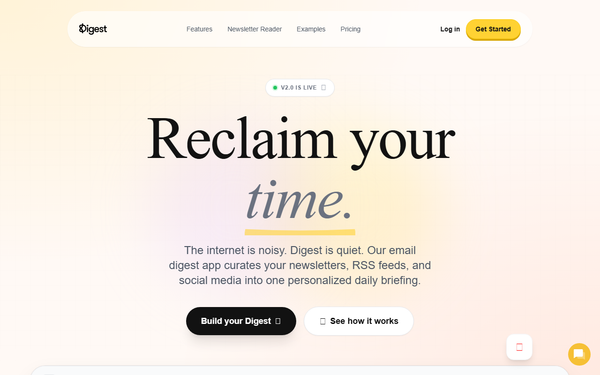
Setup is exceptionally straightforward with a minimal learning curve—most users can create their first digest in under two minutes via the clean web dashboard at app.usedigest.com. The interface is modern and intuitive (notably improved in v2.0), with drag-and-drop source addition, live previews, and mobile-friendly design (addable to phone home screen as a PWA). Email delivery feels polished and spam-resistant when following simple Gmail tips provided in help articles. Documentation is practical rather than exhaustive: the Help Center covers setup, source-specific guides, troubleshooting (e.g., keeping digests out of spam), and feature walkthroughs without videos, while the blog offers targeted how-tos (e.g., “Create a Newsletter From Your Favorite Bluesky Accounts”). Support is responsive via the site, though public user forums are limited. Overall, the experience prioritizes speed and simplicity over power-user customization.
Performance & Reliability
Digests generate and deliver quickly at scheduled times with reliable email infrastructure; users report consistent morning arrivals once configured. The web viewer loads fast and supports easy archiving/search in the Newsletter Reader (now out of beta). Known issues have been minimal and quickly addressed in updates—early delivery hiccups or mobile formatting glitches noted in 2024 HN discussions were resolved by v2.0. Common complaints are sparse due to the tool’s niche adoption: occasional source lag (e.g., delayed TikTok/Instagram updates) or plan-based limits on volume, but no widespread reliability outages or data-loss reports. Testimonials highlight “hundreds of hours saved per year” with no major downtime complaints in available reviews.
Pricing & Value
Digest offers a free-to-start trial (no credit card required) with basic capabilities, including a limited free plan (up to 3 sources per earlier documentation). Paid plans begin at approximately $6/month for Starter (up to 5 Digests), scaling to Pro (~$19 for 10) and Pro+ (~$39 for 15), with 17% savings on annual billing. High-volume creators (over 3,000 subscribers or 15 Digests) move to custom tiers starting at $59. Value shines for users needing more than a handful of sources or multiple themed digests—far cheaper than maintaining multiple newsletter subscriptions or apps. Compared to alternatives like Feedly (subscription-focused but less email-centric) or former Mailbrew, Digest delivers stronger social integration and inbox consolidation at a competitive price point, making the paid upgrade worthwhile once the free tier feels restrictive.
Practical Tutorial
Official documentation provides a clear getting-started guide at https://usedigest.com/help/getting-started/setup-a-digest/. Here is a complete step-by-step walkthrough for a common task—building a daily developer-focused Digest (e.g., tracking tech news, open-source trends, and tutorials):
- Sign up — Go to https://app.usedigest.com/signup and create a free account (no credit card needed).
- Create a new Digest — On the dashboard, click “Create Digest” and name it (e.g., “Dev Daily”).
- Add sources — Search and connect relevant feeds: add “Hacker News” (top posts), a Reddit source for r/webdev or r/programming (custom keywords), GitHub Trending (filtered by language like Python), specific YouTube channels (e.g., freeCodeCamp), and an RSS feed from your favorite tech blog. Use the Newsletter Reader by forwarding subscriptions to your unique @usedigest.com address for auto-inclusion. Customize each source (e.g., only upvoted posts or specific playlists).
- Set your schedule — Choose daily delivery at 8:00 AM (or weekdays only) and select your timezone.
- Save and activate — Preview the sample digest on the dashboard, then save. Your first email arrives on schedule; view the web version anytime via the provided link. Tip: Start with 3–5 sources to avoid overload, then iterate. For advanced tweaks, see blog posts like “Discover Trending GitHub Repositories with Digest.”
Additional official guides cover adding Digest to your phone home screen or Gmail organization.
Final Verdict
Overall rating: 4.5/5. This tool excels for anyone drowning in fragmented feeds who values a single, curated email over app-hopping or manual RSS management—ideal for developers, designers, investors, and marketers seeking efficiency without FOMO. Users should avoid it if they need unlimited free sources, fully mature AI summarization right now, or prefer deeply interactive reading experiences over email-first delivery. In one sentence: Digest is a smart, actively evolving time-saver that turns chaotic internet consumption into a quiet, personalized daily briefing—highly recommended to try for free today.