Echostash Review: The Ultimate Prompt Management Infrastructure
Overview & Purpose
EchoStash is a prompt infrastructure platform that serves as a centralized repository for creating, storing, organizing, versioning, searching, testing, and deploying AI prompts. It eliminates the chaos of hardcoded strings, scattered notes, or lost chat histories by providing a searchable, AI-friendly system that supports consistent and optimized outputs across generative AI tools. Primary use cases include managing prompts for production AI applications (with evaluation and deployment), personal prompt libraries for quick reuse, and collaborative workflows for teams building AI features. While early directory descriptions emphasize simple organization for everyday tools like ChatGPT and Midjourney, the current platform has evolved into developer-focused infrastructure with runtime rendering and CI/CD integration.
Target audience spans individual prompt engineers, writers, marketers, and designers who need fast access to proven prompts, as well as developers and AI product teams requiring version control, evaluations, and scalable deployment. Research conducted as of March 8, 2026.
Key Features & Capabilities
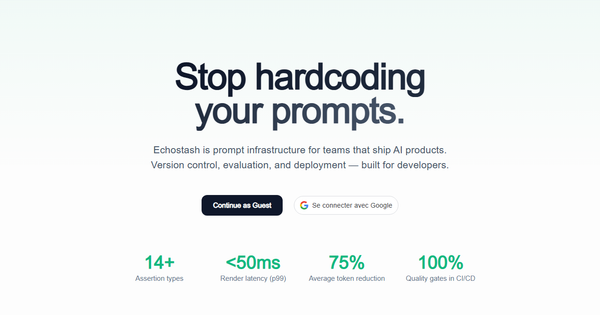
Core functionality revolves around a centralized prompt library with semantic/AI-powered search, tagging, folders, and template variables (e.g., {{variable}} syntax). Users can version prompts, run built-in evaluations with assertion types, perform A/B testing, and enforce quality gates in CI/CD pipelines. Standout features that differentiate it from simpler alternatives include the Echo PDK (a Domain-Specific Language) for dynamic prompts supporting variables with transforms, conditionals to filter irrelevant sections, modular partial blocks for reuse, and LLM-evaluated "AI Gate" logic for intelligent content selection; an SDK (JavaScript, Python, cURL) with sub-50ms p99 render latency and automatic format conversion for providers like OpenAI, Anthropic, Google, Meta, and Mistral; 75% average token reduction through context filtering; and the open-source Prompt Library Protocol (PLP) plus public Registry for discovering, forking, and deploying community prompts like an npm for prompts.
These elements set EchoStash apart from basic libraries or competitors like PromptLayer (stronger in no-code editing but lighter on evaluations) or LangSmith by combining storage with production-grade testing and open sharing protocols. Limitations include API call quotas on lower tiers, a steeper learning curve for the full DSL and evals (potentially overkill for pure end-users), and nascent ecosystem details around advanced team collaboration or mobile support. Missing features noted in comparisons: extensive pre-built prompt marketplaces beyond the Registry and deeper native integrations compared to enterprise alternatives.
User Experience
The platform offers a clean, modern web-based dashboard with low barrier to entry for core tasks like creating and searching prompts. The learning curve is gentle for individuals (intuitive AI search and quick saves), but rises for advanced DSL syntax and evaluation setup—mitigated by clear examples and a dedicated Playground. Interface quality feels developer-friendly with visual editors for prompts and real-time test results, though public screenshots are limited. Documentation is comprehensive via the official docs site (quick starts, API authentication, DSL syntax, and PLP specs), and support resources include in-app guidance plus open-source GitHub components for the PDK and protocol; community feedback on early Reddit and HN posts highlights the relief from "losing prompts" with positive notes on speed and organization.
Performance & Reliability
Rendering is exceptionally fast at under 50ms (p99), with built-in optimizations delivering an average 75% token reduction and reliable CI/CD quality enforcement. Efficiency shines in production scenarios where prompts are fetched and rendered programmatically without code deploys. No widespread known issues or complaints surfaced in searches across Reddit, comparison sites, or forums—attributable to the tool's relatively recent growth (e.g., early milestones of hundreds of users). Early adopter feedback praises stability for both personal and team use, with no reports of downtime or rendering failures in available discussions.
Pricing & Value
EchoStash follows a freemium model with clear scaling: the Free tier is $0 with 1,000 API calls per month (plus optional $1 per additional 5K via auto top-up), suitable for individuals and exploration. The Pro tier targets serious users with higher limits (e.g., 10,000 API calls/month) and full power features; enterprise options exist for larger teams with custom scaling. Plans emphasize "start free, scale as you grow" and include free-forever access for individuals.
Value is compelling compared to ad-hoc solutions (Notion, plain text) or competitors: token savings and evaluation tools accelerate workflows and reduce costs for heavy AI users, while the open protocol avoids vendor lock-in risks seen in some platforms. It outperforms free alternatives for anyone beyond casual prompting and offers strong ROI for teams through deployment independence and testing—especially versus tools like PromptLayer focused more on observability.
Practical Tutorial
Official quick-start documentation is available at https://www.echostash.app/docs/echostash/quick-start (with full ecosystem docs at https://www.echostash.app/docs). Below is a step-by-step walkthrough for a common task: creating, testing, and programmatically deploying a reusable prompt (adapted directly from official guidance with a real example for a marketer generating product descriptions).
-
Sign up and access the dashboard: Visit echostash.app and create a free account (no credit card required). Log in to the dashboard.
-
Create a new prompt: Click "New Prompt." Name it (e.g., "product-description-generator"). Enter the template using variables:
"Write a {{tone}} product description for {{product_name}} aimed at {{audience}}. Highlight benefits and include a call-to-action." -
Add an evaluation/test suite: Switch to the Evals tab. Create a new test suite in YAML:
suite: "Basic Validation" tests: - name: "Includes product name" given: tone: "engaging" product_name: "Wireless Earbuds" audience: "tech enthusiasts" expect_render: - contains: "Wireless Earbuds" - contains: "tech enthusiasts" -
Run the evaluation: Click "Run." Review pass/fail results, rendered output, and assertion details to refine the prompt iteratively.
-
Generate an API key: Go to Settings → API Keys and create one. Store it securely (e.g., as an environment variable).
-
Integrate via SDK for runtime use (example in JavaScript for a developer or automated workflow):
Install withnpm install @echostash/sdk.import { EchostashClient } from "@echostash/sdk"; const client = new EchostashClient({ apiKey: process.env.ECHOSTASH_API_KEY }); const prompt = await client.getPrompt("product-description-generator"); const rendered = await prompt.render({ tone: "persuasive", product_name: "Smart Watch", audience: "fitness lovers" }).toOpenAI(); // Converts to OpenAI format console.log(rendered);For a non-dev marketer: Use the dashboard search to find and copy-paste the prompt into Midjourney or ChatGPT, tagging it "marketing,product" for future AI-assisted retrieval.
This workflow typically takes under 10 minutes and demonstrates building upon successful prompts instead of starting from scratch. For community prompts, browse the Registry at https://www.echostash.app/browse and fork one instantly.
Final Verdict
Overall rating: 8.5/10. EchoStash excels as a balanced, evolving platform that bridges simple organization with powerful production tools, though its youth means fewer third-party reviews and some pricing opacity.
Who should use this tool: Developers, prompt engineers, and AI product teams (or power users in marketing/writing) who want versioned, testable, and deployable prompts to save time and reduce costs—especially those frustrated with scattered notes or inconsistent outputs. Who should avoid this tool: Absolute beginners needing only occasional one-off prompts or teams seeking heavily no-code enterprise suites without dev involvement (overkill and API-focused).
One-sentence recommendation: If you're serious about scaling AI workflows beyond copy-paste, start with EchoStash's generous free tier today—it's the smartest way to turn prompts into reliable infrastructure.