ElevenLabs Review: The Gold Standard for Realistic AI Voices
Overview & Purpose
ElevenLabs is a leading AI voice generation platform that transforms text into ultra-realistic, natural-sounding speech, with a strong emphasis on long-format audio such as audiobooks, podcasts, and extended voiceovers. The tool uses advanced AI models to create compelling voices that capture emotion, intonation, and context, making it ideal for producing professional-grade audio content at scale without hiring voice actors or recording studios. Primary use cases include narration for audiobooks and podcasts, video game character dialogue, marketing advertisements, social media content, educational materials, and even real-time conversational agents. It has expanded beyond core speech synthesis to include music generation, custom sound effects, dubbing, and omnichannel voice agents.
The target audience spans independent creators and publishers seeking efficient content production, marketers and businesses needing branded voiceovers, game developers and animators requiring character voices, and developers integrating TTS via API for apps or customer experience tools. Enterprises and government organizations also use it for scalable voice solutions. As of April 13, 2026, ElevenLabs positions itself as an all-in-one creative audio platform trusted by both hobbyists and large-scale producers.
Key Features & Capabilities
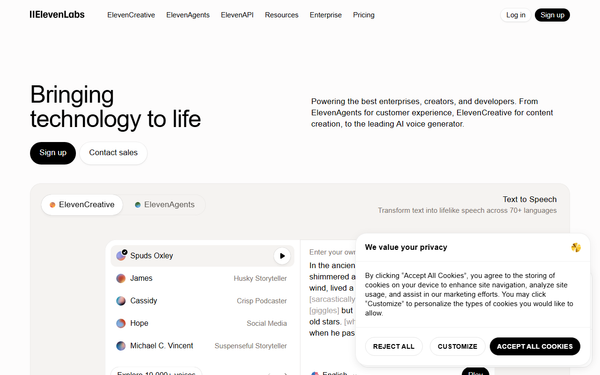
Core functionality revolves around text-to-speech (TTS) conversion with support for over 70 languages, voice cloning (instant from short clips or professional-grade from longer samples), and a library of more than 10,000 studio-quality voices. Users can generate speech with fine control over emotion, pacing, and style using models like Eleven v3 (most expressive), Eleven Multilingual v2 (consistent for long-form), and Eleven Flash (ultra-low latency at ~75ms). Long-format projects are handled via the Studio (formerly Projects) editor, which supports chapter-based organization, multi-speaker assignment, and seamless regeneration of specific sections.
Standout features that differentiate it from competitors include exceptional vocal realism and emotional expressiveness that often surpasses human recordings in natural prosody, integrated tools for adding AI-generated music and sound effects within the same workflow, professional voice cloning with high fidelity, and one-click publishing options like ElevenReader for audiobooks. Additional capabilities such as speech-to-text (98% accuracy with diarization), dubbing, and API access for custom integrations make it versatile. Recent additions like Flows in ElevenCreative (March 2026) further enhance automation for complex audio projects.
Limitations include credit-based consumption that can escalate quickly with revisions or failed generations, occasional pronunciation quirks requiring manual tweaks, and less emphasis on highly stylized or cartoonish voices compared to some niche alternatives. Very long sessions may experience minor consistency drift without careful editing.
User Experience
ElevenLabs offers an intuitive web-based interface with a low learning curve, making it accessible even for non-technical users. The Studio editor feels like a familiar document processor, allowing drag-and-drop text import (EPUB, PDF, TXT), voice assignment, and inline editing without coding. Developers appreciate clean REST APIs with Python and TypeScript SDKs for seamless integration.
Interface quality is polished and modern, with real-time previews, progress tracking, and collaborative elements for teams. Documentation is comprehensive, including API references, code examples, and blog tutorials, while support resources feature a help center, community forums, and responsive (though sometimes slower for non-enterprise users) customer service. Overall, users report high satisfaction with ease of use, though some note initial time investment to master advanced voice customization and editing for optimal long-form results.
Performance & Reliability
Generation speed is a major strength, with low-latency options enabling near-instant previews and efficient handling of long-form content (e.g., full chapters in seconds to minutes depending on model). Audio output quality is consistently rated among the highest in the industry, delivering 128-192 kbps clarity with natural breathing, pauses, and emotional nuance.
Known issues include occasional volume fluctuations, minor inconsistencies in ultra-long generations (e.g., subtle voice drift after 6,000+ words), and credit consumption on failed or imperfect outputs that require regeneration. Common user complaints center on these glitches in extended projects and occasional language/accent switching, though newer models like v3 have significantly reduced such problems. Reliability is generally strong for production use, with built-in safety features like content moderation and watermarking for AI-generated audio detection.
Pricing & Value
ElevenLabs uses a credit-based system where one credit typically equals one character of TTS output (exact usage varies by model). The free tier provides 10,000 credits per month (~10 minutes of high-quality speech) for testing, with no commercial rights. Paid plans include:
- Starter: $5/month – 30,000 credits, commercial use, instant cloning.
- Creator: $22/month (often $11 first month) – 100,000 credits, professional cloning, higher-quality output.
- Pro: $99/month – 500,000 credits.
- Scale: $330/month – 2,000,000 credits.
- Enterprise: Custom pricing for high-volume needs.
Annual billing offers discounts, and credits roll over up to two months in some cases. Overages are available but can add up quickly for iterative workflows.
Value is excellent for users prioritizing top-tier voice quality and time savings over professional narration costs (e.g., an audiobook at a fraction of $2,000–$5,000 traditional rates). It outperforms many alternatives in realism but may feel expensive for high-volume or revision-heavy projects due to credit burn. Compared to competitors like Play.ht or Murf AI, ElevenLabs delivers superior naturalness and long-form tools, justifying the premium for serious creators.
Practical Tutorial
ElevenLabs provides official guidance for long-format tasks like audiobook creation via their Studio tool. Here is a step-by-step walkthrough for generating a professional audiobook chapter (based on their current workflow as of April 2026; full details available in the official blog tutorial).
-
Prepare your manuscript: Review and format your text (e.g., .epub, .pdf, or .txt) for spoken delivery. Add punctuation for natural pauses and notes for character emotions or dialogue cues.
-
Import into Studio: Log in to ElevenLabs, navigate to ElevenCreative > Studio, and upload your document or paste text. The platform auto-detects chapters and structure.
-
Assign voices: Browse the 10,000+ voice library or clone your own (upload 1–5 minutes of clean audio for Instant Clone or longer for Professional). Assign distinct voices to narrators/characters, adjusting tone, accent, and emotion via prompts or sliders.
-
Generate audio: Click "Generate" for the full project or specific sections. Studio handles long-form synthesis efficiently at high quality (128 kbps+).
-
Edit and refine: Use the document-style editor to tweak pauses, regenerate individual sentences/paragraphs for pronunciation fixes, or adjust pacing. Add AI music or sound effects for immersion if desired.
-
Export or publish: Download MP3/WAV files or publish directly to ElevenReader (with royalty options) or platforms like Spotify. Test on multiple devices for final quality.
This process typically takes minutes for generation plus 10–20 hours of editing for a full book, far faster than traditional methods. For video tutorials, search official ElevenLabs YouTube channels or their blog for "How to Create an AI Podcast with ElevenLabs Studio."
Final Verdict
Overall rating: 4.7/5 – Exceptional voice realism and long-form tools earn top marks, tempered slightly by credit economics and minor editing needs.
Who should use this tool: Content creators, podcasters, audiobook publishers, and developers who demand the most natural AI voices and integrated long-format workflows to save time and costs while achieving professional results.
Who should avoid this tool: Beginners on tight budgets needing high-volume revisions without editing time, or those seeking highly stylized/cartoon voices where cheaper alternatives suffice.
One-sentence recommendation: ElevenLabs remains the gold standard for AI long-format speech in 2026—choose it if voice quality and creative control are your top priorities.