Empaithy Review: The AI Journaling App for Better Mental Health
Overview & Purpose

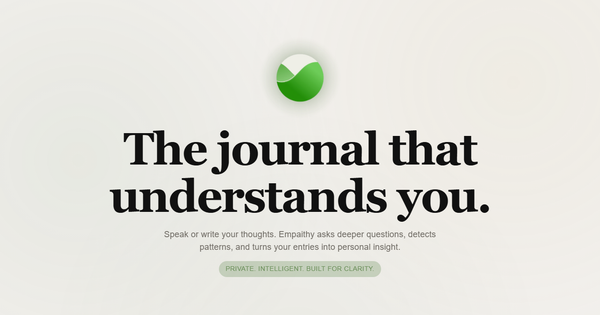
Empaithy is a mobile AI-powered companion app (available on iOS and Android) designed to support mental wellbeing through effortless micro-journaling, real-time conversational guidance, and personalized analytics. Users can speak or type short entries, receive adaptive follow-up questions inspired by CBT and Narrative Therapy, track mood patterns over time, and get daily summaries with actionable nudges. Primary use cases include daily stress management, anxiety reflection, building emotional awareness, spotting triggers (like "Sunday Scaries" or screen-time correlations), and fostering mindfulness habits without the pressure of traditional long-form journaling.
It targets everyday individuals seeking to improve emotional fitness—such as busy professionals dealing with burnout, students navigating anxiety, or anyone wanting a private space for self-reflection—rather than developers, marketers, or designers. The app also positions itself as a therapy complement, providing data clinicians can review in the future via upcoming sharing features, and offers enterprise solutions for hospitals and insurers. Research conducted as of March 13, 2026, draws from the official site, app stores, and limited third-party coverage, noting the tool's relatively recent 2.0 update in 2025.
Key Features & Capabilities
Core functionality revolves around an adaptive AI chat that remembers context, micro-journaling with smart prompts (e.g., "Where in your body do you feel this?"), mood and pattern tracking, a Daily Bulletin for personalized highlights, Voice-to-Voice hands-free interaction ("hey empaithy"), in-chat reminders, and gamified Mindful Insight Cards across categories like Insight and Growth. Analytics deliver emotional trends, correlations (e.g., sleep vs. resilience), and composite wellbeing scores in premium mode.
Standout differentiators include its "Organic Intelligence" engine for long-term pattern detection (unlike passive journals), CBT/Narrative Therapy integration for deeper insights, gamified progress via collectible cards, and strict privacy (you own your data; no training on personal entries). Voice recognition and multilingual support (English, Hindi, German, French, Spanish, Italian) add accessibility. Upcoming EmPulse will enable secure clinician sharing.
Limitations include no analytics in the free tier, reliance on internet for full AI features, occasional past bugs in journaling flow or notifications (mostly fixed in 2025 updates), and the disclaimer that it is not a medical replacement or substitute for professional therapy. No desktop/web version exists, and community features or integrations (beyond future enterprise) are absent.
User Experience
Empaithy boasts a low learning curve with its zero-friction, calm interface—users simply tap to journal or say "hey empaithy" for natural voice conversations. The design feels engaging and judgment-free, with clean prompts, reward cards, and smooth flows improved in version 2.0 (faster loads, cleaner UI). Multilingual support broadens appeal, and in-app walkthrough video plus live notifications guide new users effectively.
Interface quality is app-native and intuitive on mobile, though limited to iPhone/iPad/Android (no browser option). Documentation is minimal—primarily in-app help and a privacy policy—but support is responsive per user feedback. No extensive external guides or knowledge base exist, which suits the simple workflow but may frustrate advanced users.
Performance & Reliability
The app performs efficiently post-2025 updates, with quick voice processing, context-aware chats, and reliable pattern tracking once data accumulates. Load times improved, and features like reminders and Daily Bulletins deliver consistently for most users. With 10K+ Android downloads and sparse but positive iOS traction, it handles daily use well.
Known issues from early reviews (pre-late 2025) include journaling entries getting stuck after follow-ups, sign-in problems after reinstalls, and notification glitches—largely addressed in patches (e.g., speech fixes in v1.3.0). Complaints remain low due to limited user base; one Google Play reviewer praised self-insight and support, while others noted temporary bugs. Overall reliability is solid for a young app, though sparse reviews (3.5/5 on Google Play from 55 ratings; insufficient for iOS overview) mean long-term stability is still emerging.
Pricing & Value
Empaithy offers a freemium model: the free tier provides basic micro-journaling, AI chat, and tracking but excludes full analytics and advanced insights. Premium unlocks everything for $9.99/month or $99.99/year, with seamless trials requiring no initial credit card. No enterprise consumer pricing is detailed publicly (separate at empaithy.co).
Value shines for privacy-conscious users seeking AI depth without high costs—cheaper than many therapy apps while delivering unique pattern analytics and gamification. Compared to alternatives like basic mood trackers or other AI chatbots (e.g., Wysa), it stands out with CBT prompts, voice-to-voice, and long-term memory, though budget users may find the analytics paywall limiting. The strong privacy stance (no data selling, export/delete options) boosts its proposition over ad-supported competitors.
Practical Tutorial
No external official tutorials beyond the in-app walkthrough video are available, so here is a step-by-step walkthrough for a common task—completing your first micro-journal entry and reviewing AI-generated insights (based on official app descriptions and features as of March 2026). Download from the App Store or Google Play and sign up with email (free tier works initially).
- Open the app and complete the quick onboarding (choose language, set basic preferences).
- Tap the journal icon or say “hey empaithy” to start Voice-to-Voice. For text: select “New Journal Entry.”
- Respond to the initial prompt, e.g., “How are you feeling right now?” Type or speak: “Overwhelmed after a long meeting—tight chest and racing thoughts.”
- The AI follows up adaptively (CBT-style): “Where in your body do you feel this weight most?” Answer, then it probes: “Did something specific trigger this today?”
- Continue 2–3 more exchanges (3–5 minutes total). End the entry.
- Receive instant insight: e.g., “This ties to your work stress pattern—screen time correlation -0.85 noted last week. Try a 2-minute breath break tomorrow?”
- Check your Daily Bulletin (home screen) for mood trends, earned Insight Card (e.g., “Growth” category), and nudge: “Set a reminder: ‘Breathe before meetings.’”
- In premium, view analytics tab for weekly patterns. Export data anytime via settings.
This builds habits quickly—repeat daily for compounding insights. For video guidance, use the in-app option or visit https://empaithy.com/.
Final Verdict
Empaithy earns a solid 4 out of 5 stars for its thoughtful blend of AI journaling, gamification, and privacy in a mobile-first package—strong for daily emotional support but held back by limited free features and sparse user validation.
It suits individuals wanting low-effort mental habit-building, stress coping, or therapy adjuncts who value voice interaction and data ownership. Avoid it if you need offline access, professional crisis support, or a non-app experience, or if you're on a tight budget unwilling to upgrade for analytics.
One-sentence recommendation: Download Empaithy today for a private, insightful AI journaling companion that turns fleeting thoughts into lasting clarity—perfect if you're ready to invest a few minutes daily in your mental wellbeing.