Evaligo Review: Build and Deploy AI Workflows Without Code

Overview & Purpose

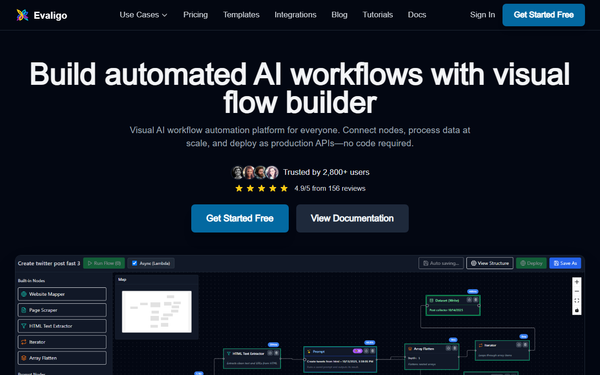
Evaligo is a no-code AI workflow builder and app creator platform that empowers users to visually design, test, optimize, and deploy AI-powered automations and applications. At its core, it combines advanced prompt engineering tools with end-to-end workflow orchestration, allowing developers and teams to experiment with language model prompts in an interactive playground, receive AI-driven feedback and suggestions, compare outputs, and integrate them into scalable production pipelines—all without writing infrastructure code. Primary use cases include content generation at scale (e.g., social media posts or blog drafts), data extraction and processing from websites, lead enrichment, research summarization, and building production-ready AI features like custom agents or APIs.
The platform targets developers, power users, AI teams, and businesses building reliable language model applications. It is particularly suited for those who need to move beyond ad-hoc prompting into systematic testing, monitoring, and deployment, with testimonials highlighting adoption by over 2,800 developers and teams at companies like ClientCues and TechFlow.
Key Features & Capabilities
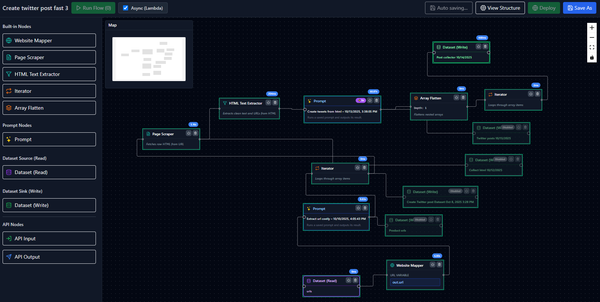
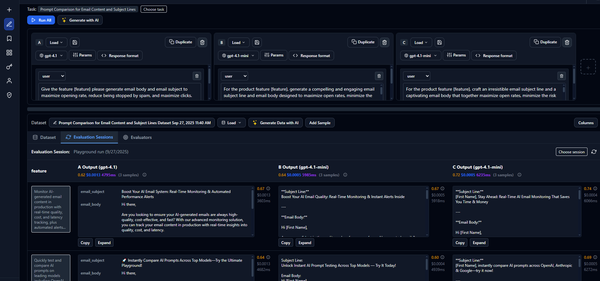
Core functionality revolves around a visual drag-and-drop flow builder with pre-built nodes for web scraping, text extraction, AI prompting (with structured JSON outputs), batch processing, and API deployment. Users can create workflows that accept inputs, process data in parallel or async modes, apply custom prompts, and output results—all testable instantly in a playground. Standout features include AI-powered prompt optimization with smart suggestions, A/B testing and experiments, LLM-as-a-judge evaluators for scoring outputs at scale, human-in-the-loop annotation, real-time production tracing and monitoring (quality, cost, latency with alerts), analytics dashboards, prompt versioning and organization, dataset integration for automated testing, and one-click deployment as authenticated REST APIs with code examples.
Differentiation comes from its AI-native design: built-in prompt testing, evaluation-driven CI/CD checks to catch regressions, vision processing nodes, and seamless connection of optimized prompts into full workflows—features not native in general automation tools like n8n or Zapier. Users can upload evaluation data, enforce schemas, compare models side-by-side, and use their own API keys for unlimited usage. Limitations include a credit-based system for platform-handled model calls (though own keys bypass this), no mention of advanced enterprise features like SSO in basic plans, and fewer total integrations (100+) compared to broader tools. CI/CD is supported via evaluation hooks but lacks deep native pipeline orchestration.
User Experience
Evaligo offers a low learning curve thanks to its intuitive visual canvas, pre-built nodes, and 5-minute starter tutorials that guide users from idea to deployed API. The interface is clean and modern, with real-time execution previews, dynamic data mapping, and collaborative elements in the playground for prompt iteration. New users can start building immediately via a free signup with no credit card required. Documentation is structured with clear sections on playground optimization, evaluators, tracing, monitors, and workflows, though it leans more toward feature lists than exhaustive code snippets or advanced troubleshooting examples. Support includes priority email on paid plans; community resources are supplemented by official tutorials and comparisons. Overall, the experience feels productive for technical users familiar with no-code tools, with quick wins reported in the first week.
Performance & Reliability
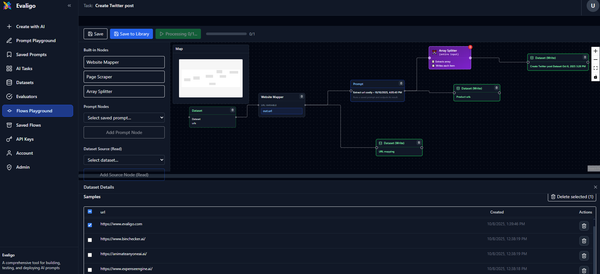
Workflows execute efficiently with support for batch processing of thousands of items, parallel node execution, and real-time progress monitoring with detailed logs and error handling. Production tracing provides full visibility into prompts, responses, and decisions, backed by alerts for anomalies. The platform claims up to 80% fewer AI failures through integrated dataset evaluations and regression checks. As of March 2026 research, no widespread user complaints or known issues appear in reviews on G2, Capterra, Reddit, or LinkedIn; the tool is still emerging, with positive self-reported metrics like 4.9/5 customer ratings from early adopters. Reliability is enhanced by version control and one-click deployments, though performance depends on chosen models and credit usage.
Pricing & Value
Evaligo uses a simple, transparent credit-based model with a generous free tier (500 credits monthly, forever free, no card needed) suitable for experimentation. The Pro plan costs $7 per month (cancel anytime) and includes 10,000 credits, recurring schedules, 10 concurrent API executions, and priority support; additional credits can be purchased as needed. All plans support using your own API keys for truly unlimited runs without platform fees. A 30-day money-back guarantee applies. Compared to alternatives, it delivers strong value for AI-focused teams—cheaper entry than many cloud automation platforms while offering deeper prompt evaluation and workflow deployment than standalone prompt tools. Self-hosted options like n8n require more setup for similar AI depth, making Evaligo's hosted simplicity a compelling proposition for rapid development.
Practical Tutorial
Official tutorials are readily available on the site. Below is a complete, real-world walkthrough for a common task—building an AI Twitter Post Generator from any website URL—adapted directly from Evaligo's official 5-minute beginner tutorial. This demonstrates prompt engineering within a full workflow, including scraping, structured output, and deployment. (Original: https://www.evaligo.com/tutorials/build-twitter-post-generator)
-
Sign up and create a new flow: Go to app.evaligo.com/signup (free) and start a new workflow in the visual builder.
-
Add API Input node: Configure it to accept a "website_url" string field (required). This becomes the entry point for your API.
-
Connect Page Scraper node: Set the URL to
{{website_url}}, enable "wait for page load," and set a 30-second timeout. This fetches the raw HTML. -
Add HTML Text Extractor node: Connect to the scraper output. Enable remove scripts/styles and set max length to 5,000 characters. Output variable:
{{extracted_text}}. -
Add Prompt node (core prompt engineering step): Select GPT-4 (or cheaper alternative), temperature 0.7. Use this system prompt:
You are a social media expert. Create 3 engaging Twitter posts about the following content.

Content: {{extracted_text}}

Requirements:
- Each post must be under 280 characters
- Use emojis strategically
- Include relevant hashtags
- Make it engaging and actionable
- Focus on key features or benefits

Return as JSON array with this format:
[
 { "post": "...", "hashtags": ["..."] },
 ...
]
Enable structured output schema for reliable JSON.
-
Add API Output node: Map the prompt result to return
{ "posts": {{prompt_output}}, "source_url": {{website_url}} }. -
Test and deploy: Click "Run Flow," input
https://www.evaligo.comas the URL, and execute. Expected output: three ready-to-publish posts (example from site test):[ { "post": "🚀 Build AI workflows visually without code! ... #NoCode #AIAutomation", "hashtags": ["NoCode", "AIAutomation"] }, ... ]Click "Deploy" for an instant REST API endpoint with auth—ready for apps or schedules.
Tips from the tutorial: Switch to GPT-3.5-turbo for speed/cost; add error handling nodes for robustness. This entire flow takes under 5 minutes and showcases Evaligo's prompt optimization in action.
Final Verdict
Overall rating: 4.7/5. Teams of developers and AI builders building or maintaining language model features should use this tool for its seamless prompt-to-production pipeline, regression prevention, and no-code speed—saving hours of manual testing and deployment. Avoid it if you need extensive non-AI integrations, enterprise-grade SSO/SLA out of the box, or rely heavily on community-validated maturity, as it remains an emerging platform with limited third-party reviews. One-sentence recommendation: Evaligo is an excellent all-in-one solution for any team serious about turning experimental prompts into reliable, scalable AI applications.