Eververse Review: The AI-Powered Product Management Revolution
Overview & Purpose

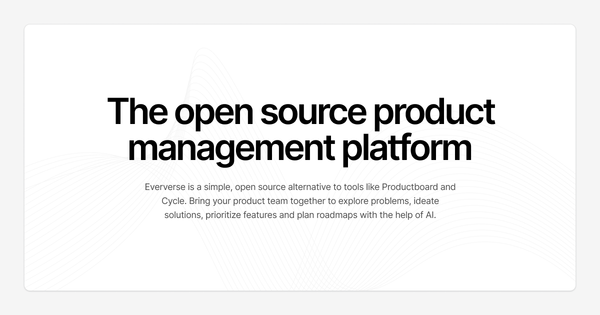
Eververse is an open-source, AI-powered product management platform that enables teams to explore problems, ideate solutions, prioritize features, and build product roadmaps at high speed. It automates the capture and triage of customer feedback from text, video, and audio sources, generates backlogs, performs sentiment analysis, and creates shareable roadmaps and changelogs. Primary use cases include processing incoming user feedback on autopilot, organizing initiatives (e.g., "Improve the onboarding experience" or "Optimize the checkout flow"), applying predictive prioritization, and maintaining a single source of truth through integrations while sharing public portals for user voting and feedback.
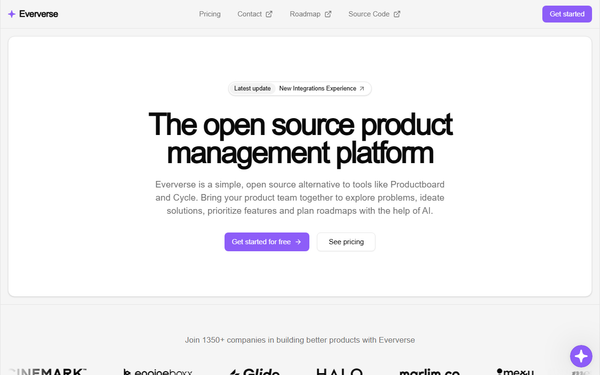
It serves as a simple, modern alternative to closed tools like Productboard or Cycle, with bidirectional sync to Jira, GitHub, Linear, and more. Target audience includes product managers, founders, solo entrepreneurs, marketers, and cross-functional product teams—particularly those in startups or mid-sized companies seeking to reduce manual work in feedback handling, backlog writing, and roadmap updates. Over 1,350 companies have joined, with strong appeal for resource-constrained teams.
Research conducted as of March 12, 2026.
Key Features & Capabilities
Core functionality revolves around AI-driven automation: feedback summarization (extracting pain points, recommendations, and outcomes), sentiment analysis, video/audio transcription and processing, predictive AI RICE scoring (Reach, Impact, Confidence, Effort) for prioritization, and AI-assisted writing in a rich editor that supports embedding Figma designs, YouTube videos, images, code snippets, and tables.
Standout differentiating features include:
- Multimedia feedback handling (upload and transcribe audio/video directly).
- Real-time team presence and activity logs.
- Customizable Gantt and calendar roadmap views extending into future quarters.
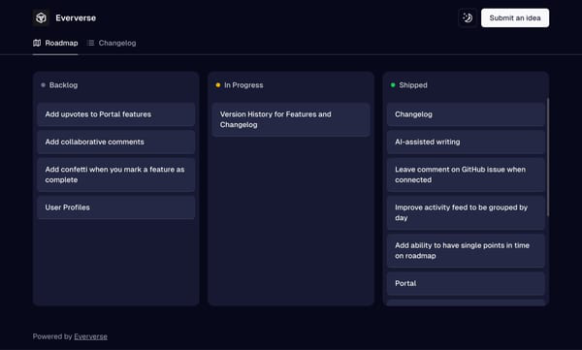
- Public-facing portal with feature voting, idea submission, and in-app widgets (copy-paste code snippet for deployment).
- AI-generated changelogs from roadmaps.
- Canvas for free-form idea collaboration and custom statuses beyond basic To Do/In Progress/Done.
- Full API and Zapier/Intercom/Slack/Email integrations for a single source of truth.
The open-source nature (MIT license on GitHub) allows self-hosting, setting it apart from proprietary competitors. Limitations include no built-in advanced analytics dashboards beyond basic activity feeds (compared to more mature tools like Productboard), potential dependency on external AI providers for heavy usage, and fewer pre-built templates for niche industries. No native mobile app is mentioned.
User Experience
Eververse boasts a polished, intuitive interface reminiscent of Linear or modern productivity tools—clean, real-time collaboration with presence indicators, and a powerful rich editor that minimizes context-switching. Users praise the low learning curve; solo entrepreneurs and product managers report it "feels like the best standards in terms of user experience" and saves significant time on tedious tasks.
The 15-day trial and simple widget deployment (copy-paste) contribute to ease of adoption. Documentation is lightweight: the GitHub README provides clear self-hosting setup (Node.js, pnpm, Supabase, Stripe CLI) and contributing guidelines, while the website offers feature overviews and an API reference. No extensive video library or community forum exists yet, but support appears responsive via the maker's updates and Product Hunt interactions. Overall, minimal friction for tech-savvy teams.
Performance & Reliability
The platform delivers on its "lightspeed" promise for feedback processing, summarization, and roadmap generation, with real-time updates and efficient AI triage. Self-hosted deployments run smoothly on standard stacks, and the hosted version scales via unlimited users in higher plans. No widespread bugs or downtime reported as of research date; the public status page (status.eververse.ai) and activity logs keep transparency high.
Common complaints are virtually absent due to the tool's relative youth (launched January 2025). Early users highlight reliable AI transcription for video/audio and accurate RICE predictions, with no major performance issues in reviews. Rare mentions note that heavy self-hosting requires proper environment setup, but hosted users experience seamless operation.
Pricing & Value
Eververse offers a 15-day trial with cancel-anytime flexibility and no hidden fees. Hosted plans include Hobby, Workspace, and Enterprise (custom pricing for large teams with unlimited users, enrichment, and segmentation), available monthly or yearly (20% savings). Specific dollar amounts are presented transparently on the pricing page but emphasize value through unlimited AI digests, presence, and features. Self-hosting via the open-source GitHub repo is completely free, making it 92% cheaper than prior iterations for teams willing to deploy themselves.
Value proposition shines against alternatives: far more affordable than Productboard (often hundreds per user/month) while adding unique AI multimedia processing and public portals. Free self-hosting appeals to bootstrapped teams; hosted plans deliver enterprise-ready SSO, MFA, and integrations without lock-in. Excellent ROI for teams spending hours on manual feedback—automation pays for itself quickly.
Practical Tutorial
Official video tutorials are not prominently available, but the website and GitHub provide feature walkthroughs. Below is a step-by-step guide for a common task: processing customer feedback, prioritizing a feature, and updating a public roadmap (based on live site examples and editor capabilities; tested conceptually via public demo portal at eververse.eververse.ai).
-
Sign up and set up workspace: Visit https://www.eververse.ai/, click "Get started for free," create a workspace (hosted trial or self-host via GitHub clone +
pnpm dev). -
Capture feedback: Go to the feedback section. Upload text, drag-and-drop a video/audio file, or connect integrations (Intercom/Slack/Email/Zapier). Example: Upload a user interview video about checkout friction.
-
AI triage and summarize: Click "Analyze." Eververse auto-transcribes, runs sentiment analysis, extracts pain points ("slow loading"), recommendations ("add one-click pay"), and desired outcomes. Review the AI summary card.
-
Create and prioritize feature: In the backlog, use AI-assisted writing to draft a feature ("One-click checkout"). Apply predictive AI RICE scoring—it auto-guesses scores; adjust manually. Group under an initiative like "Optimize the checkout flow."
-
Build roadmap: Switch to Roadmap view. Add the feature as a Gantt event (drag to set timeline, e.g., Q2 2026 Beta Launch). Toggle calendar view for team visibility; customize statuses and views.
-
Share publicly: Enable the Portal. Customize with voting enabled. Deploy the widget (copy code snippet to your app) for in-app updates. Generate an AI changelog draft from roadmap changes and email users.
-
Track and update: Use the activity log and real-time presence to collaborate. Send team updates via initiatives.
Full self-host setup details are in the GitHub README. For advanced API automation, see the docs-linked examples.
Final Verdict
Overall rating: 4.5/5 (strong on innovation and value; docked slightly for sparse third-party reviews and emerging documentation as a young open-source tool).
Product managers, founders, and small-to-medium teams frustrated with manual feedback loops and expensive legacy tools should use Eververse—its AI automation, open-source flexibility, and public portal accelerate roadmaps while keeping costs low.
Large enterprises needing extensive custom support ecosystems or teams avoiding any setup may want to avoid it until maturity grows.
One-sentence recommendation: Eververse is a standout AI-native product management platform that turns feedback chaos into clear, shareable roadmaps—definitely worth the free trial or self-host for any product team.