Featherless AI Review: Unlimited Serverless Inference for LLMs

Overview & Purpose

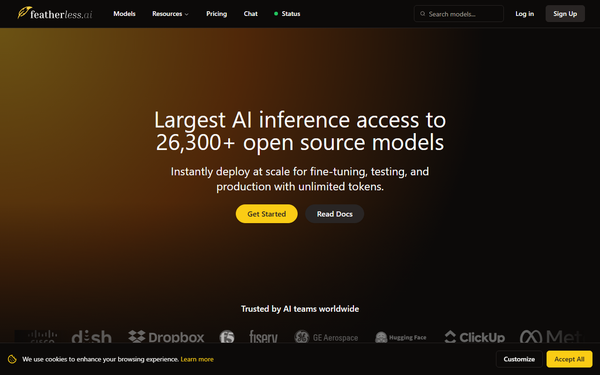
Featherless.ai is a serverless AI inference platform that delivers instant API access to over 26,700 open-weight models from Hugging Face, with a focus on popular text-generation architectures such as Llama, Mistral, Qwen, DeepSeek, and Gemma. Users send standard OpenAI-compatible API calls to run inference on any supported model without provisioning GPUs, managing servers, or dealing with scaling complexity. Primary use cases include building production AI applications, coding agents (e.g., OpenHands), creative writing tools (e.g., Novelcrafter), role-playing chat apps (e.g., WyvernChat), and complex prompt orchestration with frameworks like LangChain or LlamaIndex.
The platform targets AI developers, researchers, data scientists, indie hackers, and organizations that need flexible, high-performance access to open-source LLMs for prototyping, testing, and production workloads. It appeals especially to teams who want to swap models instantly, avoid infrastructure overhead, and maintain privacy without logging prompts or completions.
Key Features & Capabilities
Core functionality revolves around a fully OpenAI-compatible REST API (endpoint: https://api.featherless.ai/v1) that supports chat completions, tool calling, vision (multimodal), and a realtime API beta. Models are served at FP8 precision (FP16 for <5B) with context lengths up to 32K depending on architecture, and any public Hugging Face model with 100+ downloads is automatically available. Standout features include unlimited monthly tokens and requests under subscription plans, dynamic auto-scaling via advanced GPU orchestration, private/anonymous usage with zero prompt logging, and native integrations with LangChain, LiteLLM, n8n, Aider, Cursor, and OpenHands.
What truly differentiates Featherless.ai is its unmatched model catalog—the largest serverless inference provider on Hugging Face—combined with flat, predictable billing instead of volatile per-token pricing. Users can switch between thousands of fine-tunes (coding, creative, RP, research) by changing a single model ID. Business/Scale plans also allow private model deployment by connecting a Hugging Face account.
Limitations include strict concurrency caps (requests exceeding your plan’s allotment return HTTP 429), model-size restrictions on lower tiers, cold-start latency on large models (common to serverless), and model onboarding requirements (must be safetensors, full weights, standard tensor shapes—no GGUF, LoRA, or custom embeddings). Consumer plans cannot deploy arbitrary private models without requesting via Discord or support. Advanced enterprise features like dedicated hardware or custom quantization are absent.
User Experience
Setup is extremely straightforward for anyone familiar with the OpenAI Python/JS SDK: sign up, choose a plan, copy an API key from the dashboard, and replace the base URL. The learning curve is minimal—most developers are productive in under five minutes. The web interface is clean and functional, featuring a dashboard for API keys and subscriptions, a searchable models catalog, and system-status monitoring. There is no full web playground, but the focus on API-first design keeps it lightweight.
Documentation is excellent: a concise quickstart guide, detailed pages on completions, tool calling, vision, concurrency, and model compatibility, plus blog tutorials for real-world integrations. Community support via Discord is active for model requests and troubleshooting; email support is also available. Overall UX is polished and developer-friendly, though power users in high-traffic scenarios occasionally note the need to monitor concurrency usage.
Performance & Reliability
Smaller models (≤15B) deliver responsive inference suitable for interactive applications, while the serverless orchestration ensures models spin up automatically. Larger models (70B+) can experience 30-second to 2-minute response times or occasional failures during peak load or cold starts, as reported by users in communities such as r/SillyTavernAI. Concurrency is strictly enforced by model-size “cost” units, preventing overload but requiring planning for parallel workloads.
Reliability is solid overall, with a public status page showing consistent uptime across popular models like DeepSeek variants and Llama families. No widespread outages have been documented in recent reviews. The platform shines for variable or bursty workloads where predictable cost matters more than sub-second latency. Common complaints center on occasional slowness with the largest models rather than outright downtime.
Pricing & Value
Featherless.ai uses a simple subscription model with unlimited tokens and requests:
- Feather Basic — $10/month: models ≤15B parameters, 2 concurrent requests.
- Feather Premium — $25/month: all models (including DeepSeek V3/R1, Kimi-K2), up to 4 concurrent requests (varies by model size).
- Feather Scale — $75/month per unit: higher concurrency (8 units per scale), private model support, enterprise scaling to arbitrary concurrency.
Billing is flat and transparent—no surprise token bills. This structure delivers exceptional value for heavy users or those experimenting with dozens of models, often undercutting per-token providers like OpenRouter or Together.ai when usage is high. It is particularly cost-effective compared with self-hosting GPUs or managing dedicated instances. Lower-volume users may find the fixed monthly fee less attractive than pay-per-token alternatives, and very high-throughput applications require purchasing additional Scale units. Overall, the combination of massive model selection and predictable pricing offers strong ROI for the target developer audience.
Practical Tutorial
Featherless.ai provides an official quickstart (https://featherless.ai/docs/quickstart-guide). Here is a complete, ready-to-run walkthrough for the most common task: generating a chat completion with a popular model.
- Sign up at https://featherless.ai/register and subscribe to a plan (Basic or Premium).
- Navigate to https://featherless.ai/account/api-keys and generate a new API key.
- Install the OpenAI SDK:
pip install openai - Run the following Python script (replace
YOUR_API_KEY):
from openai import OpenAI

client = OpenAI(
    base_url="https://api.featherless.ai/v1",
    api_key="YOUR_API_KEY"
)

response = client.chat.completions.create(
    model="Qwen/Qwen2.5-7B-Instruct",  # or any model from the catalog, e.g., "meta-llama/Meta-Llama-3.1-8B-Instruct"
    messages=[
        {"role": "system", "content": "You are a helpful assistant."},
        {"role": "user", "content": "Explain serverless AI inference in one paragraph."}
    ],
    temperature=0.7,
    max_tokens=300
)

print(response.choices[0].message.content)- Execute the script. The response appears instantly (for models within your plan’s limits).
The same base URL and key work with LangChain, LlamaIndex, LiteLLM, or any OpenAI-compatible client. For direct HTTP calls or advanced parameters (tool calling, vision, streaming), see the official completions docs. Official integration guides for OpenHands, Aider, Cursor, and n8n are also available on the Featherless blog.
Final Verdict
Overall rating: 4.3/5
Featherless.ai is ideal for developers, researchers, and teams that need instant access to the widest possible range of open-source LLMs at predictable monthly costs without managing infrastructure. It excels when model variety and simplicity matter more than absolute lowest latency.
Avoid it if you require guaranteed sub-second responses for 70B+ models at high concurrency or prefer pay-per-token billing for very light usage.
One-sentence recommendation: For anyone building with open models and tired of infrastructure headaches, Featherless.ai is the most frictionless and affordable serverless inference platform available today.
Research conducted as of March 11, 2026, based on official documentation, pricing pages, integration blogs, system status, and community feedback from Reddit and tech comparison articles.