Feedback Navigator Review: Turn Customer Reviews into Insights
Overview & Purpose
Feedback Navigator is an AI-powered platform designed to aggregate customer feedback from multiple online sources and transform it into actionable insights through intelligent analysis. Users can import data directly from review platforms or via CSV uploads and a simple API, enabling quick extraction of trends, sentiments, and requests to drive business improvements. Primary use cases include monitoring online reputation for service-based businesses, identifying recurring issues like feature requests or complaints, and generating reports to enhance customer satisfaction and operational decisions.
The tool primarily targets property managers, hotel managers, restaurant owners, gym owners, product teams, and consultants who manage feedback across scattered platforms. It appeals to non-technical users seeking fast overviews rather than developers or designers focused on custom coding, though its API and webhook support offer some flexibility for automation enthusiasts.
Key Features & Capabilities
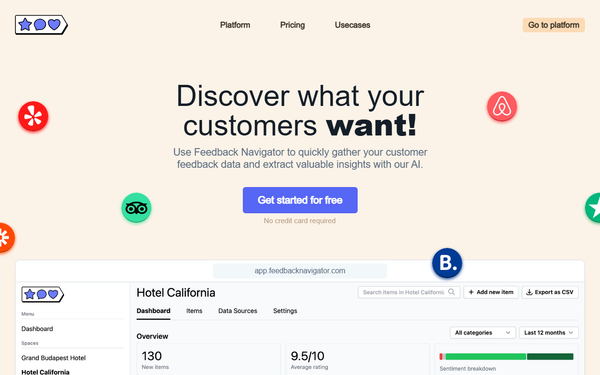
Core functionality revolves around data import from built-in sources (Yelp, Google Maps, Trustpilot, Tripadvisor, Booking, and Airbnb), AI-driven processing, and visualization in intuitive dashboards. Key capabilities include custom category creation (tailored per “space” for locations or products), sentiment analysis (positive, negative, or neutral), automatic detection and grouping of feature requests or reported issues, and export options for further use.
Standout features that differentiate it from general sentiment tools or basic review aggregators include per-space customization, webhook integrations compatible with Zapier for automated workflows (e.g., triggering support tickets on negative feedback), and unlimited spaces and data sources across plans—allowing hotels to track multiple properties or product teams to monitor competitors separately. The credit-based AI analysis processes feedback in minutes, turning raw reviews into grouped insights without manual tagging.
Limitations include a strict credit system (one credit typically consumed per feedback item analyzed), which can add up for high-volume users, and a relatively narrow set of direct integrations compared to enterprise CX platforms. Missing features noted in available descriptions include advanced multi-language support beyond English-dominant sources, deep BI integrations (e.g., with CRM systems), or white-label options for agencies. No unlimited processing tier exists, and scalability relies on purchasing additional credits.
User Experience
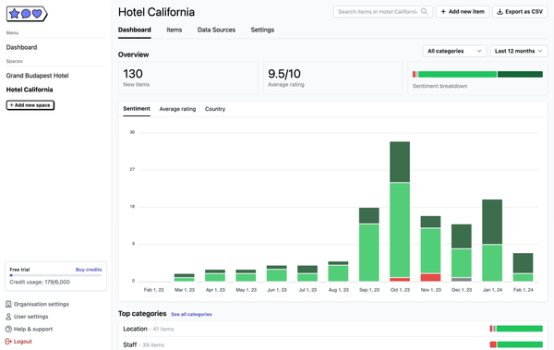
Feedback Navigator offers a low learning curve, with users reporting the ability to set up spaces, import data, and generate dashboards within minutes thanks to its streamlined web-based interface. The dashboard is described as user-friendly and visual, focusing on clear summaries of sentiments, top categories, and request groupings rather than overwhelming charts—ideal for busy owners and managers.
Interface quality feels modern and focused, with straightforward navigation for imports, category setup, and webhook configuration. Public documentation is limited (primarily in-app guidance and basic site explanations), and support resources appear to center on email or chat within the platform rather than extensive knowledge bases or community forums. As a newer tool, users may need to experiment slightly with custom categories, but overall onboarding is accessible even for non-technical audiences.
Performance & Reliability
The platform delivers fast processing, with AI analysis typically completing in minutes even for batches of reviews, making it efficient for regular monitoring. Speed remains consistent across moderate volumes within credit limits, and the built-in connectors handle direct pulls reliably without manual scraping in most cases.
No widespread known issues or common complaints appear in public sources as of March 2026 research—likely due to the tool’s emerging status and limited user base. Early Product Hunt feedback highlights smooth organization and insightful results, with no reports of downtime, inaccurate sentiment detection, or integration failures. Reliability seems solid for its intended SMB use cases, though high-volume enterprises may encounter credit throttling or require verification of API uptime.
Pricing & Value
Feedback Navigator uses a credit-based model (one credit per feedback analyzed) with flexible options including a free trial of 100 credits (no credit card required) and subscription packs or one-time credit purchases. Current tiers include the S Pack (1,000 credits for $15/month), M Pack (2,500 credits for $25/month), and larger options such as an L Pack (up to 5,000 credits). Historical AppSumo lifetime deals offered similar tiers (now sold out). Unlimited spaces and data sources apply across plans, with webhook access included.
Value is strong for small-to-medium businesses handling hundreds to thousands of reviews monthly, providing an affordable alternative to manual spreadsheet analysis or pricier enterprise tools like BirdEye or Thematic. The entry-level pricing and direct review-site connectors deliver quick ROI through time savings and actionable insights, though heavy users may find credits add expense compared to unlimited plans from competitors. Overall, it offers excellent bang-for-buck for targeted review aggregation without bloat.
Practical Tutorial
No official video tutorials or extensive guides were prominently available on the site or third-party sources as of March 2026, but the process follows a clear, repeatable flow based on documented features. Here is a step-by-step walkthrough for a common task—analyzing hotel reviews from Booking.com to identify service improvement opportunities (realistic example for a property manager):
- Sign up for free at https://www.feedbacknavigator.com/ and verify your account (no credit card needed for the 100-credit trial).
- Create a new “Space” (e.g., name it “Downtown Hotel – Q1 Reviews”) to keep data organized—spaces support unique custom categories per location or product.
- Import data: Connect directly to Booking.com (or alternatives like Tripadvisor/Yelp) using the built-in integration, or upload a CSV export from Trustpilot/Google Maps. The system pulls recent reviews automatically.
- Define custom categories: Add tags such as “Cleanliness,” “Staff Friendliness,” “Amenities,” and “Value” (AI will auto-assign future reviews).
- Run AI analysis: Click to process the imported feedback—credits are deducted per review. The tool performs sentiment analysis, groups requests (e.g., “more pool towels needed”), and flags issues.
- Explore the dashboard: View summaries like “70% positive sentiment on staff, but 25% requests for faster Wi-Fi,” trend charts, and exportable reports.
- Set up automation (optional): Configure a webhook to Zapier so negative reviews or high-priority requests automatically create tasks in your project management tool.
This entire workflow typically takes under 15 minutes for initial setup and delivers immediate insights. For ongoing use, schedule regular imports or rely on webhooks for real-time updates. Test with your own sample CSV to explore before committing credits.
Final Verdict
Overall rating: 4.3 out of 5.
This tool is ideal for small-to-medium service businesses (hotels, restaurants, gyms, or product teams) that rely on scattered online reviews and want fast, AI-driven insights without complex setup or high costs—especially those already using platforms like Booking.com or Yelp.
Avoid it if you manage enterprise-scale volumes (thousands of reviews monthly) needing unlimited processing, advanced CRM integrations, or proven long-term support ecosystems, as the credit model and emerging documentation may feel restrictive.
One-sentence recommendation: Feedback Navigator is a smart, affordable choice for turning fragmented customer reviews into clear, actionable improvements—worth trying with the free credits if you’re overwhelmed by multi-platform feedback.