Feeling Great App Review: Crush Negative Thoughts with AI CBT
Overview & Purpose

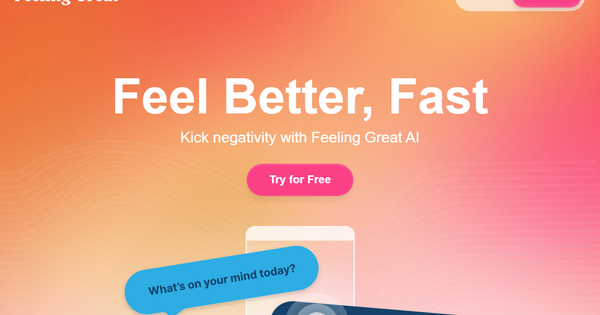
The Feeling Great app is a mobile application (available on iOS and Android) that leverages AI-powered chatbot interactions and structured interactive courses to help users rapidly improve their emotional well-being. Built on the TEAM-CBT (Testing, Empathy, Assessment, and Methods) framework developed by Dr. David Burns over 40+ years of clinical practice and research, the app guides users to identify cognitive distortions, challenge negative thoughts, and transform emotions such as anxiety, depression, shame, guilt, and hopelessness into positive states like joy and self-esteem. Primary use cases include daily mood management, processing specific upsetting events or thoughts, and building long-term resilience through self-help exercises—often delivering noticeable improvements in as little as one session or under a day. It targets individuals experiencing mild to moderate emotional distress who seek convenient, evidence-informed self-help tools, rather than specialized audiences like developers, marketers, or designers. Anyone struggling with negative self-talk, low mood, or anxiety can benefit, with strong appeal for fans of Dr. Burns’ bestselling books like Feeling Good and Feeling Great. The app explicitly states it is not a substitute for professional therapy or crisis intervention (directing users in emergencies to resources like 988).
Key Features & Capabilities
Core functionality centers on a friendly AI chatbot that engages users in real-time text or voice conversations to empathize, summarize feelings accurately, pinpoint cognitive distortions (e.g., all-or-nothing thinking), and apply proven TEAM-CBT techniques such as positive reframing, externalization of voices, or humorous exaggeration to “crush” negative thoughts. Complementing this are vibrant interactive courses featuring illustrations, stories, quizzes, and audio clips of Dr. Burns himself, covering topics like overcoming shame, building self-esteem, and daily mood tools. Standout features include the AI’s reported high empathy (often articulating feelings better than users can themselves), rapid mood-shifting results (users frequently report 60-87% reductions in negative emotions per session), and seamless integration of learning with practice—making abstract CBT concepts immediately actionable. These differentiate it from generic meditation or mood-tracking apps by delivering structured, Burns-specific methods with AI personalization. Limitations include occasional AI responses that feel scripted or slightly off-topic for complex issues, high dropout rates observed in early beta studies (around 65% for full 4-week protocols), and lack of integration with human therapists or advanced analytics. It is also not designed for severe psychiatric conditions or real-time crisis support.
User Experience
The app boasts an intuitive interface with a clean chat layout, simple navigation between conversations and learning tabs, and recent updates adding smoother animations, voice chat, and refined onboarding—resulting in a low learning curve for most users. Newcomers can start chatting or browsing courses within minutes, though those unfamiliar with CBT may initially find the “emotional mirror” process uncomfortable or require scrolling through techniques. Interface quality is generally praised as modern and engaging, with users describing it as “like a therapist in your pocket.” In-app resources include built-in FAQs, progress tracking, and direct support contact; the official website offers additional guidance and a reviews page. Documentation feels sufficient for self-guided use, though some users note minor frustrations like missing back buttons during exercises or the need for patience with longer sessions. Overall, the experience emphasizes validation and empowerment, leading to testimonials of users feeling “so seen” that they become emotional.
Performance & Reliability
Sessions are fast and responsive, with the AI delivering immediate empathy and technique guidance—many users report significant mood lifts within 10-80 minutes. Efficiency shines in its ability to handle repeated use without lag, supported by frequent updates fixing bugs and improving reliability (e.g., voice chat added in March 2025, smoother conversations in 2025 releases). Known issues are minor and mostly addressed over time: occasional unrelated AI replies, technical glitches (now rare), or sessions feeling lengthy/protocol-driven. User complaints on platforms like the App Store and Reddit are infrequent compared to glowing feedback, with no widespread reliability problems reported as of March 2026. Early feasibility data showed safety (no increase in suicidality) and meaningful hopelessness reductions. The app performs reliably for its intended self-help scope but may feel repetitive for advanced users.
Pricing & Value
The app is free to download and try, offering access to the AI chatbot and select interactive lessons. Full access to all courses, unlimited conversations, voice features, and premium tools requires a subscription—typically $99 per year (or monthly options introduced in mid-2025), with a 7-day free trial for the complete experience; one-time purchase options around $99 have also been available, plus hardship/accessibility programs via email support. Promotional periods in 2025 made it completely free for limited times. Compared to traditional therapy ($100+ per session) or similar apps with higher ongoing costs, it delivers exceptional value through 24/7 access to expert-backed methods—often described as “more affordable than therapy and it actually works.” The proposition is particularly strong for self-motivated users seeking rapid, lasting tools without ongoing professional fees.
Practical Tutorial
Official tutorials are integrated directly into the app’s courses and onboarding flow, with no standalone external video series prominently linked on the website (though Dr. Burns discusses techniques on the Feeling Good podcast and YouTube). Here is a step-by-step walkthrough for a common task—using the AI chatbot to challenge a negative thought (e.g., “I’m a failure because I messed up at work today”)—based on the app’s TEAM-CBT process and user-reported flows. This mirrors real examples from reviews and descriptions:
-
Download the app from the Apple App Store or Google Play and sign up with your email (quick onboarding with optional profile setup).
-
Tap “New Conversation” or the chat icon on the home screen to launch the AI chatbot.
-
Describe your situation and emotion in your own words (text or voice): “I feel worthless and anxious because I made a mistake in today’s meeting and now I think everyone sees me as incompetent.”
-
The AI will first provide empathy (“That sounds incredibly painful—I can hear how ashamed and hopeless you feel right now”) and ask you to rate the intensity of negative emotions (0-100%).
-
It identifies cognitive distortions (e.g., “This seems like all-or-nothing thinking and mind-reading—let’s examine the evidence together”) and guides you through methods: positive reframing, examining pros/cons of the belief, or the “externalization of voices” role-play.
-
Follow prompts to generate counter-thoughts (the app suggests or lets you create them) and re-rate your belief and emotions—most users see dramatic drops here.
-
End the session with a summary and optional mood log; save or revisit in the learning tab for reinforcement.
This process typically takes 10-30 minutes and often leads to immediate relief, as reported by users who crushed similar thoughts in one go. For deeper dives, start the “Overcoming Shame” or “Daily Mood Training” course. Official download link: feelinggreat.app.link (via the website).
Final Verdict
Overall rating: 4.5/5. This app excels for motivated individuals dealing with everyday negative thoughts or mild anxiety/depression who appreciate structured CBT and want an empathetic AI companion available anytime—ideal for fans of Dr. Burns or those seeking fast, affordable self-help. Users who should avoid it include those in acute crisis (who need human professionals or hotlines immediately), individuals uncomfortable with AI or CBT-style introspection, or anyone expecting fully personalized therapy without self-effort. One-sentence recommendation: If you’re ready to crush negative thoughts and feel dramatically better in minutes using proven methods from a mental health legend, download Feeling Great today—it’s a game-changing pocket therapist.