Fiddler AI Review: Enterprise Observability and AI Governance

Overview & Purpose

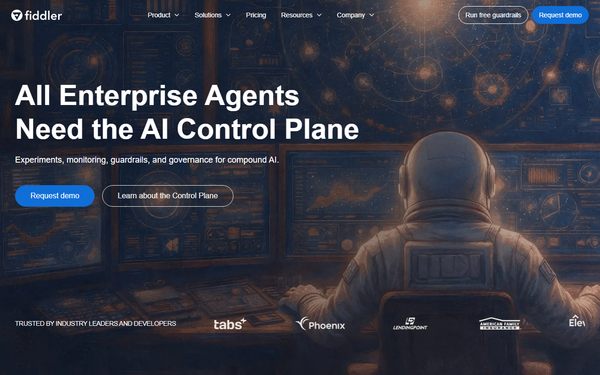
Fiddler AI is an enterprise AI Control Plane platform that delivers unified observability, monitoring, explainability, security guardrails, and governance for machine learning models, LLM applications, generative AI systems, and especially compound agentic workflows. It tracks every action, decision, and outcome across agent hierarchies with full execution context and decision lineage, while providing real-time alerts for issues like data drift, performance degradation, bias, hallucinations, toxicity, prompt injections, and PII leaks. Primary use cases include pre-production testing/experiments, production monitoring of complex AI agents, root-cause troubleshooting, bias/fairness auditing, and enforceable policy-based governance to ensure compliance and safety before and after deployment. Organizations use it to build trust in AI, reduce risks in regulated environments, optimize ROI on production models, and meet emerging AI governance standards.
The target audience is data scientists, MLOps and AI engineering teams, security professionals, and governance/compliance leaders—primarily in large enterprises in finance, healthcare, retail, and government sectors deploying production-scale AI. It is less suited for individual developers or small startups without governance needs.
Key Features & Capabilities
Core functionality centers on three integrated products: Evaluate & Test (experiments, evaluators, and validation), Observability (real-time monitoring, dashboards, drift detection, and root-cause analysis), and Protect & Guardrails (real-time safety checks and policy enforcement). Standout capabilities include agentic observability with hierarchical traces and decision lineage, explainable AI techniques (such as SHAP values), custom evaluators or “bring your own judge,” Fiddler Trust Models for low-latency (<100 ms) detection of hallucinations/toxicity/PII/prompt attacks, flexible dashboards, alerts, and embeddings visualization. It supports predictive ML, LLMs, RAG systems, and multi-agent setups with seamless integrations to LangGraph, OpenTelemetry, and major MLOps platforms.
Differentiators from competitors like Arize AI, LangSmith, WhyLabs, or Galileo include the “batteries-included” Trust Models that run locally in your environment (no external API costs), unified coverage across traditional ML and agentic GenAI, enterprise-grade governance with on-prem/VPC deployment options, and auditable policy enforcement for compliance-heavy organizations. Limitations include a heavier enterprise focus that may feel overkill for simple projects, limited free-tier scope beyond basic guardrails, and occasional integration complexity with legacy stacks. No fully open-source self-hosted version exists for the complete platform.
User Experience
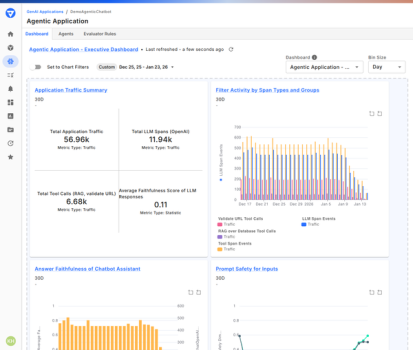
Fiddler AI offers a clean, modern interface with visualization-rich dashboards that make it straightforward to track issues, drill into traces, and configure monitors once familiar with the concepts. The learning curve is moderate to steep—praised as intuitive for experienced MLOps practitioners but challenging for newcomers to AI monitoring due to terminology around spans, evaluators, and hierarchical traces. Documentation is comprehensive and well-organized at docs.fiddler.ai, with SDK quickstarts, code examples, and video product tours; enterprise users receive white-glove support, a dedicated Customer Success Manager, and customized onboarding. Overall, users highlight the platform’s ability to centralize observability and deliver actionable insights quickly after initial setup.

Performance & Reliability
The platform delivers real-time monitoring and guardrail evaluations with sub-100 ms latency, scaling efficiently to high-volume enterprise workloads without noticeable overhead. Root-cause analysis via decision lineage and trace context is consistently fast and reliable in production. Known issues are minimal; user feedback reports no widespread reliability problems, though some note that creating highly customized dashboards can require extra configuration time. Performance remains strong across SaaS, VPC, and on-prem deployments, with enterprise users citing consistent uptime and precise anomaly detection.

Pricing & Value
Fiddler AI uses a transparent, consumption-based model with three tiers (research as of March 2026):
- Free: Real-time guardrails only (hallucinations, toxicity, PII/PHI, prompt injection, jailbreak protection) — ideal for initial safety testing.
- Developer: $0.002 per trace; includes full unified observability, tests/experiments, custom evaluators, RBAC/SSO, and SaaS deployment.
- Enterprise: Custom pricing (contact sales); adds enterprise-grade guardrails, massive scalability, flexible deployment (SaaS/VPC/on-prem), dedicated support, and named Customer Success Manager.
Value is excellent for mid-to-large organizations needing comprehensive governance and risk reduction—paying only for actual usage while gaining audit-ready compliance tools that can prevent costly AI failures. Compared with alternatives (Arize, LangSmith), it offers stronger built-in trust models and deployment flexibility, though smaller teams or budget-conscious users may find the per-trace cost or enterprise focus less economical than lighter open-source options.
Practical Tutorial
A common task is onboarding and monitoring a simple LLM or RAG application (e.g., a customer-support chatbot). Fiddler provides official quickstarts and an Evals SDK; below is a practical walkthrough based on the platform’s GenAI onboarding and Evals SDK (approximately 15–20 minutes). Full details and code are available in the official documentation.
-
Sign up and create a project/application: Log into your Fiddler account (free tier works for guardrails; request Developer access for full features). In the UI, create a new Project, then an Application (e.g., “Support-Chatbot”). Note the Application ID and generate an API key from Settings > Credentials.
-
Install the SDK: In your Python environment (3.10+), run
pip install fiddler-evals(or the core fiddler-client SDK for monitoring). -
Connect and instrument your code: Initialize the client and wrap your LLM/RAG logic to log traces. Example snippet for a basic evaluation experiment:
import fiddler_evals as fe
client = fe.FiddlerClient(url='https://your-fiddler-instance.com', token='your-access-token')
# Define your task (e.g., RAG function)
def rag_task(inputs):
   # Call your LLM/RAG here
   return {"answer": "Your response here", "retrieved_docs": [...]}
Use built-in evaluators like AnswerRelevance, ContextRelevance, or RAGFaithfulness.
-
Build a test dataset and run evaluations: Create a dataset with inputs/expected outputs, then execute:
experiment = client.evaluate(
   task=rag_task,
   dataset=your_test_dataset,
   evaluators=[fe.AnswerRelevance(model="openai/gpt-4o"), fe.RAGFaithfulness()],
   score_fn_kwargs_mapping={"rag_response": "answer", "user_query": "question"}
)
Results (scores, metrics, traces) appear automatically in the Fiddler UI.
-
Set up production monitoring and guardrails: In the UI, configure monitors for latency, toxicity, drift, or custom metrics. Enable Fiddler Trust Models for real-time guardrails on prompts/responses. Add alerts for thresholds (e.g., faithfulness < 0.8).
-
Analyze and iterate: Use the dashboard to explore traces, embeddings (UMAP), root causes, and export reports. Adjust models or add custom evaluators based on insights.
This workflow gives immediate visibility and safety controls. For production agents, extend with LangGraph or OpenTelemetry instrumentation (see official guide at https://docs.fiddler.ai/). Video product tours on Fiddler’s YouTube channel provide visual walkthroughs.
Final Verdict
Overall rating: 4.5/5. Fiddler AI excels for enterprise teams that require robust, unified observability and governance across ML, LLM, and agentic AI deployments—delivering enterprise-grade safety, explainability, and compliance tools that directly reduce risk and accelerate responsible AI adoption. It is ideal for regulated industries or organizations scaling production AI agents. Teams should avoid it if they are small startups, hobbyists, or on tight budgets, as the learning curve and consumption pricing may outweigh benefits compared to lighter or open-source alternatives. One-sentence recommendation: For organizations serious about trustworthy, production-ready AI, Fiddler AI is a powerful control plane worth investing in.