Fish Audio Review: The Best Budget-Friendly AI Voice Cloning Tool
Overview & Purpose

Fish Audio is an advanced AI-powered platform for text-to-speech (TTS) generation and instant voice cloning, delivering studio-quality, emotionally expressive audio from text or short voice samples. It enables users to create lifelike human voices in over 30 languages, with fine-grained control over emotions, tone, and prosody, while supporting real-time streaming and API integration. Primary use cases include video voiceovers for YouTube and ads, audiobook narration meeting ACX/Audible standards, character voices for games and animations, conversational chatbots or virtual assistants, and podcast production.
The target audience spans content creators (YouTubers, podcasters), marketers and businesses needing ads or explainers, developers building apps or voice agents, and teams producing scalable audio content. As of research conducted in March 2026, the platform—powered by its S1 model and with roots in the open-source Fish Speech project—positions itself as a highly accessible and cost-effective alternative for anyone seeking professional-grade AI voices without hiring human talent.
Key Features & Capabilities
Core functionality revolves around TTS conversion of scripts into natural speech and voice cloning from as little as 10–15 seconds of audio, allowing unlimited generation in the cloned voice across languages. Users access a library of over 2 million community and pre-built voices, with tools for emotion tagging (e.g., [excited], [laugh], or calm tones), tone swapping, and dynamic prosody control. Standout features include ultra-low-latency streaming API with SDKs for Python and JavaScript, multilingual support (strong in English, Chinese, Japanese, Korean, French, German, Spanish, and Arabic), real-time voice activity detection, and additional audio tools like speech-to-text.
What differentiates Fish Audio from competitors like ElevenLabs is its unmatched speed and accuracy in zero-shot cloning from short samples, superior emotional nuance (including laughter, whispering, or crying in the S1 model), and significantly lower pricing—often 50–70% cheaper—while maintaining comparable or better realism in expressive scenarios. It also offers self-hosting options via open-source roots and a web-based Story Studio for multi-character projects.
Limitations include a restrictive free tier (personal use only, with commercial rights requiring paid plans), occasional inconsistencies in long-form narration (such as minor pacing or inflection drops reported by some users), and variability in quality depending on sample clarity. Advanced features like heavy API customization have a slight learning curve for non-developers, and it may not always lead in raw fluency for every edge-case scenario compared to more established tools.
User Experience
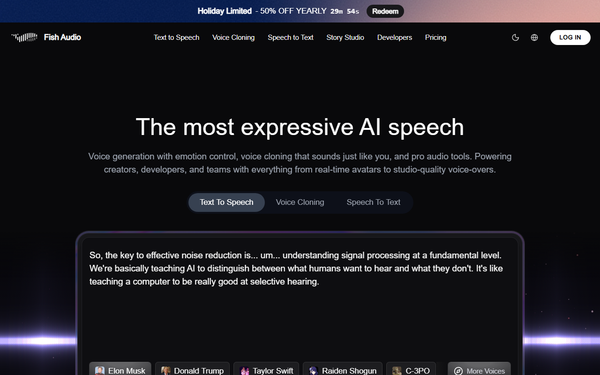
The platform boasts an intuitive web dashboard with sections for voice discovery, cloning, TTS playground, and API management, resulting in a low learning curve for core tasks—even beginners can clone a voice and generate audio in minutes. The clean, preview-rich interface feels modern and responsive, with easy upload of audio samples or script pasting.
Documentation is comprehensive at docs.fish.audio, featuring quick-start guides, full API references, SDK examples, best practices for optimal cloning (e.g., using clean 15–20-second natural speech), and emotion reference lists. Community resources, blog updates, and numerous YouTube tutorials supplement this. Support is primarily self-service via docs and email, though some users note slower response times and occasional billing management frustrations. Overall, the experience is highly accessible for both casual creators and technical users.
Performance & Reliability
Generation and cloning are exceptionally fast—often under 10 seconds for short clips—with ultra-low latency in streaming mode, making it suitable for real-time applications like chatbots. Audio quality is consistently praised as studio-grade and nearly indistinguishable from humans, excelling in emotional expressiveness, accents, and multilingual fidelity; independent benchmarks and user tests frequently rank the S1 model at or near the top for naturalness.
Known issues are minor: occasional prosody glitches in extended outputs, rare rate-limit hiccups on free tiers, and isolated reports of model deprecation transitions. Common complaints center more on billing processes than core reliability, with no widespread outages noted. Reliability is strong for production use on paid plans, backed by AWS partnerships.
Pricing & Value
Fish Audio operates on a freemium model with clear tiers (as of March 2026):
- Free: ~8,000 credits (~7 minutes of S1 audio) per month, limited to personal/non-commercial use and basic features.
- Plus: Approximately $20/month (or ~$5.50/month billed yearly) for ~250,000 credits (~200 minutes), including commercial rights, private voice slots, and full API access.
- Pro: Higher tiers (e.g., ~$150/month or discounted yearly) for 2+ million credits and team features.
- API: Pure pay-as-you-go (~$1.25 per hour of generated speech), with no subscriptions required.
Value is exceptional—often 50–90% cheaper than hiring voice actors or using premium competitors like ElevenLabs—while delivering comparable or superior cloning and expressiveness. Paid plans unlock monetization rights and higher limits, making it highly cost-effective for high-volume creators and developers. Drawbacks include reported difficulties canceling subscriptions for some users.
Practical Tutorial
Official documentation and the web app provide built-in guidance, with additional step-by-step tutorials available on the site and YouTube channels. Below is a practical walkthrough for a common task: cloning a voice from a short sample and generating an emotionally expressive narration (e.g., a podcast intro). This uses the web interface—no coding required—and works with the free tier for testing.
- Sign up and access the dashboard: Go to https://fish.audio/, create a free account, and log in. Navigate to the app section (or directly to /app/discovery for voice library).
- Create a voice clone: Click “Voice Cloning” or “Build Voice.” Upload a clean 15–60 second audio sample (record yourself reading neutral text for best results, or use a high-quality clip). Name the voice (e.g., “Podcast Host”), select privacy settings, and click “Create.” Cloning completes in seconds with the S1 model.
- Generate speech in the TTS playground: Go to the Text-to-Speech section. Select your newly cloned voice from the library. Paste your script, e.g.: “[excited] Hello everyone! Welcome to today’s episode where we dive into AI innovation.” (Use brackets or parentheses for emotion tags like [laugh], [calm], or [whisper]—check the emotion reference in docs for full list.)
- Customize and generate: Adjust speed, volume, or add chapter breaks if needed. Click “Generate” to preview instantly. Download as MP3/WAV or stream via API for apps.
- Refine and export: Regenerate takes with different emotions or upload to Story Studio for multi-voice projects. For API users, refer to the Quick Start at docs.fish.audio for Python/JS code examples.
Example result: A 30-second excited intro sounds natural and engaging. For advanced control, explore the official Voice Cloning Tutorial resources or developer quickstart guides linked in the app.
Final Verdict
Fish Audio earns a strong 4.5 out of 5 rating for its exceptional realism, lightning-fast cloning, emotional depth, and unbeatable value—making it one of the top AI voice platforms in 2026.
Content creators, marketers, developers, and small businesses seeking affordable, expressive, multilingual voices for narration, ads, podcasts, or apps should use it—especially those prioritizing quick cloning and cost savings over enterprise-level support.
Avoid it if you need flawless long-form consistency every time, heavy customer service reliance, or easy subscription management, as minor quality variances and billing hiccups appear in user feedback.
In one sentence: Fish Audio is the smart, budget-friendly choice for anyone ready to produce professional AI voices that genuinely feel alive—start with the free tier today.