Flytest Review: The Ultimate AI-Powered No-Code Test Automation
Overview & Purpose
FlyTest is an AI-powered no-code/low-code test automation platform designed for web and mobile applications. It enables teams to create, execute, and maintain tests using plain English or simple video recordings rather than traditional scripting, while leveraging AI to adapt to UI changes, predict potential issues, and provide actionable insights. Primary use cases include end-to-end (E2E) testing, regression testing, cross-browser/device validation, and industry-specific scenarios such as ensuring seamless checkouts in e-commerce, compliance in finance, patient data security in healthcare, rapid iterations in SaaS, and performance across devices in gaming or mobile apps. The tool aims to eliminate manual QA errors, reduce test maintenance overhead, and accelerate release cycles without requiring dedicated coding resources.
Target audience spans technical and non-technical users alike: developers and QA engineers benefit from faster automation and self-healing, while product managers, marketers, designers, and support teams can contribute tests directly via natural language. It is particularly suited for startups, SMEs, and growing organizations seeking to democratize quality assurance, though larger enterprises may also explore it for hybrid human-AI support. Research conducted as of March 6, 2026.

Key Features & Capabilities
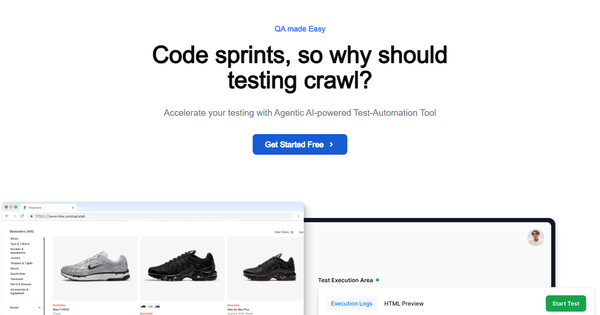
Core functionality revolves around effortless test creation, visual execution, intelligent analysis, and scheduling. Users install a Chrome extension to record real user interactions as a video, which the AI automatically converts into editable plain-English test cases; alternatively, tests can be authored directly in natural language. Tests run with live visual monitoring of actions in the browser, generate detailed reports and analytics, and support scheduling for continuous validation. Mobile testing utilizes cloud-based device labs for cross-platform consistency.
Standout features that differentiate FlyTest include AI-driven self-healing (tests automatically adapt to UI changes), predictive bug detection and regression test prioritization based on application history, clear failure insights with suggested fixes, and on-demand access to human QA experts for personalized guidance. The video-recording-to-test workflow and hybrid AI-human support model set it apart from purely code-based or basic no-code competitors. Additional capabilities cover cross-browser visual comparisons and real-time insights to catch issues before production.
Limitations include sparse public documentation on advanced integrations (e.g., specific CI/CD pipelines or API testing depth), potential need for manual validation or tweaks in highly dynamic or custom UIs where AI interpretation may vary, and less comprehensive enterprise-scale features compared to mature competitors like Mabl or Testim. As an emerging platform, it lacks the extensive ecosystem and proven case studies of longer-established tools. Mobile capabilities, while advertised, appear more reliant on cloud labs without granular public details on supported frameworks.

User Experience
FlyTest boasts a low learning curve, making sophisticated testing accessible even to non-developers through intuitive recording or plain-English input—no prior coding experience required. The interface emphasizes visual feedback, with live browser views of test execution and clear dashboards for reviewing reports, contributing to an engaging and transparent workflow. Setup begins with a simple Chrome extension installation, and test management feels streamlined for mixed teams.
Documentation and support resources include a knowledge base with guides and FAQs, an active blog covering best practices, and a dedicated YouTube demo walkthrough. On-demand human QA professionals provide personalized assistance, which enhances the experience beyond typical self-serve AI tools. Overall interface quality appears modern and focused on clarity, though full console access requires signup and some advanced sections may feel less polished due to the platform's relative newness.
Performance & Reliability
Tests generate and execute quickly thanks to the AI backbone, with claims of significantly faster deployments and reduced repetitive maintenance compared to scripted alternatives. Self-healing and predictive features improve long-term reliability by adapting to application changes and prioritizing high-risk regressions, while detailed reports enable rapid debugging. Live visual monitoring helps teams spot issues in real time.
No widespread known issues or common complaints surfaced in public searches as of March 2026, likely due to the tool's emerging status; available demos (including tests on real sites like Flipkart and Booking.com) demonstrate consistent performance on standard web flows. Potential edge cases include occasional AI misinterpretation in complex, highly customized interfaces, which could lead to flakier tests initially—users are advised to validate outputs. Reliability strengthens over time as the system learns from application history.
Pricing & Value
FlyTest offers a free tier for small teams focused on web testing (launched in 2025 and described as "free forever" for basic needs). Paid plans start with a Starter tier at approximately $299 per month for basic testing capabilities, scaling to a Professional plan around $999 per month for advanced features and higher usage, with custom enterprise pricing for larger organizations requiring tailored support, unlimited tests, or dedicated resources. Pricing is transparent with no hidden fees once accessed via the console, though the public pricing page has occasionally been listed as "coming soon."
Value proposition is strong for teams transitioning from manual or brittle scripted testing: the free entry point lowers barriers, while AI self-healing and reduced maintenance deliver clear ROI through faster releases and smaller QA teams. Compared to alternatives (e.g., higher-cost enterprise tools or code-heavy platforms), FlyTest provides competitive accessibility and hybrid support at a reasonable entry price, making it cost-effective for growing organizations—though enterprises may need to evaluate total cost against more feature-rich rivals.
Practical Tutorial
Official resources include a knowledge base, FAQs, and blog articles, plus a public YouTube demo walkthrough (https://www.youtube.com/watch?v=x7DcUGDjcYE). Below is a step-by-step guide for a common task—creating and running a basic E2E web test (e.g., user login followed by product checkout on an e-commerce site)—synthesized from official descriptions and workflow examples. This can be completed in minutes without coding.
- Sign up for a free account at flytest.ai and access the console dashboard (console.flytest.ai).
- Install the FlyTest Chrome extension from the dashboard prompts (one-click process).
- Navigate to your target web application in Chrome, click the extension icon, and start a new recording session.
- Perform the user flow (e.g., enter credentials to log in, browse products, add to cart, and complete checkout) while the extension captures actions as video.
- Stop recording; the AI automatically generates editable test steps in plain English (e.g., "Enter username 'testuser', click 'Login', navigate to cart").
- Review and tweak steps directly in the dashboard if needed—add assertions, conditions, or scheduling without code.
- Execute the test: Watch live visuals of the browser actions, review the detailed report with AI insights (failure reasons and fix suggestions), and apply self-healing where applicable.
- (Optional) Schedule recurring runs or request on-demand QA expert review for complex failures.
For mobile or advanced flows, use the cloud device lab via the console. Test on your own app or demo sites as shown in official videos. Always validate AI-generated steps on initial runs.
Final Verdict
Overall rating: 4.2 out of 5. FlyTest excels for development and product teams (including non-technical members) in startups or mid-sized organizations that want to accelerate testing, reduce maintenance headaches, and democratize QA through intuitive AI—especially those frustrated with traditional tools' brittleness or high coding barriers. It should be avoided by enterprises requiring deeply customized scripting, extensive third-party integrations out-of-the-box, or proven performance at massive scale, given the platform's relative newness and limited independent reviews. One-sentence recommendation: Try FlyTest's free tier today if you're seeking an accessible, intelligent way to make reliable software testing a team-wide capability rather than a specialist bottleneck.