Gemelo Review: Create Photorealistic AI Twins for Scalable Video
Overview & Purpose

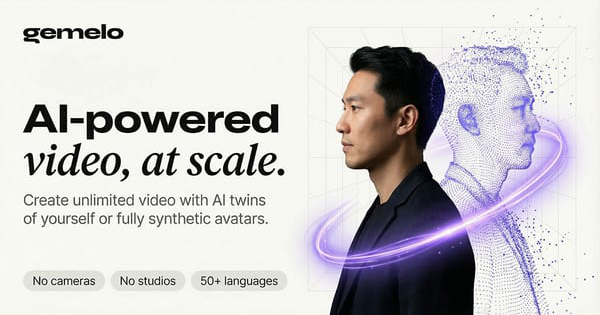
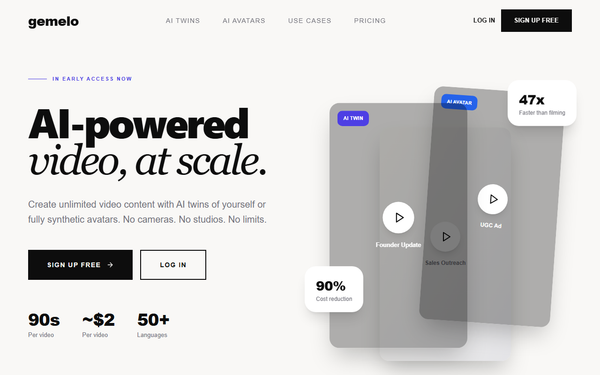
Gemelo is an AI-powered platform for creating photorealistic AI Twins (digital clones of real people) and synthetic AI Avatars to generate scalable video content without cameras, studios, or actors. Users record a short sample to clone face, voice, and knowledge, then produce unlimited personalized videos in 50+ languages with perfect lip-sync. Primary use cases include UGC-style ads, founder/brand videos for social media and outreach, marketing content, training materials, and sales videos—delivering 47x faster production and up to 90% cost savings versus traditional filming. It also supports interactive applications, such as real-time conversational avatars for customer engagement, website support, and 24/7 presence across apps or sites.
Target audience includes content creators, founders, marketers, agencies, and enterprises seeking to scale personal branding or customer-facing video experiences. Developers can integrate via API for custom apps. Research conducted as of March 14, 2026.
Key Features & Capabilities
Core functionality revolves around AI Twin creation: upload a 5-minute video sample for face/voice cloning, train on knowledge bases (docs, bios, Q&As), then generate or stream videos from text scripts. Standout features include unlimited multilingual support (50+ languages), average 90-second render times, full voice cloning with text-to-speech and speech-to-speech options, and photorealistic avatars for both pre-recorded videos and real-time interactions. It differentiates from competitors like Synthesia or HeyGen through NVIDIA Maxine-powered realism (e.g., Live Portrait for natural expressions) combined with OCI infrastructure for enterprise-scale speed and security, plus API access for voice/video twins with SDKs (TypeScript, Python, Go).
Additional capabilities cover vision (face cloning), knowledge embedding for authentic responses, and interaction services for chat-like or embedded twins that collect feedback or handle conversations. Free voice cloning is highlighted in some directories, though platform access ties it to token limits or paid plans.
Limitations include experimental video API elements, no advanced post-production editing (e.g., after-effects integration), potential reliance on high-quality training footage for best results, and sparse public documentation beyond developer API guides. Early access status (noted on site) may limit full feature maturity for some users.

User Experience
The web-based interface (app.gemelo.ai) earns praise for simplicity and intuitiveness—even beginners report quick onboarding with minimal learning curve for core cloning and generation tasks. Users upload samples, train models, and generate content via straightforward prompts or scripts; the dashboard supports testing in a sandbox before export or embedding.
Interface quality is clean and modern, though minor complaints note occasional menu glitches or naming issues in the video creator. Documentation is developer-focused via public GitHub API docs with Swagger testing, code examples, and SDKs; end-user support includes contact forms and limited help resources rather than extensive video tutorials or knowledge bases. Customer service receives high marks in small review samples, with responsive handling for enterprise needs. Overall, accessible for non-technical users but benefits from API familiarity for advanced integrations.

Performance & Reliability
Videos render in approximately 90 seconds on average, leveraging GPU-accelerated OCI infrastructure for reliable, enterprise-grade speed—significantly outperforming traditional production. Real-time interaction and streaming (via WebSocket TTS) perform well for conversational use cases, with strong multilingual consistency and natural lip-sync.
Known issues are minimal in available feedback: some users find cloned voice quality subjective (less impressive for certain accents or styles), and rare UI hiccups like stuck menus occur. No widespread complaints about downtime, data security, or output inconsistency as of 2026; enterprise users highlight faster performance than alternative clouds. With limited public reviews (a handful across platforms), reliability appears solid for its scale but lacks extensive long-term data.

Pricing & Value
Pricing is usage-based and transparent, with a free tier offering limited tokens (e.g., 600 for basic audio/video output and short recordings). Paid plans start at Starter ($19/month) for beginners, scaling to Creator ($49/month) for teams, Pro ($149/month or equivalent Professional tier around $59/month with 10,000 tokens/year, 1 HD AI Twin, full voice cloning, no watermarks, and premium avatars), and Enterprise (custom, starting ~$450/month or contact for unlimited videos, integrations, and dedicated support). Annual billing discounts apply.
Value is strong for high-volume creators: 90% cost reduction and rapid output make it competitive against manual video or pricier alternatives. Free cloning elements and token flexibility suit testing, while enterprise security/compliance adds appeal for businesses. Compared to rivals, it excels in realism and infrastructure but may require higher tiers for heavy use—ideal ROI for marketers scaling content daily.
Practical Tutorial
Official text-based tutorials are limited (primarily developer API docs at https://github.com/gemelo-ai/api-docs and scattered user videos on TikTok/LinkedIn), so here is a practical, real-world walkthrough for the common task of creating an AI Twin and generating a marketing video. This is synthesized from platform descriptions, user guides, and API examples as of March 2026.
-
Sign Up and Access Dashboard: Visit https://gemelo.ai/ or https://app.gemelo.ai/, create a free account with email, and log in. Verify any waitlist or early access prompts.
-
Create Your AI Twin: Record or upload a 5-minute clear video of yourself speaking naturally (good lighting, neutral background recommended). The platform clones face, voice, and expressions automatically using NVIDIA Maxine tech.
-
Train Knowledge Base: Upload documents, bios, Q&As, writing samples, or scripts. Set tone, boundaries, and response style (e.g., professional for marketing).
-
Personalize and Test: In the sandbox, input a sample script or prompt (e.g., "Introduce our new product in 30 seconds"). Preview the video twin, tweak parameters like language (choose from 50+), and refine if needed.
-
Generate and Export Video: Enter your full script or prompt. Select avatar style (twin or synthetic), render (typically ~90 seconds), and download or embed. For interactive use, copy the embed code or link to place on your website for real-time customer chats.
-
Iterate and Scale: Monitor tokens used; upgrade plans for more output. Example: A founder creates daily LinkedIn videos by cloning themselves once, then generating 10 variants in different languages for global reach.
For developer integrations (e.g., ChatGPT voice dialogue), refer to the public API docs and SDKs. Test with the free tier first.
Final Verdict
Overall rating: 4.5/5 – strong on realism and speed with limited but highly positive user feedback; holds back slightly due to sparse reviews and evolving documentation.
Content creators, marketers, founders, and agencies should use this tool for its unmatched scalability, photorealistic AI Twins, and cost/time savings in video production or customer engagement—perfect if you need daily personalized content without filming.
Avoid it if you require advanced video editing tools, extensive hand-holding support, or proven long-term case studies at scale, as the platform remains somewhat early-stage with reliance on quality input data.
One-sentence recommendation: Gemelo delivers professional-grade AI Twins for effortless video scaling at a compelling price—start with the free tier if you're ready to clone yourself and multiply your reach.