Gestell Review: The Ultimate ETL Pipeline for Advanced RAG

Overview & Purpose

Gestell is an ETL platform purpose-built for large language models that converts unstructured and multi-modal data—such as PDFs, images, videos, spreadsheets, legacy code, and more—into structured, searchable, AI-ready formats and databases. It automates a full pipeline of intelligent chunking, vectorization, knowledge graph creation, feature extraction, table canonization (standardization), and re-ranking to power reliable retrieval-augmented generation (RAG), enterprise search, and scalable reasoning applications. Primary use cases include constructing high-accuracy knowledge bases from document troves, enhancing LLM performance on complex queries, financial or regulatory analysis, and legacy system modernization (e.g., harmonizing mainframe COBOL and z/OS code into queryable intelligence). The official site emphasizes enterprise applications such as mainframe modernization, documentation generation, cost optimization, and security assessments.
The target audience is primarily AI developers, data engineers, and technical teams building LLM-powered applications or handling large-scale unstructured data; it is less suited for non-technical marketers or designers seeking simple drag-and-drop tools. Research conducted as of March 8, 2026, draws from the official website, GitHub/PyPI resources, launch announcements, and AI tool directories.
Key Features & Capabilities
Core functionality revolves around an end-to-end, agent-driven pipeline that processes data in stages: semantic chunking, high-quality vector embeddings, knowledge graph construction for relationships, canonization of tables and entities (e.g., standardizing dates, currencies, or metrics), and intelligent re-ranking. Users define custom structuring rules entirely in natural language—for instance, “Extract all financial metrics, link companies to dates in a graph, and canonize tables by column headers”—making configuration intuitive yet powerful.
Standout features include seamless integration of every stage (no patchwork of separate tools), multi-modal support for virtually any file type, scalability to 50,000–100,000+ pages with preserved context, model-agnostic outputs, and built-in security (zero data egress options). These elements differentiate Gestell from competitors like Unstructured.io, LlamaIndex, or Google Document AI by delivering not just parsed text but fully structured databases, graphs, and re-rankers optimized for accurate LLM reasoning—often at lower cost. Developers report strong benchmark results, such as top-tier performance on FinanceBench RAG evaluations using their pipeline.
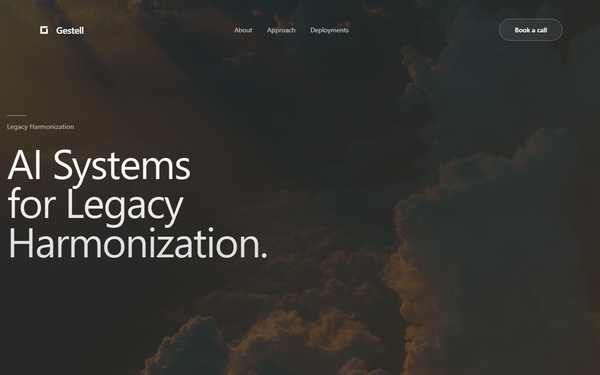
Limitations include a developer-centric workflow (SDK/API required for full power), sparse public details on advanced integrations, and an early-stage ecosystem with limited third-party connectors. The product appears to be evolving, with the homepage highlighting legacy-system applications that leverage the same ETL engine.
User Experience
Gestell offers a moderate learning curve suited to developers familiar with Python or Node.js SDKs and prompt engineering; natural-language rules significantly lower the barrier for defining complex structuring logic compared to code-heavy alternatives. The interface combines a web workspace (accessible via platform.gestell.ai) for visual management, uploads, and querying with robust SDKs for programmatic control, resulting in a clean, professional experience once set up.
Documentation consists primarily of GitHub guides and PyPI examples covering common workflows (e.g., collection creation and document processing), though public docs are not exhaustive and the former /docs endpoint now redirects to the homepage. Support is available via direct contact ([email protected]) and developer community channels; no extensive knowledge base or video library was found, which may slow onboarding for beginners. Overall, the platform feels reliable and focused for technical users rather than consumer-friendly.
Performance & Reliability
Processing is efficient and scales well, with claims of handling large datasets in minutes while maintaining high context fidelity—developers have demonstrated superior RAG accuracy on benchmarks like FinanceBench through the integrated graph and canonization steps. The pipeline’s agent-first design and built-in re-rankers contribute to consistent, production-ready outputs.
No widespread user complaints or known reliability issues appear in public forums or reviews as of March 2026, likely due to the tool’s relatively recent emergence and enterprise focus. Security features (air-gapped deployments, role-based controls) further enhance trustworthiness for sensitive data. Performance shines in complex, multi-modal scenarios where fragmented tools often fail.
Pricing & Value
Gestell follows a freemium model with a limited free tier for experimentation and paid Pro/enterprise plans for production-scale usage and advanced features. Exact tier details require contacting sales, but the platform is positioned as cost-efficient—approximately 40% cheaper than Google Document AI while offering broader multi-modal parsing, graph creation, and customization. Enterprise options include custom fine-tuning and on-site support.
Value is strong for teams tired of stitching together multiple ingestion libraries; the all-in-one pipeline with natural-language rules saves significant development time and improves LLM accuracy, delivering clear ROI for RAG-heavy applications or large document repositories. Compared to alternatives, it provides more structured, graph-enhanced outputs at competitive cost, though opacity around exact paid pricing may require negotiation for larger deployments.
Practical Tutorial
Official video tutorials or comprehensive step-by-step guides are not publicly available as of March 2026 (GitHub and PyPI provide workflow examples instead). Below is a practical walkthrough for a common task—ingesting and structuring financial PDF reports for RAG querying—based on SDK documentation and product descriptions.
-
Sign up and authenticate: Visit gestell.ai or platform.gestell.ai to create an account and obtain an API key (free tier available for testing).
-
Install the SDK: Run
pip install gestell(or use the Node.js equivalent). -
Create a collection with natural-language rules: In Python:
from gestell import Gestell client = Gestell(api_key="your_key") collection = client.create_collection( name="finance_reports", instructions="Chunk by semantic sections; vectorize with high-quality embeddings; extract and canonize all tables (standardize dates, currencies, metrics); build knowledge graph linking entities (companies, figures, dates); preserve full context for accurate retrieval and re-ranking." ) -
Upload documents:
client.upload_documents( collection_id=collection.id, files=["q1_report.pdf", "q2_report.pdf"] # Supports PDFs, images, Excel, etc. ) -
Trigger processing and review: The platform automatically runs the ETL pipeline (chunking → vectorization → graph → canonization). Monitor progress in the web workspace or via API; test retrieval with sample queries like “What was revenue growth YoY?”
-
Integrate into your LLM app: Use the collection’s search or reasoning endpoints to feed structured results into any LLM for production use.
For full code examples and variations (including legacy code ingestion), refer to GitHub repositories under Gestell-AI and PyPI package guides. This workflow typically completes in minutes for moderate datasets and can be extended with custom re-rankers or webhooks.
Final Verdict
Gestell earns a solid 4.3 out of 5 stars. It excels for AI developers and data teams who need a customizable, integrated ETL solution to turn messy unstructured data into high-fidelity knowledge graphs and vector stores that dramatically improve LLM reasoning and scalability. Enterprises modernizing legacy systems or building advanced RAG applications will appreciate the natural-language controls, multi-modal support, and cost efficiency.
Avoid it if you require a fully no-code experience, extensive community support, or mature enterprise SaaS features with abundant independent reviews—its early-stage documentation and developer focus may feel limiting for non-technical users.
Gestell is a compelling choice for developers seeking an all-in-one, customizable ETL solution to supercharge LLM reasoning with unstructured data.