HouseGPTs Review: Transform Home Photos with AI Design
Overview & Purpose
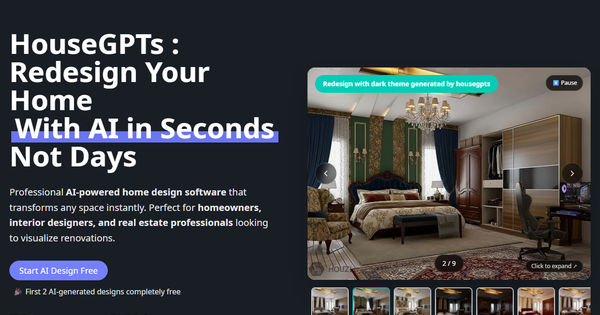
HouseGPTs is an AI-powered home design platform that transforms uploaded photos of interiors, exteriors, or specific rooms into photorealistic redesigns in seconds. It uses generative AI models to propose style variations, 3D renderings, virtual staging, furniture and layout suggestions, and color/paint options from a library of 20+ architectural styles that expands monthly based on user feedback. Primary use cases include rapid exploration of renovation ideas, visualizing curb appeal improvements, virtual staging of vacant properties for faster sales, testing furniture layouts, and generating client-ready concepts without weeks of manual work or high architect fees. The platform targets homeowners, interior designers, real estate professionals, home flippers, architects, contractors, Airbnb hosts, and DIY enthusiasts across 120+ countries—anyone needing quick, realistic visualizations to bridge the gap between idea and execution.

Key Features & Capabilities
Core functionality revolves around a simple upload-select-generate workflow: users choose a specialized AI designer (e.g., AI Kitchen Designer, AI Exterior Designer, AI Furniture Designer, or AI Paint Designer), upload a photo, select or let the AI suggest from 20+ styles (Modern, Scandinavian, Farmhouse, Victorian, etc.), and receive multiple high-resolution, photorealistic variations with accurate scale, lighting, and proportions. Standout features include virtual staging for empty homes, custom 3D furniture suggestions, whole-home redesign capabilities, and market-specific style recommendations that preserve original room layouts and dimensions while allowing instant before/after comparisons. These differentiate it from competitors like basic free tools (e.g., RoomGPT) by delivering higher realism, professional-grade outputs suitable for contractor presentations, and specialized per-room tools rather than generic renders. Limitations include no native CAD export or collaborative editing, outputs that prioritize aesthetics over strict buildability (e.g., potential clearance violations or ignored plumbing constraints), heavy dependence on high-quality input photos, and a credits-based system that restricts free experimentation. The platform does not replace structural engineering or code compliance checks.

User Experience
HouseGPTs offers an exceptionally low learning curve—users sign in with Google in seconds, upload a photo, and generate designs with no prior design experience required. The interface is clean and intuitive, featuring a dashboard for project management, specialized room selectors, style carousels, and easy download/share options, with a 5.0-rated ease-of-use score in site testimonials. Documentation consists of an extensive blog with practical guides, FAQs on credits and plan changes, and community inspiration; support is primarily email-based with responsive claims but no live chat or extensive knowledge base detailed publicly. Overall, the experience feels professional yet accessible, though heavy users may need to manage credit consumption across model tiers.

Performance & Reliability
Design generations complete in 20-30 seconds on average, enabling 10+ variations in minutes and delivering consistent photorealistic quality with proper lighting and scale understanding. Performance is reliable for visualization tasks, with 2.3 million+ designs generated for 78,000+ users and high testimonial praise for accuracy in client presentations or staging. Known issues, as acknowledged in the platform’s own analysis, include occasional unrealistic layouts that look stunning but may violate clearances, work triangles, or building codes, plus variability tied to input photo quality; no widespread external complaints about speed, downtime, or major bugs appear in searches as of March 2026. Users are advised to validate outputs with professionals for construction.
Pricing & Value
HouseGPTs follows a credit-based freemium model: the free tier provides two high-resolution designs with no credit card required and no watermarks. Paid plans include a Weekly Trial at $15 for 300 credits, the popular Pro Creator plan at $39 per month for 1,200 credits (most popular for professionals), and yearly options for savings; all plans grant full access to every AI model, style, and feature with flexible upgrades/downgrades and prorated billing. Extra credits can be purchased as needed. The value proposition is strong compared to alternatives—users routinely report saving $3,000–$5,000 in architect fees and weeks of time for concept work—making it far more cost-effective than traditional designers or slower tools while delivering contractor-ready visuals superior to many free competitors. Heavy users or businesses see rapid ROI through faster staging, higher booking rates, or data-driven flip decisions.
Practical Tutorial
A common task is redesigning a kitchen using the AI Kitchen Designer. Here is a complete step-by-step walkthrough based on official guidance (real example drawn from a 1990s oak-laminate kitchen renovation that saved $3,500 in fees and avoided $8,000 in layout mistakes):
- Prepare high-quality photos: Shoot in natural daylight from corner angles (level camera, no clutter), capturing all cabinets, counters, appliances, windows, doors, floor, and ceiling for accurate scale.
- Go to https://housegpts.com/ai-kitchen-designer (or dashboard/interior) and click “Start Free Design.” Sign in with Google (5 seconds).
- Upload your best kitchen photo.
- Select a style (e.g., Modern Minimalist for clean lines and neutral colors, or Contemporary for mixed materials). Test extremes first—one bold dream version and one safe conservative option.
- Click “Generate Design” and wait 20–30 seconds for photorealistic results.
- Analyze outputs: Check work triangle (sink-stove-fridge 12–26 ft), clearances (36–48 inches walkways), and functionality (no blocked doors). Download high-res images.
- Iterate: Regenerate with material changes (e.g., white quartz counters, subway tile backsplash, navy two-tone cabinets) or new styles until 5–10 variations are ready.
- Share with contractors for quotes and validation, then use as reference during construction.
This process turned a dated kitchen into a modern two-tone design under budget in one weekend. For full details and more examples, see the official blog tutorial.
Final Verdict
HouseGPTs earns a solid 4.5 out of 5 stars for its speed, realism, and accessibility in home visualization. It is ideal for homeowners, real estate pros, flippers, and designers seeking rapid, cost-effective ideation and client presentations; anyone planning renovations or staging will benefit from exploring dozens of concepts instantly without hiring expensive help. Avoid it if you need precise structural engineering, CAD files, or heavy customization without professional follow-up, or if occasional one-off use makes the credit system inefficient. Highly recommended as the go-to starting point for turning renovation dreams into photorealistic plans in seconds.