Validate Business Ideas Fast with Idea Screening Lab Review
Overview & Purpose
Idea Screening Lab is a web-based validation platform designed to help entrepreneurs and startups evaluate business ideas using SEO data before significant investment. Users store concepts in a private repository and run screenings that match ideas against vast Google keyword databases to gauge market demand through search volumes, trends, and opportunities. Primary use cases include early-stage idea validation, prioritizing which concepts to pursue, identifying SEO-friendly niches, and reducing failure risk from low-demand products. It serves as a quick proxy for consumer interest via online search behavior.
Target audience primarily includes solo entrepreneurs, indie hackers, SaaS founders, product managers, and small startup teams—especially those in digital products, apps, or content-driven businesses where SEO and search traffic are key growth channels. Less suited for traditional offline businesses or those requiring deep qualitative research.
Key Features & Capabilities
Core functionality revolves around the private idea repository for secure storage and the AI/SEO-powered screening engine. Users input a brief product description, and the tool analyzes it for keyword matches, providing data on search volume (as demand indicator), keyword relevance, online interest levels, potential reach, and opportunities.
Standout features:
- Real-time or near real-time Google SEO data integration for actionable insights.
- Market analysis including estimates of marketability and competition.
- Idea brainstorming and generation tools.
- Exploration of related social media threads for additional validation signals.
- Quick reports to support go/no-go decisions.
This differentiates it from general keyword tools like Google Keyword Planner (manual) or broad SEO suites by focusing specifically on idea-to-market-fit screening in one integrated workflow with private storage.
Limitations or missing features: Reliance on search data as a proxy may miss latent demand for novel ideas, offline markets, or B2B purchase intent; no built-in customer survey integration or advanced competitor website crawling. As a newer tool (launched around 2025), it lacks extensive third-party integrations (e.g., with Notion or CRM) and enterprise features like team collaboration or API access in lower tiers. Free tier restricts the number of ideas screened or report depth.
User Experience
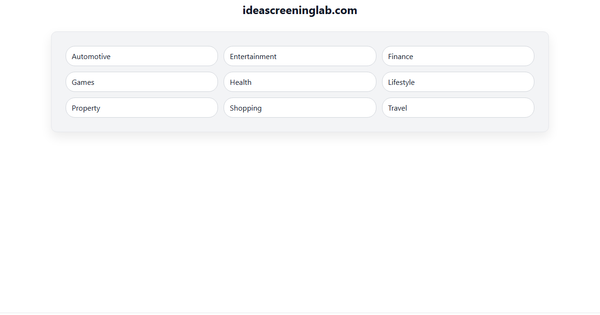
The platform offers a straightforward, user-friendly interface focused on simplicity: dashboard for idea repo, easy input forms for descriptions, and clear report visualizations for keyword data and insights. The learning curve is minimal for anyone with basic familiarity with startup validation or SEO concepts.
Interface quality appears clean and modern, with emphasis on actionable data presentation and minimal clutter. Documentation and support resources are basic—primarily in-app guidance with limited public knowledge base. A short demo video is referenced in some listings, and founder support (via email or community channels) has been responsive during early launches. No extensive help center or forum exists yet, which may require initial experimentation.
Performance & Reliability
Screenings are efficient, delivering insights quickly (often in minutes) to enable rapid iteration across multiple ideas. The tool leverages large-scale Google keyword data for reliable demand signals in most consumer-facing categories.
Known issues or common complaints from users: Extremely limited public feedback exists due to the tool's relative newness, with no widespread complaints or reliability issues reported across directories or community discussions as of research. Potential edge cases include data fluctuations in highly niche or emerging markets and rate limits on the free tier, but these align with typical SEO-tool limitations rather than platform-specific problems.
Pricing & Value
Idea Screening Lab follows a freemium model. The free tier provides limited screenings and basic features suitable for testing or evaluating a handful of ideas. Paid Pro/premium plans unlock unlimited analyses, deeper reports, advanced metrics, and full repository capabilities (exact pricing and tiers should be verified directly on the site, as options may include flexible one-time or subscription structures).
Value proposition compared to alternatives: Strong for bootstrapped users, delivering targeted validation at far lower cost than building MVPs, running ad tests, or subscribing to full SEO suites like SEMrush/Ahrefs (often $100+/month). It offers excellent ROI by helping avoid development on low-demand concepts, serving as an accessible entry point before scaling to broader market research tools.
Practical Tutorial
Official tutorials are limited, but the workflow is intuitive. Here is a step-by-step walkthrough for a common task: screening a new business idea (real example: "Sustainable Packaging Subscription Service for small e-commerce businesses").
- Visit https://ideascreeninglab.com/ and create a free account (or log in).
- From the dashboard, navigate to your private idea repository and click to add a new idea.
- Enter a concise description: "A subscription service delivering eco-friendly, biodegradable packaging materials tailored for small e-commerce businesses with monthly customized boxes and usage tips."
- Submit the idea for screening—the tool automatically extracts keywords and matches them against billions of Google SEO records.
- Review the generated report: View estimated monthly search volumes and trends for terms like "biodegradable packaging" or "eco-friendly shipping supplies," keyword opportunity scores, competition indicators, related long-tail keywords, and an overall demand viability assessment.
- Interpret results and take action—e.g., high volume with moderate competition signals strong potential; save the report in the repository for comparison with other ideas or iterate by tweaking the description and re-screening.
- Export insights or use them to guide next steps like landing-page tests targeting high-opportunity keywords.
The entire process typically takes under 5 minutes per idea. For visual guidance, search YouTube for "Idea Screening Lab demo" or check the site for any embedded resources.
Final Verdict
Overall rating: 4/5.
Summary of who should use this tool and why: Bootstrapped entrepreneurs, indie hackers, and early-stage startup teams seeking fast, affordable, data-backed validation of business concepts using real search demand signals to prioritize efforts and avoid building products with insufficient market interest.
Summary of who should avoid this tool and why: Teams needing comprehensive multi-channel validation (e.g., surveys, interviews, or financial modeling), enterprises requiring advanced integrations or support, or founders in industries where search volume poorly correlates with actual buying behavior (such as highly regulated B2B or local services)—they should supplement or choose broader platforms instead.
One-sentence recommendation: Idea Screening Lab provides entrepreneurs an efficient, SEO-driven shortcut to smarter idea prioritization that can save significant time and resources—well worth trying its free tier before committing to full development. (Research conducted as of March 2026; verify latest details on the official site as tools evolve rapidly.)