Imean AI Review: The Ultimate Conversational Trip Planner
Overview & Purpose
iMean AI is a conversational, browser-based AI trip planner that transforms vague travel ideas into actionable, personalized itineraries by pulling real-time data on flights, hotels, activities, and destinations. Users simply chat their requirements—such as budget, trip duration, group size, or preferences—and the tool generates tailored recommendations, day-by-day schedules, and cost breakdowns while centralizing everything in one interface. Primary use cases include quick inspiration for weekend getaways, detailed multi-city international trips, family vacations, solo adventures, business travel with leisure elements (bleisure), group tours, budget-conscious planning, and last-minute escapes. It covers domestic and international travel with emphasis on finding deals, optimizing routes, and suggesting hidden gems.
The target audience is everyday travelers of all types—solo adventurers, couples, families, groups, and business professionals—rather than niche professionals like developers, marketers, or designers. It appeals to anyone overwhelmed by traditional booking sites or generic AI chatbots, especially those who value natural-language interaction over spreadsheets or manual research. Research conducted as of March 11, 2026.
Key Features & Capabilities
Core functionality revolves around a chat interface where users describe trips in plain English; the AI responds with flight options (including multi-city and flexible-date searches), hotel recommendations filtered by price/amenities/location, activity suggestions, and one-click day-by-day itineraries. Additional tools include dedicated flight and hotel planners, travel inspiration discovery, and shareable itinerary links. Itinerary generation is labeled beta and incorporates transportation, dining, budgets, and thematic routing.
Standout features that differentiate it from competitors like Wanderlog (more of an organizer) or general LLMs such as ChatGPT include real-time price scanning across the web, hybrid AI that combines conversational flow with live data for accurate deal hunting, multi-person/multi-city optimization, and seamless progression from chat to structured, bookable plan without leaving the platform. It also provides practical metadata (hours, reviews, maps) on suggestions and handles complex constraints like “no car rental” or “budget-friendly with links.”
Limitations include no native mobile app (browser-only), fragmented booking (users are directed to third-party sites for final reservations), and the fact that suggestions still require user verification for accuracy, transfers, or availability. Itinerary creation can take up to 10 minutes for detailed plans, and there are no advanced collaboration tools for large groups or enterprise integrations.
User Experience
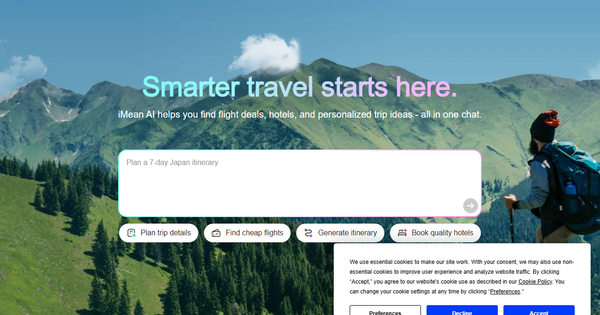
The interface is clean and intuitive—a simple chat window with quick-start buttons for “Build Itinerary,” “Find Flights,” “Find Hotels,” or “AI Suggestion.” No login is required to begin, creating a zero-friction entry point; the learning curve is minimal for anyone familiar with ChatGPT-style interactions. Detailed prompts yield better results, and the platform feels responsive on desktop and mobile browsers.
Interface quality is modern and visually driven with clear results sections for flights, hotels, and maps, though it lacks polish in mobile optimization compared to dedicated apps. Documentation is light—primarily in-app examples, blog posts, and external YouTube guides—with no comprehensive knowledge base or help center. Support appears limited to in-chat responses or email ([email protected]); no live chat or phone options were evident.
Performance & Reliability
Response times for flight and hotel queries are fast (seconds), leveraging real-time web data for competitive pricing. Complex itinerary generation takes longer—approximately 10 minutes in beta—but produces structured, logical plans. Reliability is strong for price comparisons and route optimization, often outperforming generic tools in multi-city tests.
Known issues include occasional off-topic or inaccurate responses (especially when rules are ignored), suboptimal ground transport or hotel suggestions requiring double-checking, and the need to verify details on aggregator sites. A single Trustpilot reviewer (paying customer) reported 90% of answers being wrong or rule-ignoring. Overall user feedback on directories rates accuracy around 4.2/5, with the consensus that sanity-checking remains essential.
Pricing & Value
iMean AI follows a freemium model: free daily access for testing and basic planning, with a Premium plan at $6.99 per month for unlimited trips and full features. No enterprise options or higher tiers are advertised.
Value is excellent for the price—far cheaper than hiring a travel agent and more capable than free generic AI for travel-specific data. Compared to alternatives, it removes more planning friction than Wanderlog while delivering real-time deals unavailable in basic chatbots. The low premium cost makes it accessible, though free users may hit daily limits quickly on ambitious trips.
Practical Tutorial
A common task is creating a detailed budget itinerary. Here is a step-by-step walkthrough (adapted from real user guides and tested examples):
-
Visit https://www.imean.ai/ and click “Start Planning Now” (or go directly to https://www.imean.ai/agent).
-
In the chat, paste or type a detailed prompt. Example for a 5-day Italy trip (replace brackets with your details):
“Create a detailed 5-day budget itinerary in [Florence and Tuscany] in [June 2026] (plus two days for travel from/to [NYC airports]), including the most budget-friendly direct flight options. Plan full days with 5-7 nearby attractions per day focused on [medieval history and wine]. Budget: hotels under [120] euros/night (provide booking links); meals—breakfast [10] euros, lunch [15] euros, dinner [25] euros. No car rental—use bus/train with links and schedules. Balance cultural sites and photo ops.” -
Hit send. The AI will analyze flights, suggest hotels, build a day-by-day schedule with timings, costs, restaurants, and transport.
-
Review the output carefully: check transfer times, hotel locations/reviews, and current prices on external sites like Booking.com or airline pages.
-
Refine via follow-up chat (e.g., “Make Day 3 cheaper” or “Add vegan options”).
-
Export or share the finalized itinerary.
For official examples and variations, see the site’s quick-start buttons or the detailed guide at https://edusama.org/how-to-plan-trip-using-imean-ai/. Video walkthroughs on YouTube also demonstrate real-time results.
Final Verdict
Overall rating: 4.3/5. iMean AI shines for travelers who want fast, conversational planning with real-time deals and structured outputs but falls short on seamless booking and mobile experience. Use it if you’re a casual or complex-trip planner seeking to save hours versus manual research or generic AI. Avoid it if you need a native app, fully integrated reservations, or zero verification effort. Highly recommended as an affordable AI travel companion that actually understands natural-language trip dreams and delivers practical plans.