Inferable Review: Build Secure, Self-Hosted AI Workflows
Research conducted as of March 11, 2026.
Overview & Purpose

Inferable is an open-source developer platform for building reliable, distributed, LLM-powered workflows and agents. It provides a durable execution runtime that integrates directly with existing codebases, APIs, and data sources, allowing developers to create production-grade AI automations without rewriting logic or exposing internal systems.
Primary use cases include replacing internal tools with conversational AI agents, orchestrating long-running processes (e.g., data extraction, approvals, multi-step reasoning), and embedding structured LLM interactions into applications. Workflows run entirely in your infrastructure via long polling, while a control plane handles orchestration, state, and monitoring.
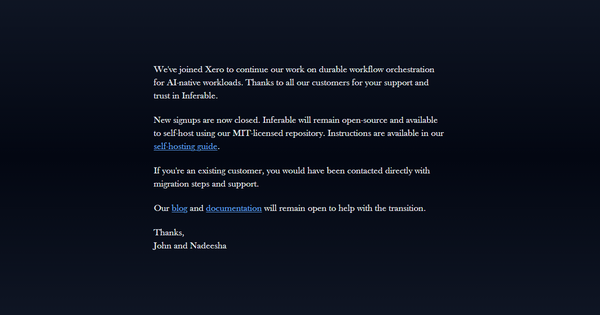
Target audience is primarily developers and engineering teams (backend, full-stack, or platform engineers) at startups and enterprises who need secure, compliant AI integrations. It is not aimed at non-technical users like marketers or designers. Following its acquisition by Xero, the hosted SaaS platform has closed new signups, but the entire stack (control plane, SDKs, and CLI) remains fully open-source under the MIT license for self-hosting.
Key Features & Capabilities
Core functionality revolves around defining versioned workflows in code (TypeScript/Node.js, Go, or experimental .NET) that register with a control plane. Workflows support durable execution (stateful, retryable, long-running), structured outputs via schema validation (Zod-style), and agentic behavior where LLMs call registered tools/functions.
Standout differentiators include:
- Self-hosted execution with no inbound ports required (long polling keeps workflows behind firewalls or private VPCs).
- Human-in-the-loop approvals via Slack or email, preserving full context.
- Memoization and notifications for caching expensive steps and alerting stakeholders.
- Built-in observability with timeline views and integration hooks.
- BYO models (Anthropic, Cohere, AWS Bedrock, etc.) for full control.
These features provide reliability and security that pure LLM frameworks (e.g., LangChain/LangGraph) or generic orchestrators often lack.
Limitations include limited first-party SDK language support (primarily TypeScript and Go), a headless self-hosted mode (web UI not yet fully documented for self-hosting), and dependency on external LLM providers. No native no-code interface exists—everything is code-first.
User Experience
Ease of use is excellent for developers familiar with SDKs. A basic workflow can be registered in minutes using familiar patterns. The learning curve is low if you follow the official quick-start, though self-hosting the control plane adds a one-time Docker/CLI setup step.
Interface quality centers on the developer console (hosted version) for execution timelines and debugging, or CLI-only in self-hosted setups. Documentation is clear, concise, and example-driven with working code snippets. Support resources include comprehensive docs, a GitHub repository, and (for prior hosted users) direct migration assistance from Xero. Community support is emerging but currently modest given the platform’s relative youth and recent acquisition.
Performance & Reliability
Inferable is architected for production reliability: workflows are durable and versioned, automatically handling retries, state persistence, and distributed execution. Self-hosted runs on modest hardware (Docker + PostgreSQL + Redis) with no reported scalability bottlenecks in public sources. Execution happens on your compute, so performance mirrors your infrastructure.
No widespread issues or common complaints appear in user reviews or forums as of March 2026. The single Product Hunt review rates it 5.0/5 with no detailed criticism. Early adopters on Reddit highlight its security advantages for database querying and internal tools.
Pricing & Value
Since the platform is now fully open-source (MIT), self-hosting is completely free beyond your own infrastructure, database, Redis, and LLM API costs (e.g., Anthropic or Bedrock usage). Previously, the hosted version used consumption-based pricing (pay-per-execution and concurrency, with a free experimentation tier and custom enterprise plans), but new signups are closed.
Value proposition is strong for teams prioritizing data sovereignty, security, and cost predictability. Compared to alternatives like Temporal (more general-purpose) or agent frameworks (less durable/human-in-loop focus), Inferable offers a vertically integrated, AI-native experience with minimal boilerplate. It shines for enterprises wary of vendor lock-in or data exfiltration risks.
Practical Tutorial
Official quick-start and self-hosting guides remain available and up-to-date. Below is a complete walkthrough for the common task of creating and running a simple workflow that fetches a URL and extracts structured data (e.g., menu items and hours from a text file) using an LLM—adapted for the current self-hosted reality.
Step 1: Self-host the control plane
- Install Docker and Docker Compose.
- Download the compose file:
curl -O https://raw.githubusercontent.com/inferablehq/inferable/main/control-plane/docker-compose.yml - Create a
.envfile with:MANAGEMENT_API_SECRET=$(openssl rand -hex 32) ANTHROPIC_API_KEY=your-key-here - Start services:
docker-compose up -d. The control plane runs athttp://localhost:4000.
Step 2: Install CLI and create a cluster
npm install -g @inferable/cli
export INFERABLE_API_ENDPOINT=http://localhost:4000
inf clusters create
inf auth keys create --cluster-id <your-cluster-id>
Step 3: Set up a Node.js project
Clone the starter or create a new one:
git clone https://github.com/inferablehq/inferable-node-starter
cd inferable-node-starter
npm install
Step 4: Configure and define the workflow (src/workflows/simple.ts)
import { Inferable } from "inferable";
import { z } from "zod";

const inferable = new Inferable({
  apiSecret: "<your-generated-key>",
  baseUrl: "http://localhost:4000",  // point to self-hosted
});

const workflow = inferable.workflow("simple");

workflow.version(1).define(async (ctx, input) => {
  const text = await fetch(input.url).then(res => res.text());

  const { menuItems, hours } = await ctx.llm.structured({
    input: text,
    schema: z.object({
      menuItems: z.array(z.object({ name: z.string(), price: z.number() })),
      hours: z.object({ saturday: z.string(), sunday: z.string() }),
    }),
  });

  return { menuItems, hours };
});

workflow.listen().then(() => console.log("Workflow listening"));
Step 5: Run and trigger
npx tsx src/workflows/simple.tsTrigger via curl (replace IDs):
curl -XPOST http://localhost:4000/clusters/<cluster-id>/workflows/simple/executions \
  -d '{"executionId": "demo-$(date +%s)", "url": "https://a.inferable.ai/menu.txt"}' \
  -H "Content-Type: application/json" \
  -H "Authorization: Bearer <your-key>"
Monitor progress via logs or (when UI self-hosting matures) the console.
This example runs in under 5 minutes once the control plane is up and demonstrates structured outputs, durable execution, and your own compute. Full official guides: Quick Start and Self-Hosting.
Final Verdict
Overall rating: 4.5/5
Developers and engineering teams needing secure, self-hosted, production-ready AI workflows with human oversight and durable execution should strongly consider Inferable—its open-source nature post-Xero acquisition delivers excellent control and reliability at zero licensing cost. Avoid it if you prefer a fully managed SaaS with zero infrastructure overhead, need broad no-code support, or require extensive language SDKs beyond TypeScript/Go.
One-sentence recommendation: Inferable is an outstanding open-source choice for developers who want reliable, secure AI automations that run entirely in their own environment.