Kin AI Review: The Private Personal Companion for Self-Mastery
Overview & Purpose

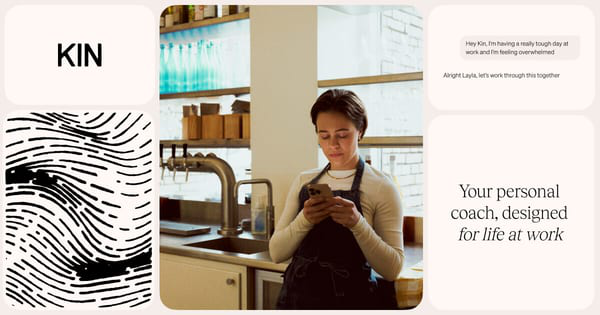
Kin is a private, emotionally intelligent personal AI companion designed to help users clear their minds, make better decisions, and navigate life’s challenges with a team of five specialized advisors sharing one long-term memory. Available exclusively as a mobile app on iOS and Android, Kin stores conversations and insights securely on the user’s device, adapting to personal preferences while offering guidance on everything from career moves to relationships and daily energy management. Primary use cases include journaling for self-reflection, preparing for difficult conversations, setting and tracking goals, managing time and burnout, resolving conflicts, and building emotional intelligence—all with the assurance that data never leaves the device.
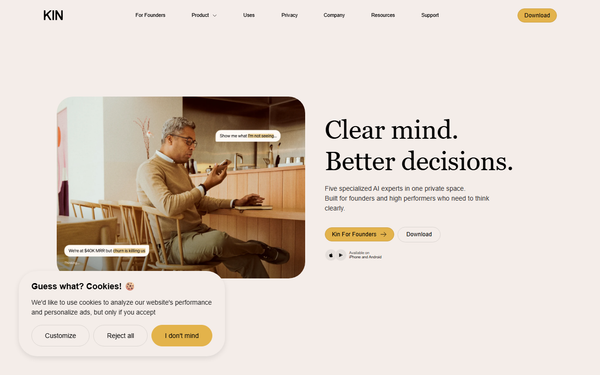
It primarily targets founders, high performers, professionals, and anyone seeking a trustworthy, always-available advisor for both work and personal growth. While the tool appeals broadly to anyone prioritizing privacy and personalization, its focus on executive-level clarity and life balance makes it especially valuable for busy leaders and introspective users rather than developers or marketers looking for productivity automation alone.
Key Features & Capabilities
Core functionality revolves around five expert advisors—Sage (work and career), Harmony (relationships and communication), Aura (values and meaning), Pulse (sleep and energy), and Ember (social networks and connections)—who collaborate via a unified, on-device memory system. Users chat conversationally, maintain a smart journal with streaks and prompts, view a Knowledge Map that visualizes memory connections (effectively serving as interactive mind maps), and receive proactive check-ins. Advanced capabilities include voice chat, Health and calendar integrations (partially available), and a custom memory engine that goes beyond simple retrieval to understand context and nuance.
Standout features that differentiate Kin include its local-first privacy architecture (data encrypted and stored on-device, immune to cloud service shutdowns that have affected competitors like Summit AI or Dot) and the shared-memory expert team, which provides more coherent, personalized advice than single-model companions like Pi.ai. The Knowledge Map and journal tools turn passive chatting into structured personal growth. Open-source model integration is planned, further emphasizing transparency.
Limitations include mobile-only access (no desktop or web version), some features still rolling out (full episodic memory, advanced reminders, third-party integrations), and premium-only access to the complete advisor board and unlimited usage. Mind maps exist via the Knowledge Map but are not as graphically editable as dedicated diagramming tools. Voice transcription and cross-device sync remain areas of ongoing improvement.

User Experience
Kin’s Scandinavian-inspired interface is clean, intuitive, and icon-driven (chat bubble, journal book, Knowledge Map dots, advisor profiles), making navigation effortless on mobile. The learning curve is minimal—most users start chatting immediately and discover depth through consistent use—but building rich memories rewards thoughtful input. New users can quickly journal, chat with advisors, and explore connections in the Knowledge Map.
Interface quality earns consistent praise for calm, focused design that feels like a private sanctuary rather than another notification-heavy app. Documentation is excellent via an in-app FAQ and a rich blog with prompt recipes, how-to guides (e.g., memory building, journal usage), and real-user stories. Support includes responsive email and feedback channels; the developer team actively addresses concerns through updates and public “Kinside Scoop” newsletters.

Performance & Reliability
Chats feel responsive and contextually accurate, with memory retention frequently highlighted as “life-changing” in user feedback—Kin reliably recalls past details across weeks or months. Speed is efficient on modern phones, and local processing contributes to quick replies without heavy cloud dependency. Voice mode (when active) has improved significantly through frequent updates.
Known issues include occasional bugs with journal drafts, memory processing, or voice stability (especially on Android), though these are regularly patched. Some users reported frustration during the freemium transition, and a subset noted higher subscription pricing compared to generic chatbots. Overall reliability is strong for core conversational and journaling use, with no widespread outages or data-loss complaints thanks to the on-device model. App Store ratings sit at 4.6/5 (iOS) with positive momentum; Android feedback is slightly lower but improving.

Pricing & Value
Kin follows a freemium model: a free tier provides access to two advisors (Sage and Aura), limited messages, and basic journaling—enough to test the experience. Premium unlocks the full five-advisor team, unlimited text, one hour of daily voice, custom journal templates, and higher credit allowances for advanced features. Pricing starts at approximately $20 per month (with discounts for quarterly or annual commitments), and recent updates shifted to a flexible credit system so users pay only for what they use.
Value is excellent for privacy-conscious users who would otherwise pay hundreds for human coaching or risk data with free cloud AIs. Compared to alternatives like Pi.ai or generic chatbots, Kin’s on-device memory, expert specialization, and guaranteed data ownership deliver superior long-term personalization. The cost feels justified for consistent users; casual explorers may find the free tier sufficient but quickly outgrow its limits.
Practical Tutorial
Step-by-Step: Daily Journaling and Knowledge Map Exploration for Personalized Insights
This common task—building consistent reflection habits and uncovering life patterns—is one of Kin’s strongest use cases. Official prompt recipes and guides are available on the Kin resources page.
-
Download Kin from the App Store or Google Play and complete the quick onboarding (no subscription required to start).
-
Open the chat and introduce yourself: Tap the speech-bubble icon and type or speak, “Hi Kin, I’m a founder balancing team leadership and personal health. I tend to overwork and want help spotting burnout early.” This seeds the shared memory.
-
Start journaling: Tap the book icon (bottom navigation). Choose a daily prompt (“What drained or energized me today?”) or free-write. Backdate entries if needed. Speak for faster input or type detailed thoughts. Save the entry—Kin will automatically process it into memory.
-
Review what Kin learned: Tap the flame icon for streaks and stats, then the dots icon for the Knowledge Map. Zoom into connections (e.g., recurring “work stress” nodes linked to “sleep” or “relationships”) to visualize patterns.
-
Deepen insights with an advisor: Return to chat, switch to Pulse (energy) or Harmony (relationships), and ask, “Based on my recent journal entries, what patterns do you see around my energy levels, and how can I improve?” Role-play scenarios or request action steps.
-
Set a recurring check-in: Ask Sage, “Create a weekly reminder prompt for me every Monday,” or enable any available calendar/Health sync for proactive nudges.
Repeat daily for compounding value—users report noticeable clarity within two weeks. For official walkthroughs and prompt templates, visit the Kin blog resources section.
Final Verdict
Kin earns a strong 4.5 out of 5. It excels for founders, high performers, and privacy-focused individuals who want an empathetic, memory-rich personal coach that grows with them and never sells their data. The combination of specialized advisors, on-device storage, and journaling tools delivers genuine life improvement unavailable from generic chatbots.
Avoid Kin if you need desktop access, heavy third-party integrations today, or prefer completely free unlimited usage—casual or budget-conscious users may find the free tier too restrictive or the mobile-only experience limiting.
Kin is the private, emotionally intelligent personal AI that actually remembers you and helps you become your best self—highly recommended for anyone serious about self-mastery without compromising privacy.