Kuberns Review: Automate Your Cloud Deployments with AI
Overview & Purpose
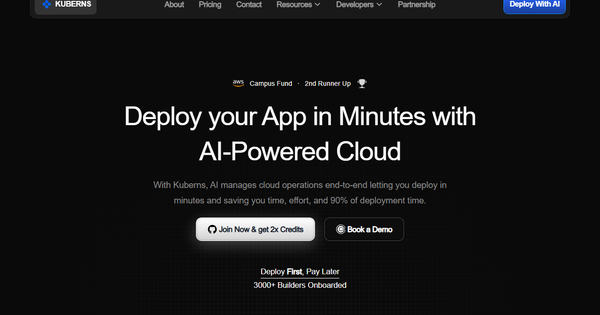
Kuberns is an AI-powered Platform-as-a-Service (PaaS) built on AWS infrastructure that automates the entire process of deploying, scaling, and managing cloud-native applications. It enables one-click deployments from GitHub repositories, with AI handling infrastructure setup, CI/CD pipelines, environment configuration, autoscaling, monitoring, and self-healing—eliminating the need for YAML files, Docker expertise, or manual DevOps tasks. Primary use cases include rapid prototyping and launching web apps, APIs, or full-stack projects (Node.js, Python, Flask, Django, Go, etc.), open-source self-hosting (e.g., Strapi or Affine), and cost-optimized scaling for startups or production workloads. It targets individual developers, freelancers, small teams, agencies, and early-stage startups who want to ship code quickly without managing servers or hiring DevOps specialists. Organizations adopt it to cut deployment time by up to 90%, reduce cloud costs by 40%, and focus on product development rather than infrastructure.
Research conducted as of March 2026.
Key Features & Capabilities
Core functionality revolves around AI-driven automation: connect a Git repo, select or let AI detect the framework, add environment variables, and deploy instantly with zero configuration. Standout features include unlimited CI/CD integrations, real-time log monitoring and alerts, vertical/horizontal autoscaling with load balancing, custom domain/SSL setup, encrypted secrets management, persistent storage (20 GB included), and a unified dashboard that replaces multiple tools. It offers 99% uptime guarantees, AWS-backed reliability across regions, and “Deploy First, Pay Later” flexibility. These differentiate Kuberns from traditional Kubernetes (no cluster management) or simpler PaaS like Render/Heroku (deeper AI automation and lower AWS costs without vendor lock-in beyond infrastructure).
Limitations include AWS-only infrastructure (no true multi-cloud support), absence of dedicated team/enterprise collaboration plans (pay-per-use only), and reliance on AI auto-detection that may require minor tweaks for highly custom or port-specific apps. Advanced Kubernetes-native features like custom operators or complex YAML orchestration are not available, as the platform abstracts them entirely.
User Experience
Kuberns boasts an exceptionally low learning curve—most users report going from signup to live deployment in minutes thanks to the zero-config AI autopilot. The interface is clean and modern, centered on a single dashboard for deployments, logs, metrics, scaling, and access controls, making it intuitive even for non-DevOps developers. Documentation is comprehensive and beginner-friendly with step-by-step guides, framework-specific tutorials, and comparison articles. Support includes dedicated channels and responsive help, though public knowledge base is still growing. Users consistently praise the simplicity: “super easy to deploy, caught me off guard on how simple it is.”
Performance & Reliability
Deployments complete in minutes with AI-optimized builds and automatic resource allocation, delivering strong efficiency and up to 99% uptime. Real-time monitoring, smart alerts, and self-healing capabilities keep apps stable during traffic spikes. Independent user feedback highlights reliable scaling and 40–85% cost reductions versus raw AWS or competitors. Common complaints are minimal; a few early users noted initial port or command tweaks for niche setups, but these resolve quickly. No widespread outages or major reliability issues reported across available reviews.
Pricing & Value
Kuberns follows a transparent pay-as-you-go model with no per-user fees or platform charges. All plans include unlimited CI/CD, 5 GB data transfer, 20 GB storage, and 1 IP address. Entry-level options start at approximately $10/month (Starter: 512 MB / 2 vCPU) up to $20/month (Standard: 2 GB / 2 vCPU), with higher tiers scaling accordingly; users can also use a pricing calculator for custom instances. New users receive free deployment credits (equivalent to 2 months at low tiers). Compared to alternatives like Render, Vercel, or direct Kubernetes on AWS, it delivers superior value through automation and 40% average savings, making it ideal for budget-conscious teams. A 100% money-back guarantee adds low risk.
Practical Tutorial
Official documentation is available at https://docs.kuberns.com/ with dedicated getting-started and framework guides. Here is a step-by-step walkthrough for a common task—deploying a Node.js application (adapted from the official Node.js tutorial at https://docs.kuberns.com/docs/tutorials/nodejs):
- Sign up for free at https://kuberns.com/ or directly via the dashboard at https://dashboard.kuberns.com/login and verify your phone number.
- Connect your GitHub account and select or create a new project.
- Choose the repository containing your Node.js app (Kuberns AI auto-detects the runtime, package.json, and start command).
- Configure environment variables if needed (e.g., PORT, API keys—stored encrypted).
- Review AI-suggested settings (memory, scaling rules) or accept defaults, then click “Deploy.”
- Monitor live logs and metrics in the dashboard as the app builds and goes live (typically under 5 minutes).
- Add a custom domain via the settings panel for production use.
For open-source templates (e.g., Strapi or Flask), select from the templates page at https://kuberns.com/deploy and follow the one-click fork-and-deploy flow. Full guides and video examples are linked in the docs.
Final Verdict
Overall rating: 4.5/5 — Excellent for simplicity and cost efficiency, with minor deductions for limited third-party reviews and AWS-only infrastructure.
Developers, freelancers, and small teams should use this tool to accelerate launches and eliminate infrastructure headaches. Larger enterprises needing full multi-cloud flexibility or deep Kubernetes customization should avoid it in favor of managed Kubernetes services.
If you want to deploy apps in minutes without touching servers, start with Kuberns today.