Lecca.io Review: Build Powerful No-Code AI Agents Easily
Overview & Purpose
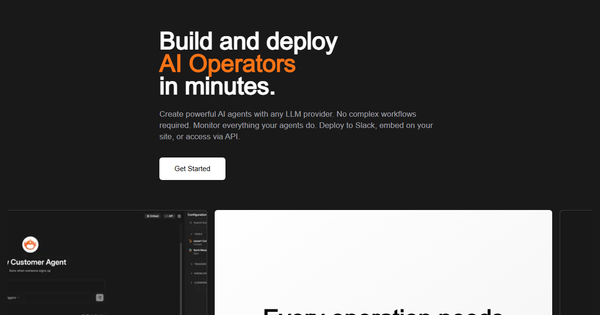
Lecca.io is a no-code platform for building and deploying AI agents (also referred to as operators) that automate tasks by connecting large language models with tools, integrations, and knowledge bases. It combines agent configuration with an optional visual workflow builder, enabling users to create intelligent automations that handle everything from customer support queries to data retrieval and multi-channel interactions without writing code. Primary use cases include building Slack or email bots for support and sales, scheduling automations, web searching, phone call handling, CRM updates via tools like HubSpot or Google Workspace, and embedding agents on websites or triggering them via API/webhooks.
The target audience spans non-technical professionals such as marketers, sales teams, customer support specialists, and small business owners seeking productivity gains, as well as developers or IT teams who value the self-hosting option for custom deployments and privacy control. Launched around 2024 and actively evolving as of March 2026 research, it positions itself as a simpler alternative to traditional workflow tools by prioritizing agent-centric configuration over complex diagramming.
Key Features & Capabilities
Core functionality revolves around an intuitive agent builder where users select an LLM (OpenAI, Claude, Gemini, DeepSeek, or any provider with bring-your-own API keys), upload documents for built-in retrieval-augmented generation (RAG), define custom instructions, and assign tools or triggers. Standout features include real-time monitoring with execution logs and debugging, deployment across 60+ pre-built integrations (Slack, Gmail, Notion, GitHub, HubSpot, and more), multi-channel activation (Slack mentions, email, scheduled runs, API calls, or chat interfaces), and full self-hosting support via Docker and GitHub for unlimited local use with models like Ollama.
These differentiate Lecca.io from competitors like Zapier or Make.com by avoiding heavy workflow mapping in favor of straightforward agent setup while still offering a powerful (if optional) workflow builder for advanced logic. Limitations include a smaller integration library than enterprise platforms (60+ versus thousands), credit-based usage caps on cloud plans that restrict high-volume LLM calls, and less emphasis on intricate conditional branching compared to dedicated orchestration tools like n8n—making it less ideal for extremely complex, multi-step enterprise processes. Self-hosting mitigates some cloud limits but requires technical setup.
User Experience
The platform offers a low learning curve for basic agent creation thanks to its clean, configuration-focused interface that emphasizes simple forms for instructions, tools, and permissions rather than drag-and-drop complexity. Advanced users may encounter a moderate learning curve with the full workflow builder, which is described in official videos as powerful yet requiring time to master variables, loops, and logic. Interface quality is modern and dashboard-oriented, with clear sections for agent management, monitoring logs, and integration connections.
Documentation consists primarily of YouTube tutorials from the official channel covering agent setup, tool configuration, and workflows, supplemented by GitHub instructions for self-hosting and in-app FAQs; written guides are still maturing, and community support (via Reddit or Product Hunt discussions) remains relatively small but helpful for early adopters. Overall, it feels accessible for no-code users while scaling to technical needs.
Performance & Reliability
Agent execution speed depends primarily on the chosen LLM and API latency but is generally efficient for defined tasks, with real-time monitoring providing instant insights into actions, errors, and optimizations. Reliability is solid for standard automations, supported by logging and debugging tools that help troubleshoot issues quickly. As a relatively new platform (active development ongoing into 2026), no widespread outages or critical bugs appear in public forums or directories; self-hosted deployments perform consistently when properly configured with Docker but rely on the user's infrastructure for uptime. Common complaints are minimal and typically relate to credit limits on free tiers or occasional integration tweaks rather than core instability.
Pricing & Value
Lecca.io follows a freemium model with a Starter plan that is free (1 user, unlimited workflows and agents, approximately 250 credits per month for LLM usage). The Professional plan costs $20 per month (1 user with higher credits and features), while the Team plan is $50 per month (unlimited users and projects). Higher tiers unlock unlimited knowledge notebooks, additional credits, priority support, and expanded capabilities; self-hosting via the open GitHub repository offers a fully free, unlimited alternative for users comfortable with Docker and their own LLM keys.
Compared to alternatives, the value proposition is strong for cost-conscious individuals and small teams—especially those leveraging bring-your-own keys or self-hosting to avoid per-call markups common in Zapier or similar services—delivering enterprise-like AI agent features at accessible entry points without sacrificing core functionality.
Practical Tutorial
Official video tutorials are available on the Lecca.io YouTube channel, making hands-on learning straightforward. Below is a real, step-by-step walkthrough for a common task: building a basic AI agent that monitors a Slack channel and responds to customer queries (adapted from the official "Build your first AI Agent with access to Slack" guide).
- Visit https://www.lecca.io/ and sign up for a free account (or self-host via the GitHub repo if preferred).
- In the dashboard, add your LLM API key (e.g., OpenAI) under settings and connect your Slack workspace via OAuth.
- Click the "Agent +" button in the top right to create a new agent; name it (e.g., "Support Assistant") and write clear instructions such as "You are a helpful customer support bot. Answer product questions using uploaded knowledge, escalate complex issues to email."
- Upload relevant documents or PDFs for the built-in RAG knowledge base (e.g., product FAQs).
- Enable the Slack tool, specifically "Send Message," and configure the trigger for new messages in a designated channel (e.g., #support) that mention the agent.
- Save the agent, deploy it, and test by posting a query in Slack—the agent will respond automatically. Monitor performance in the real-time logs dashboard and refine instructions as needed.
For variations like adding web search or phone calling capabilities, refer to additional videos such as "Build an AI Agent that can search the web." The full Slack agent tutorial is here: https://www.youtube.com/watch?v=kBk-swoAkY8. This example typically takes 10-15 minutes and demonstrates the platform's core strengths in under an hour.
Final Verdict
Overall rating: 4.2/5. Lecca.io excels for individuals and small teams who want quick, intelligent AI automations without the overhead of traditional workflow complexity or high costs. It is ideal for marketers, support staff, and developers needing flexible deployment (including self-hosting) and multi-LLM control. Avoid it if your needs demand thousands of integrations, highly intricate visual orchestration, or mature enterprise-grade support and SLAs. In one sentence: Lecca.io is a smart, affordable choice for no-code AI agents that prioritizes simplicity and ownership—definitely worth trying on the free tier if you're ready to supercharge your workflows in 2026.