Llm List Review: The Ultimate Free Directory for Finding LLMs
Overview & Purpose
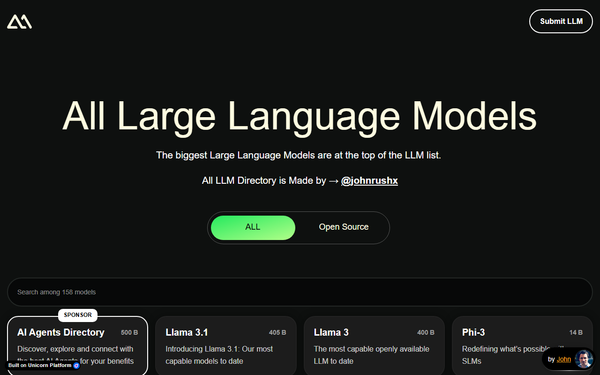
LLM List at https://llmmodels.org/ is a free online directory that aggregates hundreds of large language models, both open-source and commercial, providing a centralized hub for discovery, basic comparisons, and exposure. Users browse models sorted by parameter size (largest at the top), with short descriptions and direct links to official resources or dedicated model pages. Primary use cases include quickly identifying suitable LLMs for text generation, translation, domain-specific tasks, or research projects, as well as allowing model creators to submit their work for visibility to thousands of visitors.
The site targets AI developers, researchers, businesses implementing AI solutions, and indie model builders seeking promotion. It emphasizes side-by-side awareness of options like Meta's Llama 3.1 alongside OpenAI's GPT-4 or Anthropic's Claude, saving time compared to scattered searches across Hugging Face, official blogs, or leaderboards. Research conducted as of March 2026 confirms it functions as a living, regularly updated resource with 11 specialized categories.
Key Features & Capabilities
Core functionality revolves around a main list of models (e.g., Llama 3.1 405B described as rivaling top proprietary systems in knowledge, math, and multilingual tasks), dedicated category pages (Audio-based, Domain-specific, Few-Shot, Multilingual, NLG, NLU, Seq2seq, Text-based, Transformer-based, Visual-based, Zero-Shot), and a separate open-source section. Each model entry links to a detail page with a concise overview and official site redirect.
Standout features include an easy submission form for creators to gain exposure ("Get quick exposure to thousands of users"), a blog with LLM guides, and an integrated AI Agents Directory link. The category taxonomy differentiates it by enabling targeted browsing for niche needs like audio processing or visual-based models—more structured than generic search engines.
Limitations are notable: model detail pages are minimalist (short copied descriptions and one external link, with no built-in benchmarks, licensing details, or download buttons), comparisons rely on manual cross-referencing rather than interactive tools, and there are no advanced filters, leaderboards, or performance metrics. No global search bar exists, relying solely on scrolling and category clicks. The site is built on a no-code Unicorn Platform, keeping it simple but limiting depth compared to competitors like Hugging Face's Open LLM Leaderboard or LMSYS Chatbot Arena.
User Experience
The interface is clean, minimalist, and highly accessible with a vertical list layout, category links, and straightforward navigation—ideal for quick scans without clutter. Learning curve is near-zero: even non-technical users can browse effectively within seconds. Responsiveness appears standard for a simple directory, though no advanced mobile optimizations or interactive elements (e.g., sortable tables) are present.
Documentation includes an on-site FAQ covering usage and submissions, plus blog articles on LLM concepts. Support routes through the creator's Twitter (@johnrushx) for inquiries. Overall quality suits casual discovery but feels basic for power users expecting polished dashboards or real-time updates.
Performance & Reliability
As a lightweight directory site, loading is fast and efficient with no reported lag or downtime in available sources. Categories and lists update regularly, though exact model counts or refresh cadence are not publicly stated.
Known issues are minimal: the submission form occasionally rejects entries without a valid "@" email symbol, and as a single-person side project, coverage of the absolute latest models may occasionally trail behind more automated platforms. No widespread complaints, scams, or reliability issues surfaced in reviews or forums; Scamadviser rates it as legitimate with reasonable trust (low visitor volume noted as the primary flag). It remains stable for its purpose of static discovery.
Pricing & Value
The directory itself is completely free with no tiers, ads, or paywalls—users access everything without accounts or subscriptions. Individual models carry their own costs (e.g., open-source like BLOOM under permissive licenses; commercial like GPT-4 via API fees), but LLM List adds zero overhead.
Value proposition shines for budget-conscious discovery: it outperforms scattered Google searches by centralizing open and commercial options with category organization, offering strong ROI for initial scouting. Compared to alternatives, it lacks the benchmark depth of paid tools or Hugging Face but excels as a no-cost entry point. For model creators, the submission exposure provides free marketing value unavailable on larger platforms without promotion efforts.
Practical Tutorial
No official video or interactive tutorial exists on the site, but the FAQ and blog provide basic guidance. Below is a step-by-step walkthrough (created March 2026) for a common task: finding and comparing LLMs suitable for multilingual text generation projects, using real examples from the directory.
-
Visit https://llmmodels.org/ and scroll past the main sorted list to the "Browse Large Language Models by Categories" section.
-
Click the "Multilingual" category link (or "Text-based" for general language tasks) to filter relevant models.
-
Scan the category list (sorted by parameter size): Review entries like Llama 3.1 (405B, noted for strong multilingual translation and steerability) or BLOOM (176B, highlighted as an open-science multilingual model). Note brief descriptions and parameter sizes for quick suitability assessment.
-
Click a model name (e.g., Llama 3.1) to open its detail page. Read the full description (e.g., "the first openly available model that rivals top AI models in... multilingual translation") and follow the "Visit Llama 3.1" link to Meta's official blog for deeper docs, weights, or licensing.
-
Repeat for 2–3 models (e.g., compare Llama 3.1 to a commercial option like GPT-4 listed on the main page) by opening tabs side-by-side. Manually note strengths from descriptions (open-source accessibility vs. proprietary performance) or cross-reference external benchmarks on sites like Hugging Face.
-
If promoting your own model, scroll to the submission form on the homepage, fill in name, description, categories, functionalities, and contact email, then submit for review and listing.
This process takes under 10 minutes and links directly to official resources. For more context, explore the site's blog posts on LLM applications.
Final Verdict
Overall rating: 7/10. LLM List is ideal for developers, researchers, businesses, or model creators needing a free, straightforward starting point to discover and compare hundreds of LLMs across practical categories—especially useful for quick overviews or gaining exposure without complex tools. Avoid it if you require in-depth benchmarks, interactive comparisons, advanced search, or production-ready metrics, as more specialized platforms deliver greater depth.
One-sentence recommendation: LLM List serves as an accessible, no-frills directory for efficient LLM exploration, best paired with detailed leaderboards for comprehensive decision-making.