Matrix Game 2.0 Review: The Ultimate Real-Time AI World Model
Overview & Purpose
Matrix Game 2.0 is an open-source interactive world model developed by Skywork AI that generates real-time, streaming video sequences in virtual environments at 25 frames per second. Users provide simple keyboard and mouse inputs to control characters, camera movements, and actions, producing coherent, minute-long videos with strong physical consistency and temporal stability. It functions as a vision-driven "image-to-world" foundation model, predicting future frames autoregressively based solely on visual history and action conditions without text prompts.
Primary use cases include rapid prototyping of game worlds and mechanics, research into embodied AI and world modeling, simulation for robotics or autonomous systems, and quick visualization for content creators needing dynamic interactive scenes. As of research conducted on March 5, 2026, the tool targets technically proficient audiences such as game developers, AI researchers exploring interactive video generation, and advanced designers or filmmakers who require controllable virtual environments. It is not suited for non-technical users seeking plug-and-play tools.
Key Features & Capabilities
Core functionality revolves around a 1.8B-parameter causal diffusion model (derived from SkyReels-V2/Wan architecture) that supports frame-level action injection for keyboard (discrete movements) and mouse (continuous viewpoint/camera control). It enables auto-regressive long-sequence generation up to minute-length at 25 FPS on high-end hardware, with multiple pretrained checkpoints for universal scenes, GTA-style driving, and TempleRun-style interactions. A scalable data pipeline trained on approximately 1,200 hours of annotated footage from Unreal Engine and GTA5 environments ensures diverse styles and realistic dynamics.
Standout features differentiating it from competitors (such as closed models like Google’s Genie 3 or earlier Oasis) include true real-time streaming inference via few-step (3-step) distillation and KV caching, superior benchmark performance on GameWorld Score (e.g., higher image quality 0.61 vs. Oasis 0.27, keyboard accuracy 0.91 vs. 0.73, and object consistency), and full open-sourcing of weights, code, and training details under MIT license. The causal architecture supports seamless user interaction without latency spikes, bridging static video generation and live gameplay-like experiences.
Limitations include fixed 352×640 resolution (lower than many modern video models), occasional artifacts in out-of-distribution scenarios or prolonged specific actions (e.g., sustained upward camera movement causing black screens or oversaturation), and lack of explicit long-term memory mechanisms for ultra-extended sessions. It also requires custom configuration files and does not support text conditioning or high-definition outputs natively.
User Experience
Ease of use involves a moderate-to-steep learning curve due to its command-line interface and Python-based setup; no graphical user interface or web demo is provided, making it accessible primarily to users comfortable with coding and environment configuration. Once installed, running inference (especially streaming mode) feels responsive and intuitive, with actions translating directly to on-screen changes.
Interface quality is functional but minimalistic—purely script-driven with YAML configs for scene selection and output parameters. Documentation is strong and comprehensive, including detailed README instructions, a project website with video demos, Hugging Face model card with quick-start code, and the full technical report/arXiv paper. Community support is emerging via GitHub issues and discussions on platforms like Reddit, though no official forums or enterprise helpdesk exist.
Performance & Reliability
Speed and efficiency are exceptional: the model achieves stable 25 FPS real-time generation on a single NVIDIA H100 (or equivalent ≥24 GB VRAM GPU such as A100), with KV caching enabling streaming without quality degradation over minute-long sequences. Users report smooth performance even on high-end consumer cards like the RTX 4090 for shorter sessions.
Known issues include minor rendering glitches (e.g., brief black screens during upward camera movement, with a planned fix noted in documentation) and gradual consistency drift in very long or out-of-domain sequences. Community feedback on Reddit and YouTube (as of March 2026) is overwhelmingly positive regarding responsiveness and physical realism, with hardware requirements cited as the primary barrier rather than bugs or unreliability. No widespread complaints about crashes or instability appear in public discussions.
Pricing & Value
Matrix Game 2.0 is completely free and open-source under the MIT license, with model weights downloadable from Hugging Face and full codebase on GitHub. There are no tiers, paid plans, or enterprise options—everything required for local deployment is publicly available at zero cost.
Value proposition is outstanding for its target users compared to proprietary alternatives: it delivers industry-first real-time interactive long-video capabilities without licensing fees, enabling custom fine-tuning and research extensions. The main trade-off is local compute costs (high-end GPU required), but this is far more accessible than cloud-based closed models for prototyping and experimentation.
Practical Tutorial
Official tutorials and demos are available on the project website (https://matrix-game-v2.github.io/), GitHub repository, and Hugging Face model card. Below is a complete step-by-step walkthrough for a common task—running an interactive streaming session to control a character in a GTA-style driving scene (based directly on the official README and inference scripts).
-
Set up the environment (Linux recommended):
Create and activate a Conda environment:conda create -n matrix-game-2.0 python=3.10 -y conda activate matrix-game-2.0 -
Clone and install dependencies:
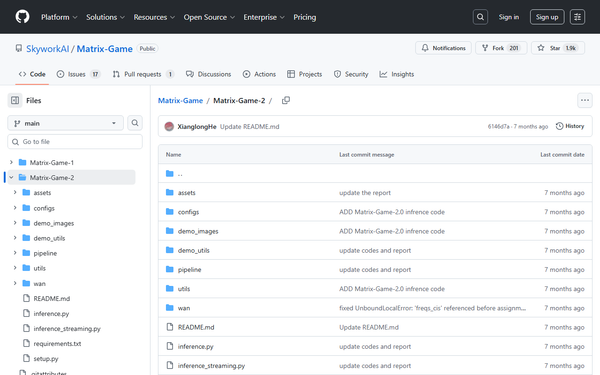
git clone https://github.com/SkyworkAI/Matrix-Game.git
cd Matrix-Game/Matrix-Game-2
pip install -r requirements.txt
python setup.py develop
(Install FlashAttention and Apex separately following their official guides if not covered in requirements.)
-
Download the model weights:
huggingface-cli download Skywork/Matrix-Game-2.0 --local-dir Matrix-Game-2.0Also download the required pretrained VAE folder if prompted in config.
-
Prepare an initial image (use one from demo_images/ or any 352×640 starting frame).
-
Run streaming interactive inference (for real-time keyboard/mouse control):
python inference_streaming.py \
   --config_path configs/inference_yaml/gta_drive.yaml \
   --checkpoint_path Matrix-Game-2.0/checkpoint \
   --output_folder outputs \
   --seed 42 \
   --pretrained_model_path path/to/vae
During runtime, use keyboard arrows/WASD for movement and mouse for camera control—the script streams video output in real time while accepting live inputs. Example output: a minute-long coherent driving sequence through a GTA-like city with responsive turns and acceleration. Adjust
--num_output_framesor switch configs (e.g., temple_run.yaml) for different scenarios. Full video examples and config details are on the project site.
For non-interactive offline generation, use inference.py instead. Official demo videos on the project page showcase these exact workflows in Minecraft, GTA, and TempleRun environments.
Final Verdict
Overall rating: 8.5/10.
Matrix Game 2.0 should be used by game developers, AI researchers, and technically skilled content creators seeking an open, real-time controllable video world model for prototyping and experimentation, thanks to its unmatched combination of speed, interactivity, and accessibility. Avoid it if you lack a high-end NVIDIA GPU (≥24 GB VRAM), prefer GUI tools, or need high-resolution outputs and zero setup friction.
In one sentence: Matrix Game 2.0 stands out as the first truly open-source real-time interactive world model, empowering creators to instantly turn keyboard inputs into immersive, minute-long virtual experiences.