Movie Book Recommender Review: Fast and Free AI Suggestions
Overview & Purpose
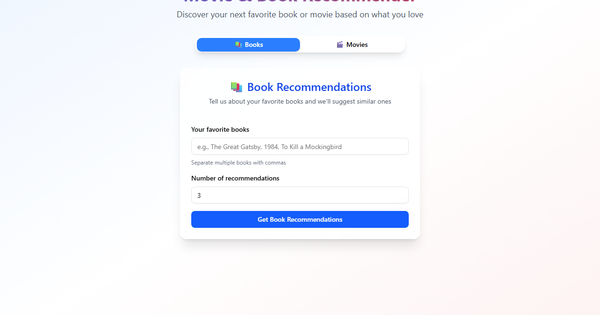
Movie & Book Recommender is a straightforward web application that generates personalized movie or book suggestions based on user-input favorites. Users select either a movie or book recommendation mode via tabs, enter one or more favorite titles (comma-separated), choose the desired number of suggestions (1-10), and receive AI-generated recommendations powered by OpenAI. Its primary use cases include discovering new entertainment options when finishing a book or movie, overcoming decision fatigue for weekend viewing/reading, or providing quick ideas for casual browsing without signing up for subscription services like Netflix or Goodreads.
The tool targets a broad casual audience—everyday readers, movie enthusiasts, students, and educators—who want simple, no-account AI assistance for recommendations. It is not aimed at developers (though open-source for those interested in forking), marketers, or designers, but serves hobbyists and educators looking for frictionless inspiration, as noted in teaching-focused blogs. Research conducted April 11, 2026.
Key Features & Capabilities
Core functionality centers on two tabbed modes (Movies and Books). Users input favorites, select recommendation count, and the Vercel AI SDK streams responses from OpenAI to deliver tailored suggestions, typically including titles and brief rationales. Standout features include its clean, responsive design built with Next.js 15, Tailwind CSS, and shadcn/ui components; instant streaming output for a responsive feel; and full open-source availability on GitHub, enabling easy self-hosting or customization.
Differentiation from competitors lies in extreme simplicity—no accounts, no lengthy quizzes, no data collection—making it faster than ChatGPT prompting or paid platforms like Goodreads algorithms. It leverages modern Vercel Edge streaming for smooth generation.
Limitations include reliance on LLM prompting rather than collaborative filtering or real-time databases (recommendations may feel generic or outdated based on model knowledge cutoff); no cross-media suggestions (e.g., books from movies); lack of user history, saving, or integration with personal libraries; and potential for hallucinations or inconsistent quality typical of generative AI. No multi-language support or advanced filters are present.
User Experience
Ease of use is excellent with virtually no learning curve: the interface loads immediately with clear tabs, a simple text input, number selector, and one-click generate button. The minimalistic, modern layout feels intuitive on desktop and mobile thanks to responsive Tailwind styling.
Interface quality is solid for a side project—clean and functional without clutter—though it retains a basic "Create Next App" vibe in some headers, indicating a template foundation. No complex navigation or settings beyond the core form.
Documentation is minimal: the GitHub README provides setup instructions and usage overview, with no extensive in-app help or official tutorials. Community support is limited to the repo's issues section; users rely on directory listings or educator blogs for guidance.
Performance & Reliability
Generation is efficient and speedy, thanks to Vercel AI SDK streaming, typically completing in seconds with progressive text output. The hosted Vercel deployment handles traffic reliably for its low-profile usage.
No widespread known issues or common complaints appear in public forums or directories as of April 2026; the tool's niche status means sparse feedback. Occasional generic recommendations or minor hallucinations are inherent to OpenAI prompting but not frequently reported. Reliability depends on OpenAI API uptime, which is generally strong. Internet connection is required, as noted in tool listings.
Pricing & Value
The hosted version at movie-and-book-recommender.vercel.app is completely free with no tiers, sign-ups, or usage limits visible to end users (the creator covers OpenAI costs via project environment variables). Self-hosting via the open-source GitHub repo requires an OpenAI API key and incurs standard pay-per-token usage fees from OpenAI, with no enterprise options.
Value proposition is strong for free, instant recommendations versus paid services or manual searching. It outperforms basic web searches for personalization while remaining zero-cost and open for modification—ideal compared to more feature-heavy but gated alternatives. Low-profile nature means no premium upsells.
Practical Tutorial
No official video or in-depth tutorials exist beyond the GitHub README and brief mentions in educator blogs; the following is a self-contained walkthrough for a common task: generating movie recommendations.
- Visit https://movie-and-book-recommender.vercel.app/.
- Click the "Movies" tab (or "Books" for book mode).
- In the input field, enter your favorites separated by commas, e.g., "Inception, The Matrix, Interstellar".
- Use the dropdown or selector to choose the number of recommendations (e.g., 5).
- Click "Generate Recommendations".
- Watch as suggestions stream in (e.g., titles like "Dune: Part Two" with short explanations why they match your sci-fi taste).
- Copy any recommendation for later use.
Example output might suggest "Blade Runner 2049" as a follow-up to your inputs, citing shared themes of dystopian futures and philosophical depth. The process takes under 30 seconds end-to-end and requires no login. For self-hosted versions, first set OPENAI_API_KEY in your .env file before running npm run dev.
Final Verdict
Overall rating: 7/10 – A polished, no-frills tool that excels at quick, accessible recommendations but lacks depth for power users.
Casual readers, movie fans, students, and educators should use this tool for its zero-cost simplicity and instant results when seeking fresh ideas without subscriptions or complex setups. Avoid it if you need data-driven accuracy, saved histories, cross-recommendations, or integration with existing libraries, as its LLM-only approach can occasionally produce generic or imprecise suggestions.
In one sentence: This lightweight open-source AI recommender delivers fast, free movie and book suggestions for anyone craving effortless discovery.