Noah AI Review: The Ultimate AI Research Agent for Life Sciences
Overview & Purpose
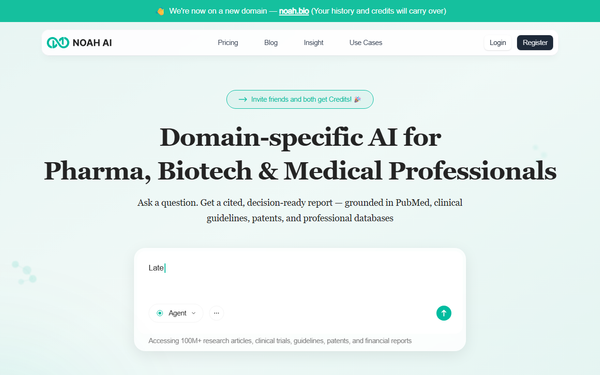
Noah AI (accessible at noah.bio, with legacy support for noahai.co) is a specialized AI agent built exclusively for life-science professionals. It transforms natural-language questions into fully cited, decision-ready reports by synthesizing data from trusted biomedical sources including PubMed, clinical trial registries, FDA/NIH resources, patents, financial filings, medical conferences, and industry reports. Rather than providing generic chatbot responses, Noah functions as a virtual research teammate that plans workflows, executes multi-step analyses, performs coverage checks, and delivers exportable outputs such as structured tables, key findings, and supporting evidence.
Primary use cases include competitive landscape analysis (e.g., oral GLP-1 drugs), Go/No-Go program evaluations, launch-ready key messaging, patient journey mapping, market assessments for drug portfolios, biotech investment screening, clinical readout analysis, manuscript drafting, and rapid literature synthesis. It accelerates the entire R&D lifecycle—from target identification to commercial intelligence—by automating the most time-intensive tasks that traditionally require weeks of manual effort.
The target audience is narrowly focused on experts in pharmaceuticals, biotechnology, medicine, and healthcare investment. Typical users include partners at healthcare consulting firms, executive directors in clinical strategy at multinational pharma companies, hedge-fund partners screening biotech investments, and heads of research at public pharmaceutical companies. It is not designed for general developers, marketers, designers, or non-scientific professionals.
Key Features & Capabilities
Core functionality revolves around two main modes: Agent (for complex, multi-step professional tasks) and Search (for rapid summaries). The Agent mode decomposes queries, selects optimal LLMs (GPT, Gemini, Claude, or Grok per task), accesses over 100 million research articles plus proprietary databases, runs parallel searches, analyzes data with professional-grade coding tools, and self-checks for gaps or conflicts before finalizing outputs. Additional capabilities include PubMed Search (filtered by impact factor), Health Search (concise summaries from NIH/FDA sites), dedicated pharmaceutical databases for drug outcomes/competition/catalysts, one-stop medical news aggregation, and a real-time Medical Conference Hub with AI-generated takeaways.
Standout features that differentiate Noah from general-purpose tools (e.g., ChatGPT or Perplexity) or lighter academic search engines (e.g., Elicit or Semantic Scholar) include:
- Transparent, multi-cycle reasoning with explicit clarification, planning, and coverage validation to minimize hallucinations.
- Domain-specific training on industry best practices, enabling expert-level clinical data analysis and comparative tables.
- Direct integration with financial reports, patents, and conference materials alongside peer-reviewed literature.
- Human-in-the-loop controls allowing users to reject steps or add custom instructions mid-process.
- Export-ready files (editable text and structured data) with full citations and interim analysis.
Limitations and missing features include slower processing times (prioritizing depth over speed—complex Agent tasks can take minutes rather than seconds), no offline/desktop app, absence of collaborative real-time editing for teams (though a Team plan exists), and no built-in image/diagram generation or integration with lab software/ELNs. Access to certain paywalled papers may still require institutional logins in edge cases.
User Experience
Noah offers an exceptionally low learning curve thanks to its conversational single-sentence input interface. Users simply type a task; the system automatically handles scoping via targeted clarification questions if needed. The clean, modern web-based dashboard (optimized for Chrome, Edge, Firefox, or Safari) features collapsible result sections, quick-expand source links, and one-click exports. Role-based starters (e.g., “Go/No-Go evaluation” or “Patient journey”) further simplify onboarding.
Documentation and support are strong for a niche tool: an interactive beginner’s guide walks through every feature directly on the site, supplemented by a detailed blog, YouTube video tutorials, a Discord community for peer discussions, and responsive email support ([email protected] or [email protected]). No extensive video library or formal academy exists yet, but the resources provided suffice for most users to become productive within minutes.
Performance & Reliability
Processing is deliberately methodical rather than instantaneous, reflecting the emphasis on accuracy and comprehensiveness—typical Agent runs complete in 2–10 minutes depending on complexity, while quick searches finish in seconds. Outputs consistently include verifiable citations, reducing the need for manual fact-checking. Users report high reliability for clinical and competitive intelligence tasks, with testimonials highlighting expert-level analysis that previously required entire teams.
Known issues are minimal. The primary complaint is occasional longer wait times compared with general AI tools, and older browsers may cause minor performance hiccups. Independent user reviews remain limited due to the tool’s specialized audience, but available feedback (YouTube demonstrations, LinkedIn commentary, and on-site testimonials) is uniformly positive regarding accuracy and time savings. No widespread reliability outages or data-privacy incidents were reported as of March 2026. Credits refresh daily on the free plan, preventing unexpected lockouts.
Pricing & Value
Noah operates on a credit-based system with a generous free tier: 60 refresh credits daily and 600 credits monthly, sufficient for approximately 10 Agent analyses, 20 database queries, 20 AI analyses, or 120 AI searches per month. Paid plans (monthly or annual with a 17% discount) unlock higher credit volumes and Team collaboration features for scaling organizational use. Exact pricing for paid tiers is shown after signup or via the “Upgrade” flow; an invite-friends program grants additional credits to both parties. No enterprise custom pricing is publicly detailed, but the Team plan is positioned for group productivity.
Value is exceptional for its niche: users routinely report compressing month-long projects into a single day, delivering clear ROI through productivity gains and faster decision-making. Compared with hiring additional analysts or relying on slower manual literature reviews, Noah offers superior cost-efficiency. General AI tools lack the depth and citation rigor, while traditional database subscriptions (e.g., PubMed alone) provide no synthesis or analysis. The free tier alone provides meaningful utility for occasional users, making it accessible yet scalable.
Practical Tutorial
Official resources include an interactive beginner’s guide on the site, YouTube tutorials, and a comprehensive blog post titled “How to use Noah AI Agent: A Step-by-Step Guide” (published June 30, 2025). Below is a self-contained walkthrough for a common task—analyzing challenges and clinical failures in CD47-targeted drug development—based directly on the official methodology. No account is required to preview, but free signup unlocks full execution.
- Visit https://www.noah.bio/ and click “Try for Free” (or log in if you have an account; credits carry over from noahai.co).
- Select Agent mode (recommended for depth) from the dashboard or use a pre-filled role starter if available.
- In the input box, type a clear single-sentence query: “What are the challenges in CD47 drug development and the main reasons for recent clinical failures?”
- Noah will display its understanding and, if needed, ask 1–3 clarification questions (e.g., “Should we focus on specific indications like oncology or include all modalities?”). Answer or accept defaults; you have a brief countdown to intervene.
- Review the proposed plan (tool selection, databases, search strategy). Decline any unwanted steps or add custom instructions (e.g., “Prioritize Phase III trials and patents post-2020”).
- Let Noah execute automatically: it runs PubMed searches (impact-factor filtered), pulls clinical trial data, patent records, and conference summaries in parallel, then synthesizes findings into structured sections.
- Explore the output: collapsible summaries, key findings tables, comparative analyses, and linked citations. Expand any section or click sources for verification.
- At the bottom, click the download link to export the full report (editable Word-style text) plus underlying data tables.
- Follow up by asking a new question in the same thread (e.g., “Compare safety profiles across top CD47 candidates”)—the conversation maintains context.
This entire process typically completes in under 5 minutes and produces a professional-grade report ready for internal sharing. For variations, try database previews directly or switch to PubMed-only mode for quicker literature scans. Full video walkthroughs are linked from the official blog.
Final Verdict
Overall rating: 4.5/5
Noah AI excels as a purpose-built research co-pilot that genuinely accelerates high-stakes life-science workflows with citation-backed rigor and expert-level synthesis. Life-science professionals in pharma, biotech, clinical development, or investment who spend hours on literature reviews and competitive analysis should use it immediately—it delivers measurable time savings and competitive advantage. Avoid it if you need instant general-purpose answers, operate outside biomedical domains, or cannot tolerate occasional processing delays and credit limits on the free tier.
One-sentence recommendation: If you work in life sciences and value speed paired with scientific accuracy, Noah AI is an indispensable daily tool worth trying for free today.