Novita AI Review: The Cheapest API for 200+ AI Models
Overview & Purpose
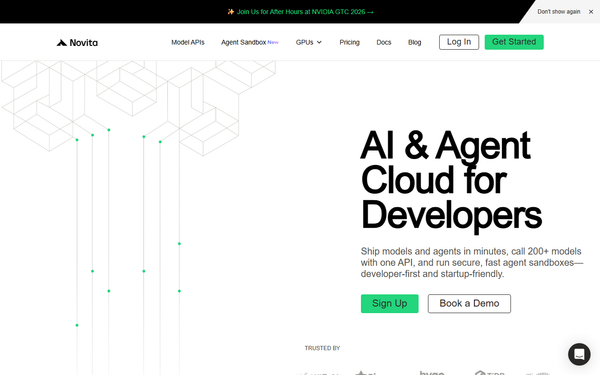
Novita.ai is a developer-first AI & Agent Cloud platform that delivers unified API access to over 200 models across large language models (LLMs), image generation (Stable Diffusion, Flux variants, Qwen-Image, Hunyuan, and more), video synthesis, text-to-speech, embeddings, and additional modalities. It also provides on-demand/spot GPU instances, dedicated custom model endpoints with SLAs, and secure agent sandboxes for isolated tool-using agents. The core purpose is to let users ship AI features—especially image generation and editing—into products in minutes without owning or maintaining GPUs, infrastructure, or DevOps overhead.
Primary use cases include embedding high-quality text-to-image and image-editing tools into web/apps (e.g., product visualization, creative marketing, e-commerce mockups), powering LLM agents or chat features, generating short videos, and deploying fine-tuned custom models at scale. It evolved from a strong Stable Diffusion focus (supporting thousands of community checkpoints, LoRAs from Civitai, VAEs, and embeddings) to a full multimodal cloud while keeping image generation as a flagship strength.
Target audience is developers, indie hackers, startups, and AI product teams who prioritize speed-to-market and cost efficiency. Designers and marketers benefit indirectly through simple API integrations that eliminate local hardware needs.
Key Features & Capabilities
Core functionality centers on a single REST API (https://api.novita.ai) with async endpoints for image tasks (txt2img, img2img, reimagine, inpainting, upscaling, hires_fix, LoRA support up to 5 adapters, face restoration, transparent backgrounds) plus OpenAI-compatible LLM chat/completion endpoints, video generation (txt2video, img2video), TTS, and model listing. Users discover models via /v3/models filters (checkpoint, lora, vae, etc.) and test them instantly in the built-in Playground. Custom model upload and dedicated endpoints allow private fine-tuned models with guaranteed performance and monitoring. Agent sandboxes offer ~200 ms cold starts with safe browser/API/code tool access, while GPU cloud supports training, fine-tuning, and inference (on-demand or spot instances).
Standout differentiators include the lowest pay-as-you-go pricing in the industry, massive community model variety (including Civitai-style LoRAs and textual inversions), webhooks and direct AWS S3 output storage for production pipelines, OpenAI SDK drop-in compatibility for LLMs, and zero-infrastructure custom deployment. Features like optional NSFW detection, batch inference discounts, and global low-latency routing further set it apart from pure GPU hosts or more expensive hosted services like Replicate.
Limitations include fully asynchronous image/video workflows (must poll task_id or use webhooks—no instant synchronous return), pricing that scales with resolution/steps/model complexity, occasional deprecation of low-usage legacy endpoints (e.g., certain Flux ControlNet variants in 2024), and a primary focus on open-source models rather than closed proprietary ones. No built-in UI editor for non-developers exists beyond the Playground.
User Experience
Ease of use is excellent for anyone comfortable with APIs or SDKs; the learning curve is minimal thanks to clear quickstarts and copy-paste examples. Sign-up takes seconds, API keys are generated instantly, and the developer console provides transparent credit tracking and model browsing.
The interface is clean and functional—dashboard for billing/keys, searchable model library with filters, and an interactive Playground for prompt testing without code. Documentation stands out as concise yet comprehensive, with full API reference, parameter tables, error codes, cURL/Python/JS examples, SDK guides (Python: pip install novita-client; JS: npm i novita-sdk), and Discord for live support (team reportedly adds requested custom models quickly).
Support resources include detailed FAQs, blog tutorials, GitHub SDK repos, and responsive Discord—users frequently praise 11/10 support and fast model additions.
Performance & Reliability
Generation speed is consistently fast (basic images in seconds, high-throughput LLM serving, low-latency agent sandboxes), backed by globally distributed infrastructure that keeps output close to users. Reliability is strong per user reports, with high uptime, automatic scaling, and stable inference even at volume; spot GPUs and dedicated endpoints add extra resilience.
Known issues are minor: some reviewers note occasional billing-top-up friction or the need to monitor credit balance (prepaid model), and a handful of legacy API deprecations caused brief workflow adjustments. Overall complaints are rare; the platform earns praise for outperforming competitors on speed and consistency for image tasks, with no widespread outages reported in 2025–2026 reviews.
Pricing & Value
Novita.ai uses a pure pay-as-you-go credit system (top-up via card/crypto, recommended auto-top-up). There is no free tier or monthly subscription—users pay only for what they consume. Example rates (as of March 2026):
- Text-to-image (512×512, 5 steps): ~$0.001 per image
- Inpainting/upscale: ~$0.0015
- Advanced models (Flux Kontext, Seedream): $0.012–$0.03
- LLMs: $0.02–$0.4 per million input tokens (output higher); batch inference 50% off
- Video clips: $0.03–$0.43 depending on duration/resolution
- NSFW detection: extra $0.0015 per image
- GPUs: spot instances up to 50% off on-demand rates; serverless billed per-second
A built-in pricing calculator helps estimate costs. Enterprise custom endpoints offer tailored SLAs at negotiated rates.
Value proposition is outstanding: repeatedly called the cheapest Stable Diffusion API and competitive LLM host, it delivers far lower per-image/token costs than Replicate, Together AI, RunPod, or Stability AI while offering broader community model support and no infrastructure overhead. Ideal for startups and high-volume users who want predictable, usage-based billing without lock-in.
Practical Tutorial
A common task is generating high-quality images from text prompts using the async Text-to-Image API (perfect for prototyping creative features).
Step-by-step walkthrough (tested via official docs):
-
Sign up and prepare — Create a free account at https://novita.ai/, verify email, go to Settings → Key Management, and generate an API key. Top up credits in Billing (start small—$10–20 covers thousands of basic images).
-
Select a model — Use the Playground or query
GET https://api.novita.ai/v3/models?filter.types=checkpointto pick one (example:sd_xl_base_1.0.safetensorsor any Flux/SDXL checkpoint). -
Make the API call (cURL example for “a cute cyberpunk cat wearing sunglasses, neon city background”):
curl --location 'https://api.novita.ai/v3/async/txt2img' \
--header 'Authorization: Bearer YOUR_API_KEY' \
--header 'Content-Type: application/json' \
--data '{
 "extra": {"response_image_type": "jpeg"},
 "request": {
   "model_name": "sd_xl_base_1.0.safetensors",
   "prompt": "a cute cyberpunk cat wearing sunglasses, neon city background",
   "negative_prompt": "blurry, low quality",
   "width": 1024,
   "height": 1024,
   "image_num": 2,
   "steps": 20,
   "sampler_name": "Euler a",
   "guidance_scale": 7.5,
   "seed": -1
 }
}'
Response returns
{"task_id": "xxxxxxxx-xxxx-xxxx-xxxx-xxxxxxxxxxxx"}. -
Poll for results (repeat until status =
TASK_STATUS_SUCCEED):curl --location 'https://api.novita.ai/v3/async/task-result?task_id=YOUR_TASK_ID' \ --header 'Authorization: Bearer YOUR_API_KEY'The JSON includes
images[]with temporaryimage_url(valid ~1 hour) and optional NSFW results. -
Download and use — Save the image URLs or configure webhooks/S3 for production. Add LoRAs, hires_fix, or upscaling in the request object for advanced control.
Full parameters, Python SDK usage (pip install novita-client then client.txt2img_v3(...)), and more examples are in the official reference: https://novita.ai/docs/api-reference/model-apis-txt2img. The entire process takes under 5 minutes from signup to first image.
Final Verdict
Overall rating: 4.5/5
Use this tool if you are a developer or startup wanting the cheapest, most versatile pay-as-you-go access to 200+ AI models (especially image generation with community LoRAs) and zero infrastructure management—Novita.ai shines for rapid prototyping and scaling creative or multimodal apps. Avoid it if you require fully synchronous responses, heavy enterprise hand-holding, or primarily closed-source proprietary models.
One-sentence recommendation: Novita.ai delivers unbeatable value and speed for developers building AI image generation and multimodal features on a budget.