Omind Review: The Ultimate AI Platform for Enterprise CX Automation

Overview & Purpose

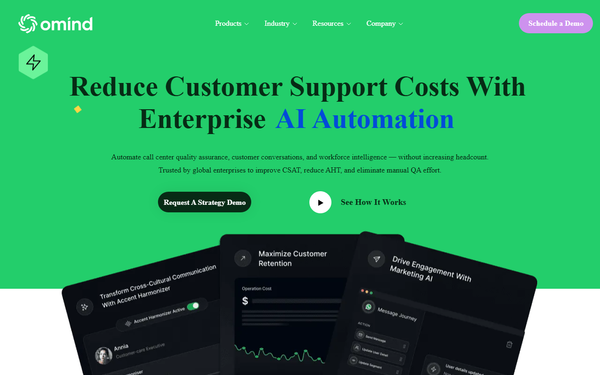
Omind is an AI-powered unified customer experience (CX) platform primarily designed for enterprise contact centers and CX teams. It automates customer interactions through conversational AI, streamlines quality assurance, enhances communication with accent harmonization, provides workforce intelligence, and supports marketing automation and social listening. Primary use cases include 100% automated call/chat QA with real-time sentiment and compliance analysis, deploying no-code GenAI voice and chat bots to deflect queries and provide 24/7 support, real-time accent adjustment for global teams, predictive analytics for scheduling and performance (via Arya), personalized marketing campaigns via omnichannel tools, and brand monitoring.
The target audience is CX leaders, contact center heads, digital transformation officers, and marketing teams in industries like banking/finance (BFSI), retail, healthcare, and telecom. Best suited for mid-to-large enterprises rather than individual developers or small businesses. Research conducted as of March 2026 from the official website and trusted review platforms confirms its enterprise focus on measurable outcomes such as improved CSAT, reduced average handle time (AHT), and cost efficiency without expanding headcount.
Key Features & Capabilities
Core functionality includes an AI Quality Management System (QMS) for comprehensive quality management; Conversational AI with GenAI chat/voicebots (no-code builder, multilingual, omnichannel); Accent Harmonizer (real-time voice clarity with noise cancellation); Arya AI engine for agent assistance, insights, and optimization; Marketing AI for customer journey orchestration, segmentation, and automation (e.g., WhatsApp, email); and Social Listening for sentiment analysis across social platforms.
Standout features that differentiate it from competitors include 100% interaction coverage for QA (versus traditional 1-5% manual sampling), unique real-time accent harmonization that preserves natural voice identity, seamless CRM/CCaaS integrations without infrastructure overhauls, and predictive workforce intelligence. These elements create a unified platform for end-to-end CX automation, particularly strong in regulated industries where compliance and global communication clarity are critical.
Limitations or missing features include its highly enterprise-oriented design, which can involve longer implementation timelines and custom configuration. Advanced customization may require dedicated support, there is no robust free tier beyond a 30-day Social Listening trial, and some advanced analytics or mobile functionality may feel limited compared to consumer-grade tools. It excels in voice-heavy contact center scenarios but may not offer the same depth for purely digital-first marketing teams without additional integration.

User Experience
Ease of use and learning curve are generally positive, with intuitive no-code tools and dashboards praised for quick navigation and real-time insights. Reviews rate ease of use around 4.3/5, noting that basic bots and QA monitoring can be set up rapidly, though complex analytics or initial integrations carry a moderate learning curve mitigated by dedicated implementation teams.
Interface quality features modern, customizable dashboards that display call breakdowns, sentiment trends, agent performance, and predictive insights clearly. Users highlight the friendly design and actionable coaching tools that feel supportive rather than overwhelming.
Documentation and support resources are enterprise-strength, with responsive customer support, dedicated onboarding teams, and a blog rich in conceptual guides and case studies. Public self-serve documentation is limited (primarily blog articles rather than interactive knowledge bases), but in-app guidance and strategy demos fill the gap effectively. Testimonials consistently commend the adaptable support and ease of integration with existing systems.
Performance & Reliability
Speed and efficiency shine in real-time processing: accent harmonization and sentiment analysis operate with low latency during live calls, while GenAI bots deliver instant responses and QA automation processes 100% of interactions without delays. Enterprise deployments report measurable gains, including AHT reductions and faster agent ramp-up, with scalable handling of high-volume global operations.
Known issues or common complaints are minimal in public feedback. Occasional mentions include minor performance slowdowns when handling extremely large datasets or highly complex queries, and suggestions for smoother recording features in some reviews. No widespread reports of downtime, reliability failures, or major outages surfaced as of March 2026; the platform’s enterprise-grade security, compliance architecture, and positive G2 feedback (4.5/5 overall) underscore strong reliability for regulated environments.
Pricing & Value
Cost structure is primarily custom and enterprise-focused with quote-based plans tailored to volume, AI features, and integrations. Some third-party sources reference flexible entry points around $99/month for basic access, but full enterprise implementations (including Arya, Accent Harmonizer, and full QMS) require personalized quotes after a strategy demo. A free 30-day trial is available for Social Listening, with no broad free tier.
Value proposition is compelling for organizations with high interaction volumes: automation of manual QA, query deflection, and workforce optimization delivers clear ROI through cost savings, higher CSAT, and improved retention—often outweighing fragmented alternatives like separate QA tools or basic chatbots. Compared to competitors (e.g., NICE CXone or Talkdesk), Omind’s unified approach plus unique accent technology provides stronger end-to-end efficiency and measurable business impact, making it cost-effective at scale despite opaque upfront pricing.
Practical Tutorial
Omind provides no-code tools and blog resources rather than exhaustive public tutorials. Here’s a practical walkthrough for a common task: Deploying a Generative AI Chatbot for Customer Support using Omind’s Conversational AI (adapted from platform descriptions and blog guidance).
Step 1: Visit https://www.omind.ai/ and schedule a strategy demo or request access to begin onboarding and receive platform login credentials.
Step 2: In the dashboard, navigate to the Conversational AI section and launch the no-code Bot Builder. Define your use case (e.g., FAQ handling, appointment booking, or billing queries) and start with pre-built intent libraries or create custom ones.
Step 3: Build conversation flows using the drag-and-drop interface. Map user intents, add entity recognition (names, dates, product IDs), incorporate real-time sentiment analysis for empathetic replies, and enable GenAI for natural, context-aware responses. Integrate compliance checks if needed for regulated industries.
Step 4: Connect the bot to omnichannel touchpoints such as your website, WhatsApp, SMS, voice systems, or CRM for seamless data flow and human-agent handoff rules.
Step 5: Test extensively in a sandbox environment—simulate customer queries across languages or accents, review accuracy metrics, and refine flows based on simulated performance data.
Step 6: Deploy live, then monitor via the unified dashboard. Leverage Arya for real-time coaching suggestions and performance analytics; iterate by updating intents or adding new channels based on interaction insights.
This process typically takes minutes for basic bots and hours to days for fully customized enterprise deployments. Expect rapid results like 24/7 query deflection and improved response times. For hands-on guidance or advanced QA integration, book the official strategy demo directly from the site.
Final Verdict
Overall rating: 4.5/5.
Summary of who should use this tool and why: Enterprises with active contact centers or high-volume customer interactions in regulated industries looking for comprehensive AI automation to boost efficiency, communication clarity, and satisfaction. Ideal if you need a unified platform that augments existing systems rather than replacing them.
Summary of who should avoid this tool and why: Small businesses, startups, or teams with limited budgets and straightforward needs, as the enterprise focus, implementation effort, and custom pricing may prove overkill. Also unsuitable for users seeking fully self-serve documentation or open-source flexibility.
One-sentence recommendation: Omind stands out as a robust AI CX platform for scaling customer experience operations efficiently—schedule a demo to see if it fits your enterprise needs.