Omnifact Review: Secure Enterprise AI for Regulated Industries
Overview & Purpose
Omnifact is a privacy-first generative AI platform built specifically for businesses and enterprises in regulated industries. It enables secure creation and use of custom AI chat assistants that leverage internal knowledge bases, automate workflows, and boost productivity while keeping all sensitive data under full organizational control. Primary use cases include document summarization and classification, policy Q&A, email drafting, internal knowledge searches, compliance automation, and team-specific AI assistants for tasks like customer inquiry handling or medical/administrative processes. It replaces risky shadow IT tools (such as public ChatGPT) with governed, auditable AI that integrates into existing systems like CRMs or databases.
The target audience is primarily IT leaders, compliance officers, data protection teams, and department heads in sectors like banking, financial services, public administration, healthcare, and social services—organizations that prioritize data sovereignty, GDPR compliance, and auditability over casual consumer use. It is less aimed at individual developers, marketers, or designers and more at enterprise-scale teams needing controlled AI without external data leakage.
Key Features & Capabilities
Core functionality revolves around conversational AI chats powered by leading models (OpenAI, Anthropic, Mistral, Google) with automatic selection or per-chat choice. Users upload documents or connect knowledge sources to create queryable “Spaces”—team-specific AI environments that act as secure knowledge bases. The proprietary Privacy Filter™ masks sensitive data (PII, patient info, internal IDs) before any external model processing, with full logging, audit trails, and zero-trust controls.
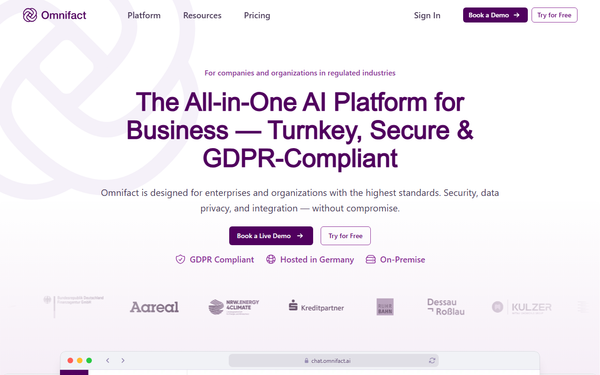
Standout differentiators include EU-hosted or fully on-premise/air-gapped deployment options, seamless SSO and API integrations, image generation, web browsing agent, multilingual support, and mobile web access—all while guaranteeing no sensitive data reaches third-party providers. This sets it apart from generic tools like ChatGPT Enterprise or Microsoft Copilot, which lack the granular Privacy Filter and self-hosting flexibility for highly regulated environments.
Limitations include credit-based access to premium models (unused credits expire monthly), dependence on well-curated internal data for optimal results (poor sources expose organizational knowledge gaps), Pro plan caps at 50 users and 5,000 document pages, and no public multimodal video support. Advanced features like self-hosted LLMs or API access to Spaces are Enterprise-only. As of March 2026, the platform is mature for its core privacy use cases but still relatively new, with limited third-party integrations compared to broader ecosystems.

User Experience
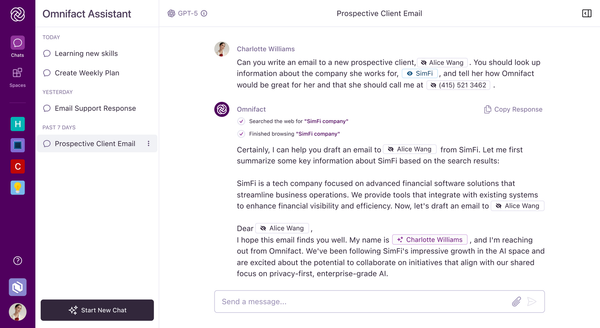
Omnifact features a clean, chat-centric interface with a left sidebar for navigation (Chats, Spaces, Settings) and real-time streaming responses—described in official documentation as “as simple as having a conversation.” No AI expertise is required; everyday language queries yield immediate, context-aware answers. The learning curve is minimal, with most users productive within minutes.
Interface quality is high: intuitive, mobile-responsive, and focused on clarity without clutter. Documentation is excellent—well-structured with a Quickstart guide, feature deep-dives, and practical examples—supplemented by onboarding webinars, video tutorials, and 24/7 email support (or dedicated Enterprise account managers). Community resources are light due to the B2B focus, but enterprise enablement (training, workshops) fills the gap effectively.

Performance & Reliability
Responses are fast and efficient, with word-by-word streaming and near-instant processing for typical office tasks. The Privacy Filter adds negligible overhead while ensuring compliance. Reliability is strong for internal knowledge tasks when sources are maintained; real-world testing shows measurable time savings on summaries, drafts, and Q&A.
Known issues are minimal: no widespread user complaints or outages reported as of March 2026. Performance dips only when querying conflicting or outdated documents (a fundamental generative AI limitation, not platform-specific). The platform’s governance tools (usage analytics, quotas) help prevent abuse and maintain consistent quality. Independent evaluations confirm it excels in regulated settings but requires upfront knowledge-base curation for best results.
Pricing & Value
Omnifact uses a tiered structure with a free Starter plan, Pro at €25 per user per month (billed annually for 16% savings), and custom Enterprise pricing.
- Starter: €0 – up to 3 users, entry-level models, 10 messages/day/user, 500 document pages, basic Privacy Filter.
- Pro: €25/user/month – unlimited messages, €5 pooled premium model credits/user/month (expire monthly), base models unlimited, 5,000 pages, email support, onboarding webinar; cloud-only, up to 50 users.
- Enterprise: Custom – unlimited users/pages/credits, on-premise/self-hosted LLMs, SSO, API access, usage analytics, dedicated support, custom SLAs, bring-your-own-key option.
Value is excellent for privacy-sensitive enterprises: the unique Privacy Filter and deployment flexibility justify the premium over cheaper public alternatives, delivering ROI through 120+ minutes daily time savings per employee and eliminated compliance risks. Smaller teams or non-regulated users may find Starter too restrictive and Pro expensive compared to general-purpose tools. Annual billing and pooled credits enhance cost control.
Practical Tutorial
Official documentation includes a comprehensive Quickstart and feature guides. Below is a step-by-step walkthrough for a common task—creating a team Space with uploaded documents and querying it for a policy summary (based on real platform flows as of March 2026).
-
Sign up / Sign in: Go to https://chat.omnifact.ai and create a free Starter account or log in with SSO (for teams). You land directly in a new chat.
-
Start a new chat (optional test): Click “Start New Chat” in the left sidebar. Type a simple query like “Draft a meeting agenda template” and hit Send. Watch the Privacy Filter message and real-time response.
-
Create a Space: Click the Spaces icon in the far-left navigation. Select “New Space,” name it (e.g., “HR Policies”), and add a description. Invite team members if on Pro/Enterprise.
-
Upload knowledge: In the Space, use the paperclip icon or upload area to add PDF/Word documents (e.g., company handbook, up to plan limits). Omnifact indexes them automatically for RAG querying.
-
Query the Space: Open the Space chat, type: “Summarize our vacation policy and highlight any updates for 2026.” Attach a specific document if needed. Follow up with “Compare to last year’s version” for context-aware refinement.
-
Share & iterate: Share the Space link internally or export the response. Use the LLM selector to switch models mid-conversation for comparison.
This task typically takes under 5 minutes. For more, see the official Quickstart: https://docs.omnifact.ai/en/platform/overview/quickstart and Spaces guide.
Final Verdict
Overall rating: 4.5/5. Omnifact shines for enterprises in regulated industries that demand unbreakable data privacy and governance—offering a secure, scalable path to AI productivity without the risks of public tools. Companies with strong internal knowledge management and compliance needs will see rapid ROI.
Avoid it if you are a small startup, solo user, or non-regulated team seeking unlimited cheap access or cutting-edge consumer features, as the credit system and focus on control add complexity and cost.
One-sentence recommendation: If data sovereignty is non-negotiable for your AI strategy, Omnifact delivers enterprise-grade security and usability that public alternatives simply cannot match.