Osam Ai Review: The Ultimate AI Operating System for Dealerships
Overview & Purpose

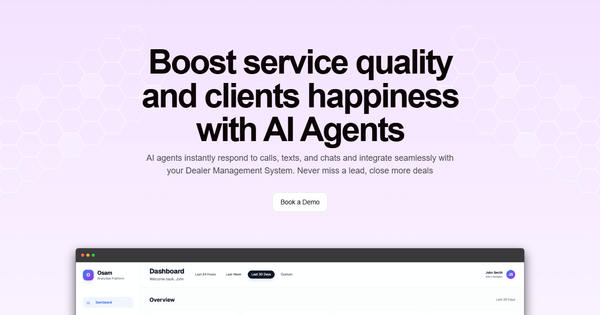
OSAM.ai is an AI-driven operations platform designed specifically as an "Operation System for automotive" dealerships. It unifies communication channels (calls, texts, and chats), data streams, and automations into a single platform powered by conversational AI agents, automated workflows, and real-time analytics. The core purpose is to ensure dealerships never miss a lead, automate routine customer interactions 24/7, reduce staff workload, and drive higher conversions through intelligent follow-ups and data-driven insights.
Primary use cases include instant AI handling of inbound inquiries for service bookings or test drives (automatically synced to calendars and Dealer Management Systems), running retention/recall campaigns, streamlining parts ordering by capturing details and notifying teams, and managing omnichannel customer communications to free staff for high-value tasks.
The target audience is automotive dealership owners, managers, and service teams—not developers, marketers, or designers. It caters to traditional dealership operations seeking to modernize without replacing human staff entirely.
Key Features & Capabilities
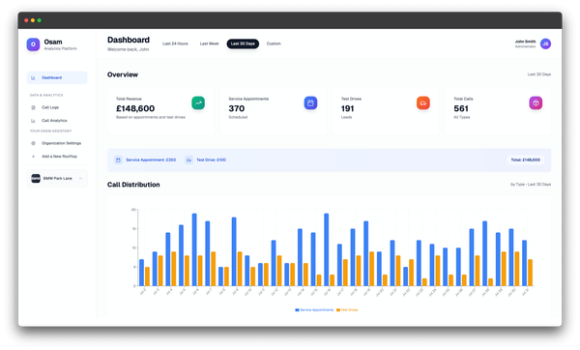
Core functionality revolves around AI agents that respond to calls, SMS, and chats in real time, with seamless DMS integration for lead syncing, appointment booking, and inventory checks. Standout capabilities include omnichannel inbox consolidation, custom workflow builders for tailored call flows and campaigns, auto-campaigns for recalls/retention/oil changes/seasonal offers, and specialized parts-order handling that extracts details and triggers team notifications. Real-time analytics support data-driven follow-ups and performance tracking.
Differentiators from general AI tools or broader competitors (like Numa or Text App) include deep automotive-specific tailoring—such as parts inquiry automation and calendar sync for test drives/service—plus "revenue on autopilot" via proactive campaigns and emphasis on never missing inbound requests. These features position it as a dealership-centric operating system rather than a generic chatbot platform.
Limitations include no publicly documented advanced analytics dashboards, multi-language support details, or third-party app marketplace. Missing features (based on available info) appear to be advanced predictive inventory AI or full CRM replacements, and there are no indications of mobile-native apps beyond web access. Integration depth is claimed as "seamless" but lacks case studies confirming compatibility with every DMS provider.
User Experience
Ease of use appears high for end customers (conversational AI handles natural interactions 24/7), with dealership staff benefiting from a unified omnichannel inbox that reduces context-switching. The learning curve for admins involves custom workflow design, which is described as intuitive but may require initial setup time—likely moderate for non-technical users given the no-code implications. No public interface screenshots or demos were available as of research, but the platform emphasizes simplicity to "free your team from routine."
Interface quality is implied to be clean and consolidated (single feed for all channels), though unverified by independent reviews. Documentation and support resources are notably absent publicly—no user guides, knowledge base, video tutorials, or help center links on the site. Support is presumably handled via demo bookings or direct contact, which could be a gap for smaller dealerships.
Performance & Reliability
Performance claims center on instant responses, automatic calendar syncing, and 24/7 availability to eliminate missed leads, with efficiency gains in staff time (focusing on high-value interactions) and revenue through automated campaigns. Speed for AI responses and notifications is positioned as real-time, with parts inquiries triggering immediate team alerts.
No widespread user data exists due to limited public adoption visibility, and no major reliability issues or common complaints surfaced in searches across review platforms, forums, or social media as of March 2026. This lack of feedback could indicate either strong early performance or simply the tool's emerging status (some directories note it as not fully launched or low-visibility). Compared to scaled competitors handling hundreds of millions of calls, real-world uptime at volume remains unproven publicly.
Pricing & Value
OSAM.ai does not publish pricing on its website or in third-party listings—no free tier, trial details, or tiered plans (starter, pro, enterprise) are available. Users must book a demo or contact sales for custom quotes, indicating a likely enterprise-oriented, dealership-specific model typical of automotive tech (per-user, per-location, or usage-based).
Value proposition is strong for dealerships struggling with lead loss and staff overload: automation delivers 24/7 coverage and campaign-driven retention at potentially lower ongoing cost than hiring more agents. Compared to alternatives like Numa (proven scale but broader focus) or general tools (less automotive-specific), OSAM.ai offers targeted ROI through DMS sync and parts workflows. However, opaque pricing makes value assessment difficult without a demo, potentially limiting accessibility for small independent dealers.
Practical Tutorial
Official tutorials, documentation, or public walkthroughs are not available on the OSAM.ai website or linked resources as of March 2026. Below is a practical, step-by-step walkthrough for a common task—setting up an automated service booking workflow for inbound calls/texts—created based on the platform's described features and capabilities. This assumes access after a demo/onboarding (typical for such tools).
-
Log in and Access Dashboard: After account setup (via demo booking), navigate to the main Operations Dashboard. Locate the "Workflows" or "AI Agents" section in the omnichannel inbox interface.
-
Create New Agent: Click "New AI Agent" and select "Service Booking" template. Configure channels (calls via voice AI, SMS/chats) and link your DMS for real-time inventory/calendar sync.
-
Build Conversation Flow: Use the no-code builder to define intents—e.g., "Book service" triggers questions on vehicle details, issue description, and preferred time. Add branches: if recall match found, auto-suggest; sync availability directly from DMS. Include fallback to human escalation after 2 failed attempts.
-
Set Auto-Sync & Notifications: Enable calendar integration and parts capture (if service involves parts). Add team notification rules—e.g., "Instant alert to service manager via SMS/email with captured details."
-
Activate Campaign Tie-In: Link to retention module—post-booking, schedule follow-up texts like "Oil change reminder in 3 months" based on vehicle data.
-
Test & Go Live: Use built-in simulator for sample calls/texts. Monitor real-time analytics preview, then toggle live. Track in the unified inbox.
For official updates, monitor https://osam.ai/ or request resources during demo. This setup typically takes 30-60 minutes and can handle bookings instantly, reducing no-shows via automated confirmations.
Final Verdict
Overall rating: 7/10. OSAM.ai shines as a specialized, dealership-focused AI platform with strong potential to automate communications and boost retention without heavy staff burden.
Who should use it: Mid-to-large automotive dealerships already using a DMS and seeking 24/7 lead capture plus tailored parts/service workflows—ideal if you want revenue on autopilot and reduced routine workload.
Who should avoid it: Small independent shops needing transparent pricing, extensive public support/docs, or proven large-scale case studies; or those preferring fully open-source/no-demo tools.
One-sentence recommendation: If your dealership is ready to embrace AI agents for calls, texts, and campaigns but values automotive-specific depth over broad alternatives, book a demo with OSAM.ai to unlock never-miss-lead efficiency.