Pentacue Review: AI-Powered Sales Intelligence for FCC Filings
Research conducted as of March 2026 using the official website and trusted sources (including accelerator announcements and directory listings). Note: Some third-party AI directories inaccurately describe PentaCue as an SEC/EDGAR financial analysis tool; the current official product focuses exclusively on FCC filings for electronics hardware intelligence.
Overview & Purpose
PentaCue AI (accessible at https://www.pentacue.com/) is an AI-powered sales intelligence platform that transforms public FCC equipment authorization filings into actionable business insights. It employs computer vision to automatically detect and catalog electronic components (chips, modules, sensors, etc.) from internal circuit board photos, test reports, and technical documentation contained in mandatory regulatory submissions for wireless devices sold in the United States.
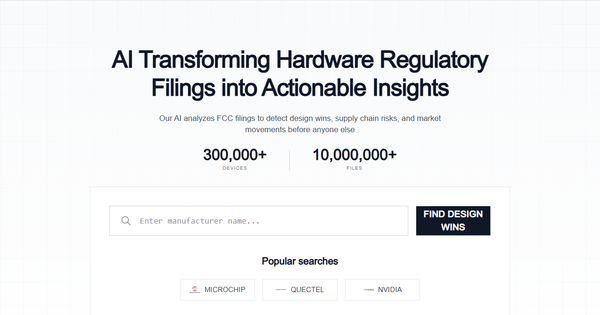
Primary use cases include tracking design wins months before product launches, generating qualified sales leads, mapping supply chain dependencies, identifying single-source risks or supplier changes, and monitoring emerging technology adoption across devices. The platform processes over 10 million files and images from more than 300,000 devices to deliver early competitive intelligence that would otherwise require manual, time-intensive review of opaque public documents.
Target audience is specialized: sales teams, manufacturers’ representatives, and business development professionals at tier-1 component makers and rep firms (e.g., those representing Samsung, Microchip, Quectel, Texas Instruments, Nordic Semiconductor, and 30+ others). It is not a general-purpose financial or equity-research tool.
Key Features & Capabilities
Core functionality revolves around an indexed database searchable by manufacturer (80+ supported, with on-demand additions) or component category, including microcontrollers & SoCs (ARM, RISC-V, PIC), wireless & RF modules (BLE, WiFi, LoRa, cellular), memory ICs, power management, interface chips, and sensors. Users can browse manufacturer-specific pages that list adopting companies, device models, countries, and part details, often with verified contact information for outreach.
Standout differentiating features include:
- AI computer vision that reads part numbers from low-quality or blurry filing photos—something standard search or general AI tools cannot reliably do.
- Design-win intelligence with alerts for new sockets won or lost.
- Supply-chain mapping to reveal component combinations, dependencies, and risks.
- Early detection of market movements directly from mandatory but previously hard-to-parse filings.
These capabilities give hardware sales professionals a significant edge over manual FCC database searches or broad platforms like ChatGPT, which lack specialized image analysis and structured extraction at scale.
Limitations include restriction to U.S. FCC-certified wireless devices only (no global or non-wireless coverage), dependence on the quality and timeliness of public filings, and a growing but not exhaustive component database. Full data exports and alerts require access approval; there is no native multi-document synthesis beyond aggregated filings or integration with external CRM tools.
User Experience
The public marketing site is clean and intuitive, featuring prominent statistics, popular search examples, and direct links to manufacturer pages with tabular previews of customer data. Once granted access (via demo request), the core dashboard presents searchable tables with filters for country, device type, or part detail, plus download options for full lists.
Ease of use and learning curve are moderate: industry professionals familiar with electronic components will find it straightforward and Sales-Navigator-like, while newcomers may need a short onboarding session to interpret part codes and filing nuances. The interface quality is professional and data-focused rather than flashy.
Documentation and support resources are limited publicly—no detailed user guides, video library, or knowledge base appear on the site. Support is handled via demo calls, email ([email protected]), and the “Request Component Addition” form. Onboarding is presumably provided during the access process.
Performance & Reliability
The platform claims efficient processing of millions of pages and images, delivering near-real-time insights as new FCC filings are filed and analyzed—often surfacing design wins months before devices ship to market. Speed appears strong for a niche dataset of this scale, with no reported lag in public descriptions.
No widespread known issues or common user complaints surfaced in searches across review platforms, Reddit, X, or tech publications; as an early-stage tool backed by Startmate accelerator (Summer ’25 cohort), it remains relatively new with limited public feedback. Reliability hinges on FCC filing quality and the accuracy of the computer-vision model, which the company continues to refine.
Pricing & Value
Pricing is not publicly listed; access is gated behind a demo request or “Get Access” form. Directories note “no pricing” information available, suggesting a custom enterprise or subscription model typical for B2B sales-intelligence tools. There is no visible free tier or trial beyond the public marketing pages and sample tables.
Value proposition is high within its narrow niche: it replaces weeks of manual regulatory research with instant, verifiable leads and competitive intelligence that directly drives revenue for component sales teams. Compared to alternatives (manual FCC searches, general databases like ZoomInfo, or generic AI), PentaCue offers unique automation and early visibility that can justify the cost for active hardware sales organizations. Broader financial-research users seeking SEC/EDGAR analysis will find far better value elsewhere.
Practical Tutorial
No official video or step-by-step tutorials are published on the site. Below is a practical walkthrough for a common task—finding companies using a specific component—based on the live public interface (as of March 2026). Real example using the Quectel EC21-A module.
- Visit https://www.pentacue.com/ and scroll to manufacturer examples or use the search bar.
- Navigate directly to a manufacturer page, e.g., https://www.pentacue.com/quectel (or search “Quectel”).
- Select a specific part (e.g., EC21-A) from the listed modules. The page loads a table showing adopting companies, device types, countries, and part details.
- Apply filters (e.g., country = United States) to narrow results—example real entry: Climax Technology Co., Ltd. (Taiwan) using EC21-A in security alarm devices.
- For full contact info, downloadable lists, or related design wins, click “Download Full List” or “Get Access” and complete the short business-form request (company email required).
- Once approved, set up alerts for new filings mentioning the part and explore “proven component combinations” across the database.
- To expand coverage, use the “Request Component Addition” form on any page if your target manufacturer or chip is missing.
This process typically takes under five minutes for initial discovery and yields immediately actionable sales prospects.
Final Verdict
Overall rating: 4.2/5. PentaCue delivers genuine innovation in a specialized domain where public data has long been underutilized.
Who should use this tool: Electronics component sales professionals, rep firms, and supply-chain analysts at semiconductor or module manufacturers who need early design-win visibility and qualified leads—especially those already working with FCC-regulated wireless products.
Who should avoid this tool: Anyone focused on SEC/EDGAR financial filings, equity research, or non-U.S. markets; general users or small teams without hardware sales pipelines will find it too niche and access-gated.
One-sentence recommendation: If you sell chips, modules, or components into hardware products, book a PentaCue demo today—its FCC-powered design-win intelligence can shorten your sales cycle by months.